
Vaginal Tightening Surgery: What It Can and Cannot Do
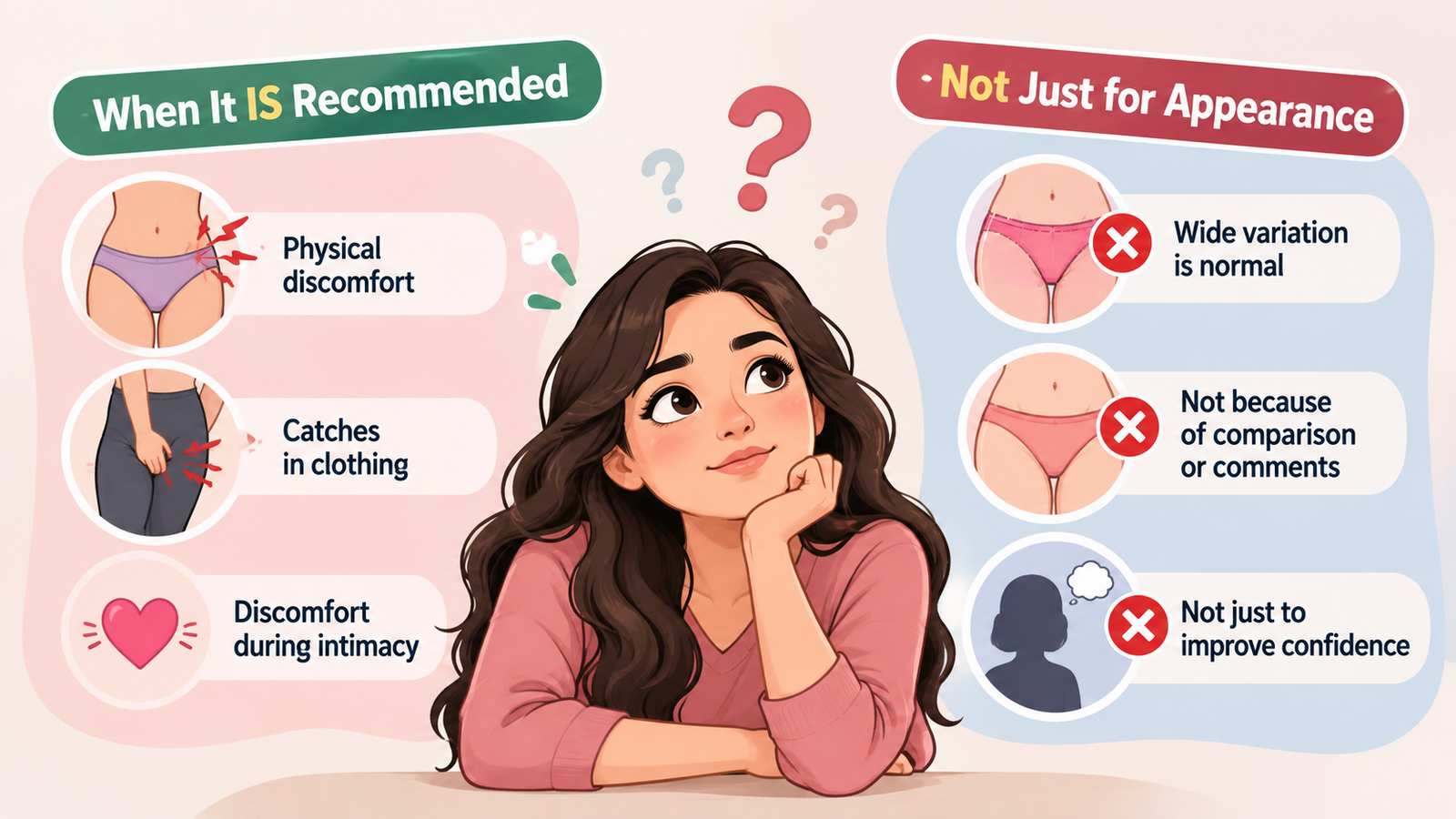
Vaginal tightening surgery narrows the vaginal canal and repairs the perineum. It is appropriate where there is a specific finding such as an unrepaired tear, prolapse, or stress incontinence that has not responded to pelvic floor training. Where no such finding exists, surgery is least clearly indicated and non-surgical options come first.
Written by Dr. Ashutosh A Shah, M.B.B.S., M.S., M.Ch., D.N.B., Board Certified Plastic Surgeon, Elegance Intimate Wellness, Surat. Reg. no. [REG NO]. 22+ years in plastic and reconstructive surgery.
Medically reviewed by Dr. Ashutosh A Shah · Published 30 September 2026 · Last reviewed 30 September 2026
Vaginal tightening surgery narrows the vaginal canal and repairs the perineum. It is appropriate where there is a specific finding such as an unrepaired tear, prolapse, or stress incontinence that has not responded to pelvic floor training. Where no such finding exists, surgery is least clearly indicated and non-surgical options come first.
This operation treats a finding, not a feeling. That distinction is the whole of this page, and it is the thing most advertising for this procedure is designed to blur.
A sensation of looseness is real and worth taking seriously. It is also not, on its own, a diagnosis, and the treatments that help it most reliably are not surgical.
What does vaginal tightening surgery actually do?
It narrows the vaginal canal and repairs the perineum, the tissue between the vaginal opening and the anus. Vaginoplasty refers to the narrowing, perineoplasty to the perineal repair, and the two are often done together.
What it is mechanically capable of changing:
- The calibre of the canal, by removing a strip of tissue and bringing the walls together.
- A defect in the perineum, such as a tear that was never repaired or that healed poorly.
- The anatomical relationship of the structures where that has been disrupted.
What it does not do, and this is where most of the disappointment comes from:
- It does not strengthen the pelvic floor muscles. Those are muscles, and surgery does not train muscles. This is the single most common misunderstanding about the operation.
- It does not by itself treat prolapse or incontinence, which are separate problems with their own assessments and their own operations.
- It does not reliably change sensation in a predictable direction, and it can change it in the wrong one.
If the sensation you want changed is coming from muscle function rather than from a structural defect, an operation on the structure is addressing the wrong thing.
What causes the sensation of laxity in the first place?
Usually a combination of pelvic floor muscle function, tissue changes after childbirth, and hormonal change, and only sometimes an actual structural defect. The causes are different from each other and they have different treatments.
The broad categories:
- Pelvic floor muscle weakness or poor coordination, which is common after childbirth and is treatable with training rather than surgery.
- An unrepaired or poorly healed tear, which is a structural finding and can be repaired.
- Prolapse, where a pelvic organ descends, which produces a sensation of bulging or heaviness and has its own pathway.
- Hormonal change, including after menopause, which alters tissue quality and is often treatable with hormone treatment rather than surgery. The NHS lists a vaginal cream, tablets, or a hormone-releasing ring among the options for prolapse symptoms.
- Nothing structural at all, where the sensation is present and the examination is normal.
That last category is larger than the advertising suggests, and it is not a dismissal. A normal examination does not mean you imagined the sensation. It means surgery is not the tool for it.
What recovers on its own after childbirth, and over what timescale, is covered in our page on vaginal laxity after childbirth, which is worth reading first if you are within a year of giving birth.
Why does a proper assessment come before any decision?
Because the same sensation comes from several different causes, and the treatment that works depends entirely on which one you have. Nobody can tell which from a description alone, and no reputable clinic will try.
| Finding on assessment | What it means | First line treatment | When surgery is considered |
|---|---|---|---|
| Pelvic floor weakness, no structural defect | Muscle function, not anatomy | Supervised pelvic floor muscle training | It is not the treatment for this |
| Stress incontinence | A diagnosis with its own pathway | Conservative treatment first, per NHS guidance | If training does not significantly improve it |
| Prolapse, mild or no symptoms | Present but not necessarily needing treatment | Training, pessary, or nothing at all | NHS: if the prolapse is severe |
| Prolapse, severe | A structural finding | Assessment by a urogynaecologist | Surgery to lift and support the organs |
| Unrepaired or poorly healed tear | A structural defect that can be repaired | Assessment and discussion of repair | Reconstructive repair is directly indicated |
| Hormonal tissue change | Tissue quality, not structure | Hormone treatment options | Rarely, and not as a first approach |
| Normal examination, sensation present | Real sensation, no surgical target | Pelvic floor assessment and training | This is where surgery is least clearly indicated |
Note what the bottom row says, because it is the row most people searching this page fall into. A normal examination with a real sensation is the situation in which an operation has the least to offer and the most to risk.
What does pelvic floor therapy fix, and how long does it need?
Muscle strength and coordination, and it needs at least three months of consistent work before anyone can judge whether it has helped. That is not a delaying tactic. It is the actual treatment, and it has a defined dose.
The NHS specifies it precisely: "Your programme should include a minimum of 8 muscle contractions at least 3 times a day and last for at least 3 months."
Read that as a prescription. Eight contractions, three times a day, for three months minimum. Most people who say pelvic floor exercises did not work for them did not do this, and often were never told it in those terms.
The NHS is equally clear about the order of treatment: "Conservative treatments, which do not involve medicines or surgery, are tried first."
Two further points that change the outcome:
- Supervision matters. The NHS notes that a GP may refer you to a specialist to start a programme, and for prolapse describes training delivered "usually with a specialist women's health physiotherapist". A significant proportion of people contract the wrong muscles when self-teaching.
- Training is not only for incontinence. It is listed among the treatments for prolapse too, alongside pessaries and hormone treatment.
If you have not done three supervised months, you do not yet know whether you need surgery, because you have not tried the thing that comes first.
When is surgery genuinely indicated?
When assessment finds something specific that an operation can repair, and when what comes before it has been tried. There are three reasonably clear situations.
- An unrepaired or poorly healed tear. This is a structural defect, reconstructive repair addresses it directly, and this is squarely within reconstructive surgical practice.
- Severe prolapse. The NHS states that "if the prolapse is severe, surgery to lift and support the pelvic organs may be an option". Assessment and the decision belong with a urogynaecologist.
- Stress incontinence that has not responded to conservative treatment. The NHS position: "If stress incontinence does not significantly improve with lifestyle changes or exercises, surgery will usually be recommended as the next step." Note the order. Exercises, then surgery.
What these have in common is that a clinician can point to something. There is a defect to repair, a descent to support, or a symptom that has failed a properly delivered first-line treatment.
It is also worth knowing that a finding does not automatically require treatment. The NHS is explicit about prolapse: "If you do not have any symptoms, or the prolapse is not bothering you, you may not need medical treatment." Something being visible on examination is not the same as something needing an operation.
When is it not, and what should a clinic say then?
When the examination is normal and the concern is a sensation, an operation is not the answer, and a clinic should tell you so plainly rather than offering you something else to buy.
This is the situation most people searching for this procedure are actually in, and it deserves a direct answer rather than a soft redirect into a package.
What a clinic should say:
- What the examination found, in plain words, including if it found nothing structural.
- That the sensation is real and that a normal examination does not contradict it.
- That pelvic floor assessment and training come first, with the actual dose, and who can supervise it.
- That surgery is not indicated for this, stated as a clear sentence rather than left implied.
- What else might be contributing, including hormonal factors, pain conditions, or other causes that have their own treatments.
What should make you cautious: being offered a procedure without an examination, being quoted a package before a diagnosis, being offered an energy-based device as an alternative when surgery is not indicated, or being told that a sensation is a condition requiring treatment. If a clinic cannot name what it is treating, it is selling rather than treating.
What does the evidence say about laser and energy based devices?
That their safety and effectiveness for this purpose have not been established, and that regulators have warned about them specifically. This is the clearest-cut part of the whole subject.
The United States Food and Drug Administration issued a safety communication about energy-based devices marketed for vaginal procedures, carried in full by Medsafe, New Zealand's medicines and medical devices safety authority. Its conclusion: "The safety and effectiveness of energy-based medical devices to perform these procedures has not been established."
On regulatory status: "To date, the USFDA have not cleared or approved for marketing any energy-based devices to treat these symptoms or conditions, or any symptoms related to menopause, urinary incontinence, or sexual function."
The communication notes that vaginal "rejuvenation" is "an ill-defined term", and lists what these devices are marketed to treat. That list opens with vaginal laxity, and also includes pain during sexual intercourse and decreased sexual sensation.
Now compare it with the list of reported harms, which the same communication gives as "serious adverse events, including vaginal burns, scarring, pain during sexual intercourse, and recurring/chronic pain."
Pain during intercourse appears on both lists. Devices marketed to treat it have been reported to cause it.
Two honest qualifications, because overstating this would be the same error as the marketing it answers. These are adverse event reports, not a measured complication rate, so nobody can tell you from this how often it happens. And a warning that effectiveness has not been established is not the same as proof that a device does nothing. What it does mean is that anyone offering you one of these treatments is offering something a major regulator has specifically warned about, and you are entitled to ask them to address that directly.
The regulator's own advice to patients is simply to "Discuss the benefits and risks of available treatment options for vaginal symptoms with your health care provider."
What are the risks, including the ones that affect sensation?
Pain, scarring, altered sensation and painful intercourse are the risks that matter most here, because they can turn a sensation you disliked into a symptom that hurts. This is genital surgery and it should be consented to as such.
The risks to have named explicitly before you agree:
- Pain during intercourse, which can be caused by narrowing that is excessive or by scar tissue at the repair.
- Altered sensation, which may be reduced, increased, or simply different, and which may not resolve.
- Scarring, in tissue that stretches during intercourse and childbirth.
- Wound breakdown or infection, in an area that is difficult to keep clean and still.
- Over-correction, which is considerably harder to fix than under-correction and which can make penetration painful or impossible.
- The symptom not improving, which is the likeliest outcome where there was no structural finding to begin with.
- Effects on future childbirth, which should be discussed if you may have more children.
That last point deserves emphasis. If you are considering this within a few years of wanting another pregnancy, that changes the calculation and must be part of the conversation.
What should you ask before agreeing to anything?
Ask what was found on examination, and do not accept an answer about how you feel. If the reply describes your sensation rather than a finding, there is nothing to operate on.
- What did you find on examination, specifically?
- What is the diagnosis, in one sentence?
- Have I had a pelvic floor assessment, and by whom?
- Have I completed a supervised programme of at least three months, and if not, why are we discussing surgery?
- Which of my symptoms will this operation change, and which will it not?
- What are the chances this makes intercourse painful?
- Can sensation change permanently, and in which direction?
- What happens if it is over-corrected, and what can be done then?
- Should I be seeing a urogynaecologist or a women's health physiotherapist instead of, or as well as, you?
- If I want more children, how does that change your advice?
- What would you advise if I were your sister?
The answer to the fourth question is the one that separates an honest recommendation from a sale. Conservative treatment comes first in NHS guidance, and a clinic skipping straight to an operation should be able to explain exactly why yours is the exception.
How is this assessed in Surat, and who should assess it?
By examination first, and by routing the parts that belong elsewhere to the people who do them properly. No single clinic covers this whole pathway, and any clinic implying otherwise is overstating its reach.
Who does what, plainly:
- A women's health physiotherapist assesses and supervises pelvic floor muscle training. The NHS describes training as usually delivered with such a specialist, and this is the first-line treatment for the largest group of people reading this page.
- A urogynaecologist assesses and treats prolapse and urinary incontinence. These are their conditions and their operations.
- A reconstructive plastic surgeon repairs structural defects such as an unrepaired or poorly healed perineal tear, which is where this practice fits.
In our practice in Surat, the most frequent outcome of a first consultation about this is a referral for pelvic floor assessment rather than a surgical plan. A meaningful number of people who arrive asking about tightening surgery have never had their pelvic floor assessed by anyone, and have never been given the training programme in the specific terms the NHS sets out.
Where examination finds a structural defect that reconstructive repair addresses, that is a conversation worth having in detail, including what it will and will not change. Where it does not, you will be told so directly, and pointed to the person who can actually help. Related pages: intimate changes after delivery, intimate pain and when to get help, and vaginismus and painful intercourse.
Next step
If you have not had a pelvic floor assessment, that is the first step rather than a surgical consultation. If you have a specific finding such as a tear that was never repaired, that is worth discussing directly. Book a consultation with Dr. Ashutosh Shah in Surat, and expect an examination and a straight answer, including that surgery is not the right treatment if it is not.
This page is for education and is not a substitute for examination and assessment. Pelvic floor rehabilitation, prolapse and urinary incontinence are assessed and treated by women's health physiotherapists and urogynaecologists, and this page routes those concerns to them deliberately. Vaginal tightening surgery permanently alters tissue and carries risks to sensation and to comfort during intercourse. Please consult Dr. Ashutosh A Shah or another qualified clinician about your own situation.
Have a Private Question?
Every concern deserves an honest answer. Book a confidential consultation with Dr. Ashutosh Shah at Elegance Clinic, Surat, for guidance made just for you.

About the Author
Dr. Ashutosh Shah is a cosmetic gynecologist and plastic surgeon with over 22 years of experience. At Elegance Clinic in Surat, he is known for safe, honest and completely confidential intimate and aesthetic care.
What is vaginal tightening surgery?
It narrows the vaginal canal and repairs the perineum, combining vaginoplasty and perineoplasty. It changes structure, not muscle function, so it does not strengthen the pelvic floor. It is directed at findings such as an unrepaired tear rather than at a sensation of looseness.
Does vaginal tightening surgery work?
It depends entirely on what is being treated. Where there is a structural defect such as an unrepaired tear, repair addresses it. Where examination is normal and the concern is a sensation, there is nothing structural for the operation to correct, and disappointment is the likeliest result.
Is laser vaginal tightening effective?
Its effectiveness has not been established. The USFDA safety communication states that the safety and effectiveness of energy-based devices for these procedures has not been established, and that no such device has been cleared or approved for these symptoms or conditions.
Do I need surgery or pelvic floor therapy?
Therapy first, in almost all cases. NHS guidance says conservative treatments are tried first, and specifies a minimum of 8 contractions at least 3 times a day for at least 3 months. Until that has been done properly, nobody can say whether surgery is needed.
What are the risks of vaginal tightening surgery?
Pain during intercourse, altered sensation, scarring, wound breakdown and infection. Over-correction is harder to remedy than under-correction and can make penetration painful. If there was no structural finding, the likeliest outcome is that the symptom does not improve.
Can vaginal tightening affect sensation?
Yes, and not always in the intended direction. Sensation may be reduced, increased or simply different, and the change may be permanent. Scar tissue at the repair can cause pain during intercourse. This should be discussed explicitly before you consent.
Who should assess vaginal laxity?
A women's health physiotherapist for pelvic floor assessment and training, a urogynaecologist for prolapse or incontinence, and a reconstructive surgeon for structural defects such as an unrepaired tear. No single clinic covers the whole pathway, and one claiming to is overstating.