
Labiaplasty Gone Wrong: Over-Removal, Wound Separation and When Revision Is Possible
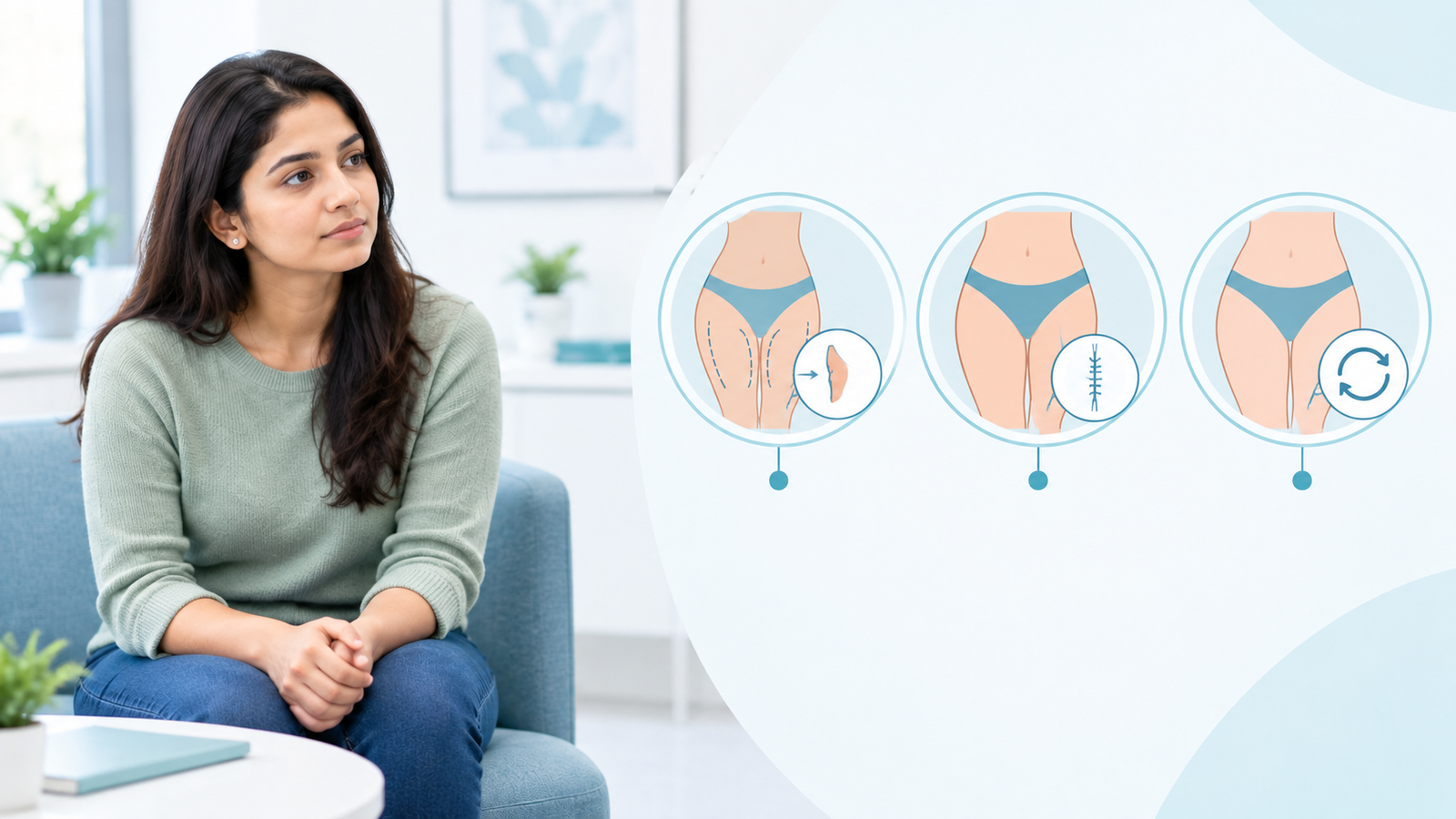
The commonest labiaplasty problems are wound separation, usually after a wedge technique, and over-removal of tissue, usually after an aggressive trim. Separation often heals or is repaired once swelling settles. Over-removal is harder to fix and may need tissue flaps or fat grafting, so most surgeons wait about six months before planning any revision.
The commonest labiaplasty problems are wound separation, usually after a wedge technique, and over-removal of tissue, usually after an aggressive trim. Separation often heals or is repaired once swelling settles. Over-removal is harder to fix and may need tissue flaps or fat grafting, so most surgeons wait about six months before planning any revision.
Labiaplasty gone wrong may involve wound separation, uneven labial edges, asymmetry, painful scarring or excessive tissue removal. Minor wound separation sometimes heals with appropriate care, while over-removal can be difficult to reconstruct. Surgeons commonly allow several months, often around six months, for healing before elective revision, although urgent complications need earlier medical attention.
A disappointing result does not always mean the first operation has failed. Swelling, temporary asymmetry and scar firmness can change significantly during recovery. However, persistent pain, open wounds, functional problems or major anatomical changes deserve careful evaluation.
Which Labiaplasty Problems Are Common and Which Are Rare?
Labiaplasty changes the size or shape of the labia minora. Different surgical techniques include trim or edge excision, central wedge resection and other modified approaches.
Each technique has potential advantages and complications. The risk depends on the surgical method, tissue handling, wound tension, patient health and postoperative healing.
Possible labiaplasty risks and complications include:
-
Wound separation: Part of the incision opens before healing is complete.
-
Asymmetry: One labial side appears longer, shorter or differently shaped.
-
Scalloped edges: The healed border develops irregular notches or uneven contours.
-
Over-removal: Excessive labial tissue has been removed.
-
Residual excess: The patient continues to experience unwanted tissue prominence.
-
Painful scarring: Scar sensitivity, tightness or discomfort persists.
-
Infection or bleeding: Complications that may require prompt medical treatment.
-
Altered sensation: Temporary or occasionally persistent sensory changes.
Published studies report generally high satisfaction after labiaplasty, but complication estimates vary considerably because surgical techniques, patient populations and follow-up periods differ.
A 2022 systematic review and meta-analysis, Maximizing Safety and Optimizing Outcomes of Labiaplasty, examined outcomes and complications across published studies. Its findings support careful technique selection and patient counselling rather than assuming that any operation is completely risk-free.
Is Early Swelling a Sign of Labiaplasty Gone Wrong?
Not necessarily.
During the first weeks, swelling may make the labia appear uneven, thickened or unusually prominent. Bruising and temporary sensitivity can also affect appearance.
Patients should compare their recovery with the expected healing process described in Normal labiaplasty recovery.
However, worsening pain, fever, spreading redness, heavy bleeding, foul-smelling discharge or a rapidly enlarging swelling requires prompt medical assessment.
Why Does Wound Separation After Labiaplasty Happen?
Wound separation after labiaplasty, medically called wound dehiscence, occurs when a surgical incision partially or completely opens.
It may happen because of:
-
excessive tension across the incision
-
swelling that places stress on the sutures
-
friction or premature physical activity
-
infection or impaired wound healing
-
reduced blood supply to tissue edges
-
tissue movement during the early recovery period
Central wedge techniques can be particularly sensitive to tension across the closure. Published research has identified wound dehiscence as an important complication associated with wedge labiaplasty, although risk varies with technique and surgical execution.
Can a Separated Labiaplasty Wound Heal Naturally?
Some small, superficial separations can heal through secondary intention, meaning the wound gradually fills with new tissue without immediate resuturing.
However, this is not appropriate for every wound.
A clinician should assess wound depth, tissue viability, infection, bleeding and the possibility of anatomical distortion.
Small separations may need careful local wound care and follow-up. Larger defects, persistent openings or wounds involving compromised tissue may require additional treatment.
Do not attempt to close the wound at home using adhesive, tight dressings or leftover medication.
If the wound is newly separated, contact the operating surgeon or another qualified clinician promptly rather than waiting several months for a revision consultation.
What Does Over-Removal Look Like and Why Is It Hard to Rebuild?
Over-removal occurs when more labial tissue is excised than was necessary or intended.
Patients may notice:
-
unusually short or absent portions of the labia minora
-
excessive exposure of adjacent sensitive tissue
-
pulling or tightness during movement
-
discomfort during intercourse
-
an unnatural or uneven contour
-
persistent dissatisfaction with the appearance
Over-removal is among the more challenging problems to correct because the original tissue cannot simply be replaced.
In selected cases, a surgeon may consider local tissue rearrangement, reconstructive flaps or scar revision. The feasibility depends on how much healthy tissue remains and the blood supply to that tissue.
Some patients may benefit from treatment of adjacent volume loss, but fat transfer or fillers cannot reliably recreate missing labial edges or restore all lost tissue functions.
Can Labiaplasty Cause Nerve Damage?
Patients sometimes ask, can labiaplasty cause nerve damage?
Surgery can affect small sensory nerves, potentially causing numbness, hypersensitivity or persistent discomfort. The extent and duration depend on the affected tissue and individual healing.
Temporary altered sensation may improve as swelling resolves and nerves recover. Persistent loss of sensation or neuropathic pain requires specialist assessment.
Revision surgery cannot guarantee that normal sensation will return, particularly when nerve injury or significant scarring has occurred.
Labiaplasty Correction Pune: When Should Revision Be Considered?
Patients researching labiaplasty correction pune should understand that revision planning begins with identifying the exact problem, not immediately scheduling another operation.
A qualified surgeon should review:
-
the patient's original concerns
-
the technique used during the first operation
-
operative notes, if available
-
current wound and scar condition
-
remaining labial tissue
-
pain or functional symptoms
-
patient expectations
-
potential benefits and limitations of reconstruction
At Elegance Intimate Wellness, patients considering assessment with Dr. Ashutosh Shah can discuss their previous surgical history, current concerns and possible management options.
An in-person examination is important because photographs alone may not establish tissue quality, scar tenderness or the feasibility of reconstruction.
How Long Should You Wait Before Labiaplasty Revision Surgery?
For elective aesthetic revision, surgeons often prefer waiting approximately six months after the original operation.
This allows swelling to settle, scars to mature and tissue contours to become more stable.
However, six months is not an absolute rule.
The appropriate timing depends on the complication and the patient's symptoms.
For example, a patient with an infected wound, significant bleeding or tissue breakdown may require prompt treatment. A patient with mild contour irregularity may benefit from additional healing time before deciding on surgery.
Problem-to-Plan Table
| Problem | Usual Cause | Wait Period | Repair Option | Realistic Outcome |
|---|---|---|---|---|
| Wound separation | Tension, healing problems or infection | Immediate assessment; elective repair after healing if needed | Wound care or selected surgical repair | Small wounds may heal; contour changes can remain |
| Residual excess | Conservative initial tissue removal | Often several months | Limited additional excision | Improved contour may be possible |
| Scalloped edge | Uneven excision or scar contraction | Usually until scars mature | Scar or edge revision | Smoother appearance may be possible |
| Asymmetry | Pre-existing differences, swelling or uneven removal | Often 3–6 months or longer | Selective correction | Better balance, not perfect symmetry |
| Over-removal | Excessive tissue excision | Often six months or longer | Tissue rearrangement or reconstructive flap | Improvement may be limited by missing tissue |
| Painful scar | Scar tension, nerve irritation or other causes | Assess promptly; treatment timing varies | Scar care, pain management or selected revision | Pain relief is possible but not guaranteed |
The table describes general planning principles. Individual management requires examination.
How Is Labial Asymmetry Corrected After Surgery?
Perfect symmetry is uncommon in natural anatomy, and a small difference between the labia does not necessarily indicate a complication.
During early healing, swelling may temporarily exaggerate asymmetry.
Persistent differences may occur when one side has more residual tissue, a different scar pattern or greater tissue removal.
Selected patients may consider Labial asymmetry correction after healing stabilizes.
A revision should not automatically involve removing more tissue from the longer side. The surgeon must first determine whether that approach would create excessive tissue loss or worsen function.
Can Fat Transfer or Fillers Repair Over-Removal?
Fat transfer may help selected patients who have volume loss in surrounding external genital tissues, particularly the labia majora.
It is not a direct replacement for missing labia minora.
The procedure involves harvesting fat from another body area, processing it and transferring it to a suitable recipient site.
Patients can learn about Female genital fat transfer when volume restoration is relevant to their concern.
Potential limitations include variable fat survival, swelling, asymmetry, nodules and the possibility of additional procedures.
Fillers also have limitations and potential complications. Neither fillers nor fat transfer should be promised as a complete solution for excessive labia minora removal.
How Can the First Labiaplasty Be Planned to Avoid These Problems?
Prevention begins before surgery.
The surgeon should assess natural anatomy, symptoms, tissue quality and the patient's expectations.
Important planning steps include:
-
Understand the actual concern. Some patients seek relief from friction or discomfort, while others have cosmetic concerns.
-
Preserve sufficient tissue. Excessive removal can create problems that are difficult to reverse.
-
Choose an appropriate technique. Trim and wedge techniques have different incision patterns and complication profiles.
-
Protect tissue blood supply. Excessive tension and compromised circulation can affect healing.
-
Discuss realistic symmetry. Natural anatomical differences should be explained.
-
Plan postoperative care. Patients need clear guidance about hygiene, physical activity, wound checks and warning signs.
Patients considering their first operation should also read How to check a surgeon's credentials.
The surgeon's training, experience with the proposed procedure, complication-management approach and willingness to discuss alternatives are important considerations.
What Should You Do If You Think Your Labiaplasty Has Gone Wrong?
First, identify whether the concern is an urgent medical problem or a longer-term aesthetic or functional issue.
If you experience severe pain, uncontrolled bleeding, fever, spreading redness, foul-smelling discharge or tissue that appears poorly perfused, seek urgent medical assessment.
For a stable concern such as asymmetry or an uneven edge, arrange a postoperative examination and discuss the expected healing timeline.
Keep copies of operative notes, discharge instructions, prescriptions and follow-up records.
Avoid repeated self-treatment with strong creams or attempts to manipulate the healing tissue.
A second opinion can be helpful when the diagnosis, treatment options or expected outcome remain unclear.
Have a Private Question?
Every concern deserves an honest answer. Book a confidential consultation with Dr. Ashutosh Shah at Elegance Clinic, Surat, for guidance made just for you.

About the Author
Dr. Ashutosh Shah is a cosmetic gynecologist and plastic surgeon with over 22 years of experience. At Elegance Clinic in Surat, he is known for safe, honest and completely confidential intimate and aesthetic care.
Is some asymmetry normal after labiaplasty?
Yes. Temporary asymmetry can occur because each side may swell and heal differently. Small differences are also part of normal anatomy. Persistent or significant asymmetry should be assessed after adequate healing.
Can a separated wound heal on its own?
Some small, superficial wounds can heal with appropriate wound care and monitoring. However, larger or infected separations may require treatment. Contact a qualified clinician promptly if the incision opens.
What if the edge looks scalloped or uneven?
Early swelling and scar formation can make the labial edge appear irregular. If scalloping persists after scar maturation, a surgeon may consider limited edge or scar revision, provided enough healthy tissue remains.
Is revision surgery more painful than the first?
Not necessarily. Pain depends on the extent of correction, scar tissue, surgical technique and individual recovery. Revision may be technically more complex, but that does not automatically mean every patient experiences more pain.
Can fillers or fat hide over-removal?
Fat transfer or fillers may improve selected volume-related concerns, but they cannot reliably reconstruct missing labia minora. Patients seeking labiaplasty correction pune should have an examination to determine whether reconstructive surgery, scar treatment or another approach is appropriate.
How do I find records from my first surgery?
Contact the hospital or clinic where the original operation took place and request copies of the operative report, consent documentation, discharge summary and relevant follow-up records. These documents can help the revision surgeon understand the original technique and complications.