
Pain During Intercourse: What Vaginismus Is, and Why It Is Treatable
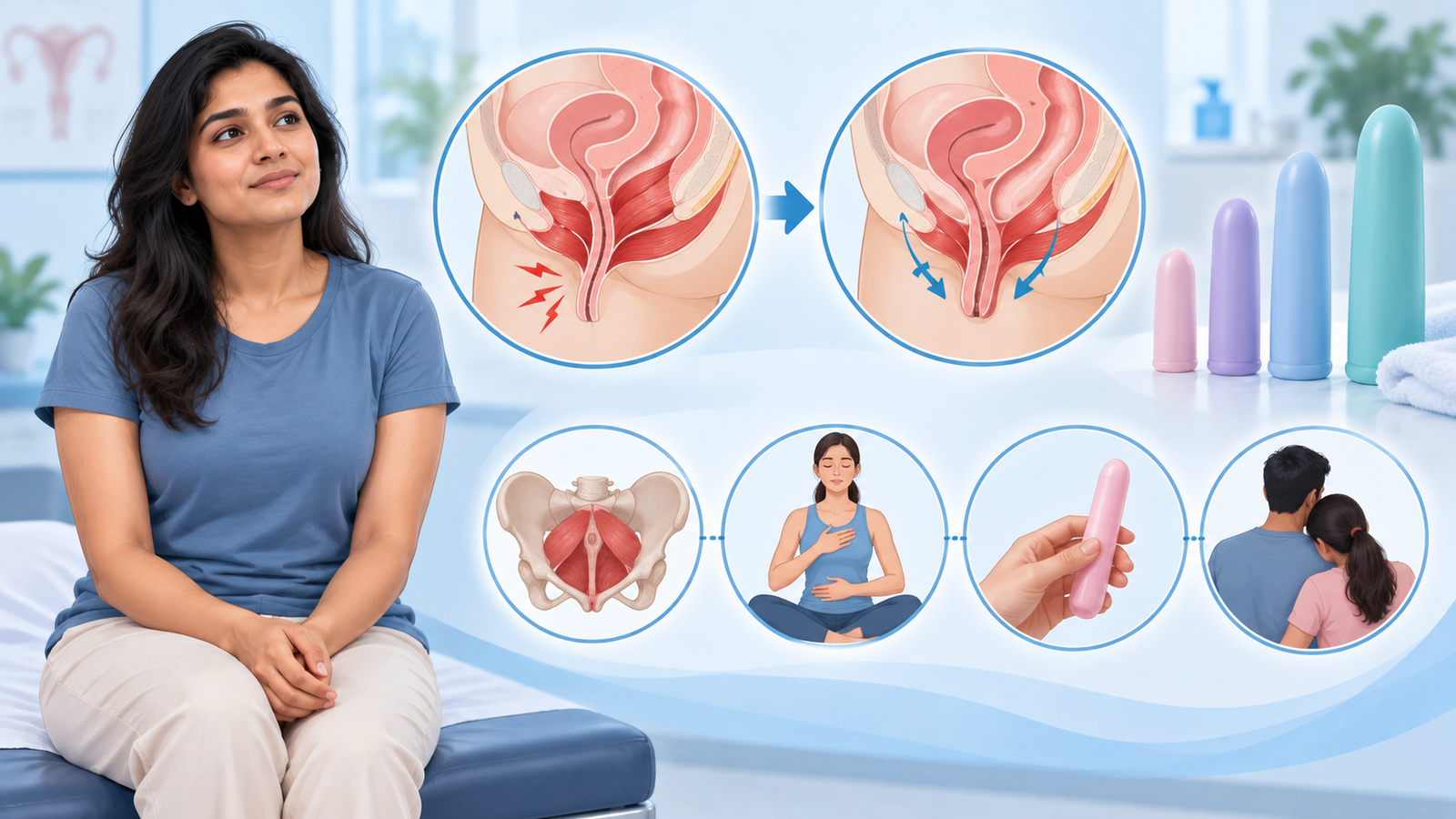
Vaginismus is an involuntary tightening of the pelvic floor muscles that makes penetration painful or impossible. It is not deliberate and it is not rare. Treatment combines education, pelvic floor physiotherapy and graded dilator therapy, and addresses anxiety alongside the muscle response. Other causes of pain must be excluded first by examination.
Written by Dr. [GYNAECOLOGIST NAME], [DEGREES], Consultant Obstetrician and Gynaecologist, Elegance Intimate Wellness, Surat. Reg. no. [REG NO]. [YEARS] years in women's pelvic health.
Medically reviewed by Dr. [GYNAECOLOGIST NAME] · Published [DD Month 2026] · Last reviewed [DD Month 2026]
Vaginismus is an involuntary tightening of the pelvic floor muscles that makes penetration painful or impossible. It is not deliberate and it is not rare. Treatment combines education, pelvic floor physiotherapy and graded dilator therapy, and addresses anxiety alongside the muscle response. Other causes of pain must be excluded first by examination.
If penetration is painful or impossible, you have probably already concluded that something is physically wrong with you, or that you are failing at something everyone else manages easily. Neither is likely to be true.
What is far more likely is a specific, recognised, treatable condition that has a name, a mechanism and a first-line treatment that does not involve surgery. This page explains what it is, what else can cause the same pain, and what treatment actually involves.
It is written to be read privately, and it does not assume you have told anyone.
What is vaginismus, and what does it feel like?
Vaginismus is when the muscles around the vagina tighten on their own when you try to insert something, so that penetration is painful or not possible at all. The NHS describes it simply as the vagina suddenly tightening up when you try to insert something into it, and states plainly that it is an automatic reaction which you do not have control over.
What people actually describe:
- A burning or stinging pain on attempted penetration, which the NHS names as the characteristic sensation.
- A feeling of a wall or a block, as though there is no opening, or as though something is in the way.
- The muscles tightening before anything touches you, sometimes at the thought of it.
- The whole body reacting. Legs closing, back arching, breath held. This is not a choice being made.
- Difficulty with tampons or a speculum examination, often long before intercourse was ever attempted.
- Pain that continues afterwards, as an ache or soreness.
It varies enormously in degree. Some women can manage a finger or a tampon but not intercourse. Some cannot tolerate anything at all. Some could previously and now cannot. All of these are the same condition at different points on a range, and all of them are treated along the same lines.
Why is "just relax" not advice?
Because the tightening is not something you are doing. It is a reflex, like blinking when something comes at your eye, and you cannot instruct a reflex to stop any more than you can decide not to flinch. The NHS states this directly: vaginismus is an automatic reaction which you do not have control over.
This matters more than it sounds, because "just relax" is what most women with this condition are told, often repeatedly, by partners, by relatives and sometimes by doctors. The implication underneath it is that she is choosing this, or not trying hard enough, or does not want to. None of those is what is happening.
Three things that are true at the same time, and the confusion between them is why this condition is so badly understood:
- The muscle response is genuinely involuntary. It is not psychological in the sense of being imagined or chosen.
- Anxiety is still part of the mechanism. Fear of pain triggers the reflex, and the reflex causes pain, which increases the fear. That is a physical loop, not a character flaw.
- Treating only one half does not work. Relaxing the muscle without addressing the anticipation, or addressing the anxiety without retraining the muscle, both tend to fail. This is covered in more detail below.
So when you read that anxiety plays a role, that is not a polite way of saying it is in your head. It is a description of a nervous system doing exactly what nervous systems do when they expect pain.
What else causes pain during intercourse?
Several things, and they need completely different treatments, which is why the first step is an examination rather than a diagnosis over a phone. Pain during intercourse is called dyspareunia, and vaginismus is one cause among many. Some of the others are simple to treat once identified.
| Cause | How it tends to present | What it needs |
|---|---|---|
| Vaginismus | Muscles tighten involuntarily, a sense of a block, burning or stinging, often difficulty with tampons too | Pelvic floor physiotherapy, graded dilators, addressing the fear cycle |
| Infection, including thrush and sexually transmitted infections | Discharge, itching, soreness, sometimes odour or bleeding | Testing, then antifungal or antibiotic treatment. Often resolves the pain entirely |
| Vaginal dryness | Friction and soreness, more common with hormonal changes and while breastfeeding | Assessment of the cause, lubricant, and treating the underlying reason |
| Insufficient arousal | Pain at entry, often situational, frequently related to anxiety or hurry | Discussion and education, often together with the above |
| Irritation or allergy to soaps, shampoos, spermicides or latex | Burning and redness of the skin, sometimes worse after specific products | Identifying and removing the irritant |
| Endometriosis or pelvic inflammatory disease | Deeper pain rather than pain at the entrance, often with period pain or pelvic pain at other times | Gynaecological assessment, sometimes imaging. A different pathway entirely |
| Skin conditions of the vulva | Persistent soreness, splitting, itching or colour change of the skin | Examination and dermatological or gynaecological treatment |
That list is drawn from NHS patient information on dyspareunia, which also names irritable bowel syndrome and pelvic floor muscle contraction among the causes. Note that more than one can be present at once. It is common for an infection or a period of dryness to cause the first painful experience, and for the vaginismus reflex to develop afterwards and persist long after the original cause has gone.
What is the difference between primary and secondary vaginismus?
Primary vaginismus means penetration has never been possible. Secondary means it was possible before and now is not. The distinction matters because it points at different starting causes, though the treatment approach is broadly similar.
Primary vaginismus is usually identified when a woman first attempts intercourse, often after marriage, or sometimes earlier when trying to use a tampon or attend a smear test. Contributing factors commonly include anxiety about sex, beliefs absorbed in childhood that sex is shameful or dangerous, a complete absence of information about one's own anatomy, and fear of pain built up from anticipation rather than from experience.
Secondary vaginismus develops after a period of pain-free penetration. Something causes pain, the body learns to guard against it, and the guarding outlasts the original problem. Common triggers include an infection, childbirth and perineal injury, surgery, menopausal dryness, or a distressing medical or sexual experience.
NHS guidance names, among the causes of vaginismus, anxiety or fears about sex, painful past sexual experiences, sexual assault or abuse, difficult medical experiences, beliefs about sex being shameful, and painful medical conditions. If something in that list applies to you, it is worth a clinician knowing, but you do not have to discuss anything you do not want to in order to be treated. Treatment can begin with the muscles and the body, and nothing else has to be talked about until and unless you choose to.
Why does examination come first, and how is it done sensitively?
Because several of the causes in the table above are straightforward to treat once identified, and because the examination also establishes what your muscles are actually doing. The NHS notes that a doctor may ask to examine you, that the examination is usually very quick, and that it is partly to rule out infection.
The obvious objection is that examination is the exact thing you cannot tolerate. That is understood, expected, and planned for.
What a sensitive assessment looks like:
- Talking first, fully clothed. History, symptoms, what you have tried, what you are hoping for. Nothing happens in the first part of the appointment.
- Explanation before anything else. You are told exactly what is proposed and why, before it happens.
- Your permission at each step, and the right to stop. You can say stop at any point and it stops. This is not a formality.
- Looking before touching. Often the first examination is visual only, checking the skin for irritation, infection or a skin condition. That alone answers several questions.
- Internal examination deferred where necessary. If you cannot tolerate it, it is postponed, not forced. Sometimes it becomes possible after a few weeks of treatment, and sometimes treatment starts without it.
- A female clinician and a chaperone, if you want them. Ask when you book. A reasonable clinic arranges this without making it awkward.
- Swabs for infection, which can usually be taken with minimal or no internal examination if necessary.
A clinician who responds to "I cannot do this" by pressing ahead is not the right clinician for this condition, and you are entitled to say so and leave.
What does pelvic floor physiotherapy for vaginismus involve?
It involves learning to relax and release the pelvic floor muscles, which is the opposite of the strengthening exercises most people have heard of. In vaginismus the muscles are overactive, not weak. NHS guidance on pain with penetrative sex describes them as non-relaxing, hypertonic or overactive pelvic floor muscles, and builds treatment around breathing and progressive relaxation.
This is an important point, and it is worth being explicit about because it is a common and harmful mistake. Pelvic floor strengthening exercises, often called Kegels, are the correct treatment for a weak pelvic floor, such as after childbirth, where the problem is leaking or poor support. For vaginismus the problem is the reverse. Doing strengthening exercises for an already overactive muscle can make symptoms worse. If you have been given a strengthening routine for this problem, that is worth raising with the person who gave it to you.
What the physiotherapy actually covers:
- Learning where the muscles are and what they are doing. Many women have never been able to feel these muscles at all, which is the first thing to change.
- Breathing work. Slow diaphragmatic breathing genuinely reduces pelvic floor tone. It sounds too simple to matter and it is where most programmes begin.
- Progressive muscle relaxation across the whole body, because the pelvic floor rarely tightens in isolation.
- Learning to release, not just to contract. The NHS describes pelvic floor exercises here as squeezing and releasing to gain muscle control, and control is the objective rather than strength.
- Manual therapy and stretching, where appropriate and tolerated.
- Positioning and posture, including how you hold your body when you anticipate pain.
This is skilled work and it is difficult to do correctly from a leaflet or a video, which is the main argument for seeing a pelvic floor physiotherapist rather than attempting it alone. Our approach is described on the pelvic floor health page.
How does graded dilator therapy work, and why is it not rushed?
Dilators, sometimes called vaginal trainers, are smooth tapered objects in a range of sizes, used in increasing order at your own pace to teach the body that insertion can happen without pain. The NHS describes them as tampon-shaped objects in different sizes. They are a retraining tool, not a stretching device.
That distinction is the whole thing. Nothing is being forcibly widened. What is being changed is a learned reflex, by giving the nervous system repeated experiences of insertion that do not hurt.
How it is generally done:
- Start with the largest size you can accept comfortably, which for some women is the smallest in the set and for some is a finger. There is no correct starting point.
- Use plenty of lubricant. Not optional, and under-using it is one of the commonest reasons a programme stalls.
- Insert slowly, then simply rest with it in place. The aim is not to achieve anything, it is to be comfortable while it is there.
- Practise regularly, commonly daily or as your clinician advises. Frequency matters more than duration.
- Move up a size only when the current one is genuinely comfortable, not when you feel you ought to have progressed.
- Expect setbacks. A bad week does not undo progress. Going back a size is a normal part of the process, not a failure.
On the evidence, stated honestly. A Cochrane review of interventions for vaginismus examined five controlled trials, four of which provided data on 282 participants, and found no clinical or statistical difference between systematic desensitisation and the control interventions studied. All the included studies carried a moderate or high risk of bias, and the authors concluded that conclusions about efficacy should be drawn cautiously.
That is the honest evidence position and you deserve to have it rather than a sales pitch. Two things put it in proportion. The trials were few, small and methodologically weak, which is a statement about the research rather than about the treatment. And dropout was higher among people left untreated on waiting lists than among those receiving treatment. These remain the treatments that the NHS recommends, and the practical reality in clinics is that most women who work through a proper programme improve. What nobody can honestly give you is a percentage.
Why does treating only the muscle not work?
Because pain and fear maintain each other, and breaking only one link in the loop lets it re-form. NHS guidance describes the cycle directly: pain causes fear, fear raises stress and anxiety, and that in turn makes the nervous system more sensitive, so the next attempt hurts more.
Follow it around once and it becomes obvious why willpower does not solve it:
- Anticipation. You expect pain, because you have had pain.
- Guarding. The pelvic floor tightens before contact. Automatically.
- Pain. Attempted penetration against tightened muscle hurts, which confirms the expectation.
- Avoidance. Attempts become less frequent and more loaded with dread.
- Pressure. Often from a partner, sometimes from family, frequently from yourself. Pressure raises anxiety, which tightens the muscles further.
Effective treatment interrupts the loop at more than one point at once: the muscle through physiotherapy and dilators, the expectation through graded experiences that do not hurt, and the anxiety through psychosexual counselling or cognitive behavioural therapy where that is helpful. NHS guidance lists psychosexual therapy, relaxation techniques, sensate focus exercises and vaginal trainers together for exactly this reason.
It also explains something women often notice and find confusing: that progress can be good in the clinic and poor at home. The dilator is not frightening. The situation is.
What if the marriage has not been consummated?
This is one of the commonest reasons women come to us, and it is a medical situation rather than a personal failing. Vaginismus is a frequent and treatable cause of an unconsummated marriage, and the fact that it is often discovered in the first weeks of a marriage is a matter of timing, not of anyone's inadequacy.
A few things worth saying plainly, because they are rarely said.
Treatment happens at your pace, and only if you want it. Some women come to this appointment because they want help. Some are brought. If you are reading this because somebody else has decided you should be treated, you are still the person who decides what happens to your body, at every step, including whether to start at all. That is not a courtesy, it is how consent works, and any clinician worth seeing will treat it that way.
Pressure makes this condition worse, not better. That is not a sentiment, it is the mechanism described in the section above. A deadline, a countdown, a family expecting news, all of it raises the anxiety that drives the reflex. If the people around you want this resolved, the most useful thing they can do is stop applying pressure to it.
Timelines vary and cannot be promised. Some women progress in weeks, some over many months. Anyone offering a guaranteed timeframe is guessing.
It is more common than the silence around it suggests. In our clinic in Surat, couples who have been married for a year or more without consummation are not unusual, and almost every one of them arrives believing they are the only ones.
You can come alone. You do not need your husband's presence or permission to attend, to be assessed, or to begin treatment.
What do partners need to understand?
Three things, and a partner who grasps them becomes genuinely useful rather than an additional source of pressure.
- It is involuntary. It is not rejection, it is not reluctance, and it is not something she is choosing. The NHS is unambiguous that it is an automatic reaction outside her control.
- Pressure is counterproductive in a specific, mechanical way. Anxiety drives the reflex. Every attempt framed as a test makes the next attempt harder. This is not about being nice, it is about not feeding the loop.
- Progress is not linear and setbacks are normal. Treating a difficult week as a failure turns a normal fluctuation into a crisis.
Partners can be involved in treatment where the woman wants that, and NHS guidance notes that exercises may be practised with a partner. The important words in that sentence are where she wants it. Involvement is an option she chooses, not a default.
Practically, the most useful things a partner can do are to stop treating penetration as the measure of progress, to take pressure off rather than adding encouragement that functions as pressure, and to attend an appointment if invited so that the explanation comes from a clinician rather than second hand.
Is it confidential, and can I come alone?
Yes, you can come alone, and medical consultations are confidential as a matter of standard professional practice. You do not need anyone's permission to seek assessment or treatment.
Because confidentiality is genuinely part of what stops women seeking help, it is reasonable to ask the clinic directly, before you book, how it handles records, appointment reminders and messages, and who else would be present during an examination. You are entitled to a clear answer and asking the question is completely normal.
You can also ask for a female clinician, ask for a chaperone, ask for the first appointment to be a conversation with no examination, and bring someone with you if you would rather not come alone. Any of those requests is ordinary.
What does intimate health care at Elegance, Surat involve?
This service treats painful intercourse as a medical problem, assessed by the right specialist, and treated in the order the evidence supports.
For vaginismus that means assessment first, to identify or exclude the other causes in the table above, then physiotherapy, graded dilator work and support for the anxiety component. There is no surgical treatment for vaginismus, and none is offered here. If a clinic proposes an operation for this condition, ask them to explain exactly what structure they intend to operate on and why.
Dr. [GYNAECOLOGIST NAME] leads assessment and treatment. Where pelvic floor physiotherapy and psychosexual counselling are needed, they are part of the plan rather than an afterthought, because for this condition they are the treatment rather than an adjunct to it.
What you will not be offered: a procedure before an assessment, a timeline anybody can guarantee, or treatment at a pace you have not agreed to. More about the team is on our about page, and the conditions assessed here are listed under conditions.
Next step
If penetration has been painful or impossible, whether for a few weeks or for years, that is a reason to be assessed rather than a reason to keep waiting. The first appointment is a conversation.
- Note when the pain started, and whether penetration was ever comfortable before
- Note whether tampons and examinations are also difficult, because that is useful information
- Note anything else happening at the same time, such as discharge, itching, dryness or pelvic pain at other times of the month
- You can come alone, and you can ask for the first visit to be talking only
Book a women's intimate health assessment at Elegance, Surat
Medical disclaimer. This article is general health information and is not a substitute for examination, diagnosis or treatment by a qualified doctor. Pain during intercourse has several possible causes that require different treatments, and telling them apart needs an assessment. Seek medical advice promptly rather than at your convenience if you have bleeding after intercourse, bleeding between periods, fever, offensive discharge, or severe or worsening pelvic pain. If any part of your situation involves feeling unsafe or pressured, a clinician can help you find appropriate support, and you do not have to discuss anything you are not ready to discuss in order to be treated.
Have a Private Question?
Every concern deserves an honest answer. Book a confidential consultation with Dr. Ashutosh Shah at Elegance Clinic, Surat, for guidance made just for you.

About the Author
Dr. Ashutosh Shah is a cosmetic gynecologist and plastic surgeon with over 22 years of experience. At Elegance Clinic in Surat, he is known for safe, honest and completely confidential intimate and aesthetic care.
What is vaginismus?
Vaginismus is an involuntary tightening of the muscles around the vagina when something is inserted, making penetration painful or impossible. The NHS describes it as an automatic reaction you do not have control over. It commonly causes a burning or stinging pain, and often affects tampon use and examinations too.
Is pain during intercourse normal?
No. Pain during intercourse, called dyspareunia, is common but it is not normal and it is not something to accept. Causes include infection, dryness, skin conditions, endometriosis and vaginismus, and they need different treatments. Several are simple to resolve once identified, which is why assessment comes first.
Is vaginismus a psychological problem?
Not in the sense of being imagined or chosen. The muscle tightening is a genuine involuntary reflex. Anxiety is part of the mechanism, because fear of pain triggers the reflex and the resulting pain increases the fear, but that is a physical loop rather than a character flaw or a lack of willingness.
How is vaginismus treated?
With a combination rather than one thing: pelvic floor physiotherapy focused on relaxing rather than strengthening the muscles, graded dilator therapy at your own pace, and support for the anxiety component through psychosexual therapy or cognitive behavioural therapy. The NHS also lists relaxation techniques and sensate focus exercises. There is no surgical treatment.
How long does vaginismus treatment take?
It varies considerably and nobody can honestly promise a timeframe. Some women progress over weeks and others over many months, and setbacks are a normal part of the process rather than a sign of failure. Frequency of practice tends to matter more than intensity, and pressure to hurry makes progress slower.
Can vaginismus be cured?
It is treatable, and most women who work through a proper programme improve. A Cochrane review found the trial evidence thin and at high risk of bias, so no honest figure can be quoted. What can be said is that these are the treatments the NHS recommends and that leaving it untreated is not a better option.
Is an intimate health consultation confidential?
Medical consultations are confidential as a matter of standard professional practice, and clinical records are kept confidential. You can attend alone, ask for a female clinician and ask for a chaperone. If confidentiality is part of what is holding you back, ask the clinic about its policy on records and appointment reminders before booking.