
Intimate Pain Is Not Something to Wait Out: What It Can Mean and When to Get It Checked
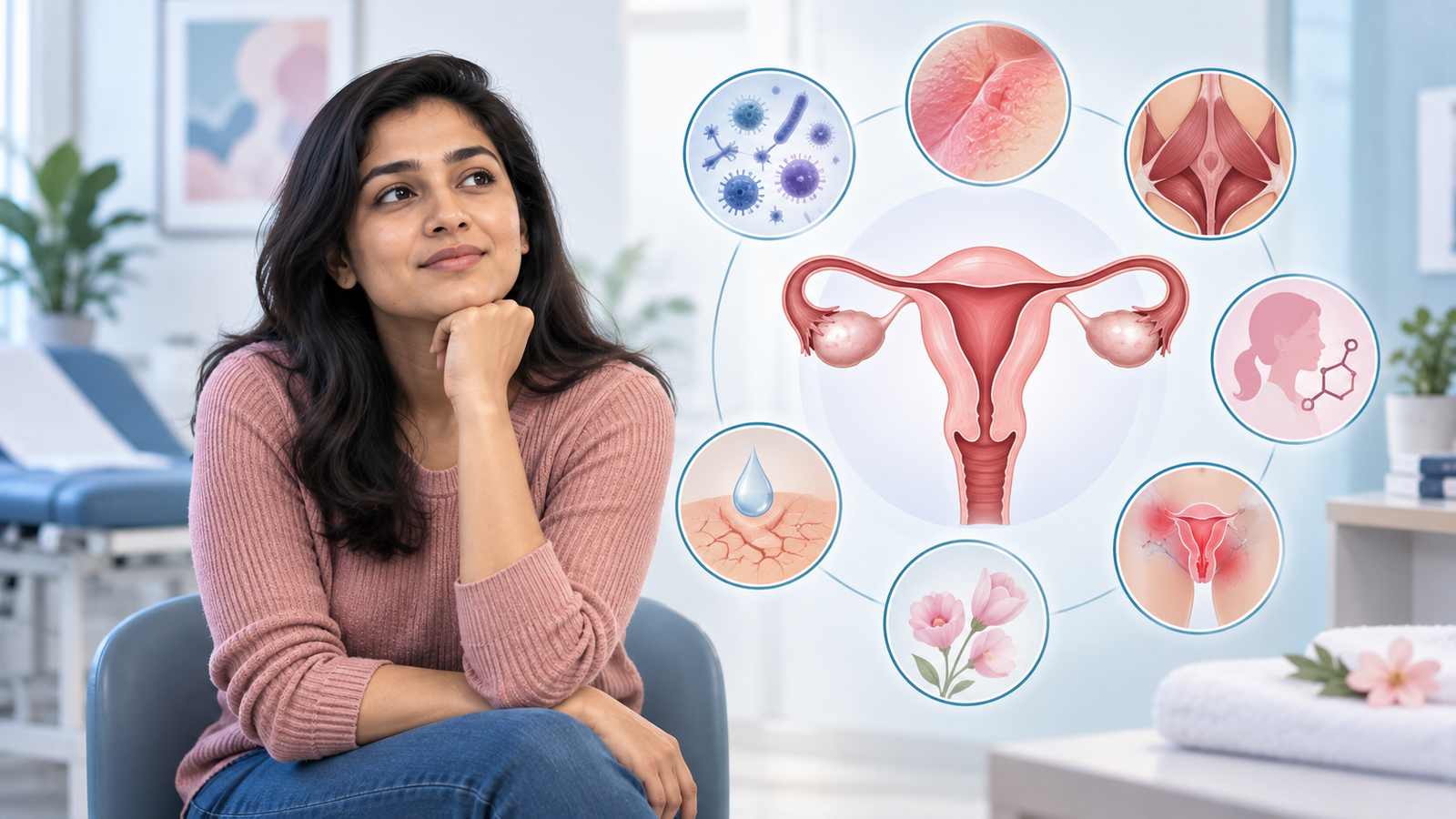
Intimate pain in women has many possible causes including infection, skin conditions, pelvic floor muscle problems, hormonal change and scarring after childbirth. Most are treatable once identified. Pain that is persistent, worsening, or comes with bleeding, fever or a lump needs medical assessment rather than waiting.
Written by Dr. [GYNAECOLOGIST NAME], [DEGREES], Consultant Obstetrician and Gynaecologist, Elegance Intimate Wellness, Surat. Reg. no. [REG NO]. [YEARS] years in women's health.
Medically reviewed by Dr. [GYNAECOLOGIST NAME] · Published [DD Month 2026] · Last reviewed [DD Month 2026]
Intimate pain in women has many possible causes including infection, skin conditions, pelvic floor muscle problems, hormonal change and scarring after childbirth. Most are treatable once identified. Pain that is persistent, worsening, or comes with bleeding, fever or a lump needs medical assessment rather than waiting.
If you are reading this, you have probably been wondering for a while whether what you are experiencing counts as a real problem. That question is the reason most women wait years, and it has a straightforward answer.
Pain is not a normal state for this part of the body. It is a symptom, symptoms have causes, and most of the causes are treatable once someone has looked. This page sets out what intimate pain can point to, which symptoms need seeing quickly, and what actually happens at an appointment, because not knowing that is often the real barrier.
Why does intimate pain get ignored for years?
Because of three things working together: not knowing whether it counts as a problem, not wanting to describe it to anyone, and often having raised it once already and been told it was nothing. Each of those is understandable. All three together produce delays of years.
What the waiting actually costs:
- Simple causes stop being simple. An infection treated in a week is a week. The same infection ignored for a year can cause lasting damage.
- Pain becomes its own problem. Persistent pain sensitises the nervous system, and the muscles around the area tighten protectively. After a while you are treating two things instead of one.
- Skin conditions progress. Some vulval skin conditions cause permanent changes to the tissue if untreated, and those changes cannot be reversed later.
- The wrong treatment gets used for years. Over-the-counter antifungal creams are the most common example. If it is not thrush, they do nothing, and buying them again confirms a diagnosis nobody ever made.
- You stop mentioning it at all. The longer something goes unsaid, the harder it becomes to say.
If you have raised this before and been dismissed, that is worth naming directly. A significant number of women have already told a doctor, or a relative, and been told it is normal, or just stress, or something that happens after marriage or after babies. Being dismissed once is not evidence that nothing is wrong. It is reasonable to raise it again, and it is reasonable to ask someone else.
What can intimate pain point to?
Broadly five categories: infection, skin conditions, muscle and nerve problems, hormonal change, and structural causes such as scarring or endometriosis. They feel different, they need completely different treatments, and telling them apart is the whole purpose of an assessment.
| Category | What it can feel like | Common examples | What it usually needs |
|---|---|---|---|
| Infection | Itching, burning, soreness, often with discharge, odour or stinging on urination | Thrush, bacterial vaginosis, urinary infection, sexually transmitted infections | Testing, then targeted treatment. Often resolves completely |
| Skin conditions | Persistent itching or soreness, skin that looks or feels changed, splitting | Lichen sclerosus, eczema and dermatitis, contact reactions to soaps or products | Examination and prescribed treatment, with follow-up. See the next section |
| Muscle and nerve | A sense of tightness or blockage, burning or stabbing pain without a visible cause | Pelvic floor muscle overactivity, vaginismus, vulvodynia | Pelvic floor physiotherapy and, where relevant, psychological support |
| Hormonal | Dryness, friction, soreness, tissue that feels thinner and more fragile | Breastfeeding, menopause, some hormonal contraceptives | Assessment of the cause, moisturisers and lubricants, sometimes oestrogen treatment |
| Structural | Pain felt deeper inside, pain linked to periods, or pain at a scar | Endometriosis, pelvic inflammatory disease, scarring after childbirth or surgery | Gynaecological assessment, sometimes imaging. A longer pathway |
Two things worth noticing about that table. More than one category can be present at once, and frequently is. And almost none of these are treated with surgery. The commonest answers are a cream, a tablet, a course of physiotherapy or a change of product.
Does it matter where and when the pain happens?
Yes, a great deal. The location and the timing are the most useful information you can bring to an appointment, and they narrow the possibilities more than anything else you could say.
What each pattern tends to suggest:
- Burning or stinging when you pass urine. Points toward a urinary infection, or toward urine passing over already inflamed or broken vulval skin. Those are different problems with the same sensation, which is why it needs looking at rather than guessing.
- Pain right at the entrance, on attempted penetration. Suggests the skin, the vulval tissue, or a muscle response rather than something deeper.
- Pain felt deep inside during intercourse. Points toward something in the pelvis. NHS guidance names pain felt deep inside during sex as a symptom of pelvic inflammatory disease, and this pattern also occurs with endometriosis.
- Constant pain, there whether or not anything touches you. Suggests a skin condition, a nerve-related pain, or persistent inflammation rather than a mechanical cause.
- Itching more than pain. Points toward skin or infection, and persistent itching that has not responded to treatment deserves a proper look.
- Pain that tracks your cycle, worse before or during periods, raises the possibility of endometriosis.
- Pain only after intercourse, or for hours afterwards. Often muscular, sometimes related to dryness or friction.
Before your appointment, note when it started, where exactly it is, what makes it worse, and whether anything has changed recently, including new soaps, detergents, products or medicines. That takes two minutes and it is genuinely more useful than most examinations.
What if the skin looks or feels different?
Changed vulval skin needs a proper examination rather than another antifungal cream. White patches, thickened or crinkled skin, skin that splits easily, or a change in the shape of the tissue are signs of a skin condition rather than an infection, and they need diagnosis and prescribed treatment.
The one most often missed is lichen sclerosus, a long-term skin condition. NHS guidance describes it as itchy white patches, most commonly on the genitals, with skin that is white, smooth or crinkled and easily damaged. It is much more common in women over 50 but occurs at all ages.
Two facts about it that belong together:
- It cannot be cured, but it is very treatable. The NHS states that a strong prescription steroid ointment usually helps relieve the symptoms. Most women do well on treatment.
- It slightly increases the risk of cancer of the vulva, and the NHS describes that risk as low. This is not a reason to be frightened. It is the reason it should be diagnosed, treated and followed up rather than left.
Why it matters so much on a page like this: women live with lichen sclerosus for years believing it is thrush that will not go away, buying antifungal creams that cannot help because the problem is not fungal. Meanwhile the condition continues, and untreated it can cause permanent changes to the tissue. NHS advice is to see a doctor about an itchy white patch on the genitals, or if you have been diagnosed and treatment is not helping.
Please do not use a steroid cream from a previous prescription, or anyone else's, on this area. Vulval skin is thin, the strength and duration matter, and the wrong steroid used the wrong way causes its own problems. This is one of the few situations where the treatment genuinely needs a prescription and a review.
Could it just be an infection?
Often, yes, and that is good news because infections are among the most straightforward causes to resolve once identified. The problem is that several different infections produce similar symptoms and need different treatments, so guessing is unreliable.
What tends to get confused:
- Thrush causes itching, soreness and typically thick white discharge. Widely self-treated, and correctly so when it really is thrush.
- Bacterial vaginosis causes discharge with a distinctive odour and needs a different treatment entirely. Antifungal cream does nothing for it.
- Urinary infection causes stinging on passing urine, frequency and urgency, and can make the vulva sore secondarily.
- Sexually transmitted infections can cause pain, discharge, bleeding or no symptoms at all, and testing is the only way to know.
- Irritation or allergy to soaps, shampoos, detergents, spermicides or latex produces burning and redness that looks like infection and is not.
If you have treated yourself for thrush more than once or twice and the symptoms keep returning, that pattern is itself the finding. Recurrent thrush that does not settle is one of the commonest ways a skin condition, a different infection, or diabetes goes undiagnosed for years.
One infection to take seriously. Pelvic inflammatory disease causes pelvic or lower abdominal pain, pain felt deep inside during sex, unusual discharge and irregular bleeding. The NHS notes that it is usually easy to treat if diagnosed early, and that left untreated it can cause abscesses, long-term pelvic pain, fertility problems and a raised risk of ectopic pregnancy. Early is the operative word.
When is the pain muscular?
When there is a sense of tightness, blockage or guarding rather than a visible cause, and particularly when examination and swabs come back normal. The pelvic floor muscles can become persistently overactive, and an overactive muscle produces genuine pain.
Two named conditions sit here. Vaginismus is an involuntary tightening of the pelvic floor muscles on attempted penetration, making it painful or impossible, and it is treated without surgery. How it is diagnosed and what treatment involves is covered fully in our guide to vaginismus and painful intercourse. Vulvodynia is vulval pain lasting at least three months without a specific identifiable cause, which the NHS describes as burning, throbbing, stabbing or soreness, possibly involving over-sensitivity of the nerves in the vulva, and which is treated with a combination that can include topical numbing creams, nerve pain tablets, pelvic floor work and psychological therapies.
The important thing to take from this section is that "the tests were normal" does not mean nothing is wrong. It means the cause is not an infection, which is useful information and the point at which a muscular or nerve cause should be considered rather than the point at which you are sent home.
Can hormonal change cause it?
Yes, and it is one of the most common and most treatable causes. Falling oestrogen makes the vulval and vaginal tissue thinner, drier and more fragile, which produces friction, soreness and splitting. This happens at predictable times in life and is frequently mistaken for something else.
When it tends to occur:
- While breastfeeding. Oestrogen is low, dryness is common, and this is expected rather than damage. It generally improves after weaning.
- Around and after menopause. The commonest cause of new intimate pain in women over 45, and among the most under-treated.
- On some hormonal contraceptives, which the NHS lists among the causes of vaginal dryness, along with some antidepressants.
- After certain cancer treatments, which is a specific situation needing specialist advice.
The NHS advises water-based lubricants and vaginal moisturisers as first steps, with creams, gels, patches or medicines that increase oestrogen where those are not enough, and recommends seeing a doctor if self-care has not worked after a few weeks or if it is affecting daily life.
Pain related to changes after childbirth, including scar pain and pelvic floor weakness, is a related but separate subject and is covered in our guide to recovery after childbirth.
Which symptoms need assessment this week rather than eventually?
Some symptoms are worth an appointment soon rather than at your convenience, because early treatment changes the outcome. Others need emergency care the same hour. These two lists are different and it is important not to blur them.
Book an appointment this week if you have any of these:
- Pain that has lasted more than a few weeks, or is getting worse
- Bleeding after intercourse, or bleeding between periods
- A lump, an ulcer or a sore that has not healed
- White, thickened or changed skin, or skin that splits easily
- Itching that has not settled despite treatment, or that keeps returning
- Discharge that is unusual for you, particularly with odour
- Pain felt deep inside during intercourse
- Pain on passing urine that has lasted more than a few days
- Any loss of control over urine, wind or stool
- Pain that is stopping you doing ordinary things, including sleeping
Go to hospital or seek emergency care now, not an appointment, if you have:
- Severe pain, or pain that is rapidly getting worse
- Heavy vaginal bleeding
- Sharp pain in your abdomen
- Pain in your shoulder
- Dizziness or feeling faint
- A high temperature, or feeling very unwell
- Severe nausea or vomiting
That second list comes from NHS guidance on pelvic inflammatory disease, and the reason those particular symptoms appear together is that they can indicate an ectopic pregnancy or another condition needing urgent surgical assessment. Shoulder pain alongside abdominal pain is the one nobody expects, and it is on the list for a reason.
What does an examination actually involve, and what can you ask for?
A first appointment is mostly a conversation. The examination, when it happens, is brief, and nothing is done without your agreement. For a great many women the anticipation is considerably worse than the appointment.
What normally happens, in order:
- Talking, fully clothed. When the pain started, where it is, what makes it worse, what you have already tried, your periods, any discharge or bleeding, and anything that has changed. Nothing is examined during this part.
- Explanation before anything else. You are told what is proposed and why, before it happens.
- Looking before touching. Often the first examination is visual only. For skin conditions that alone answers most of the question.
- Swabs if infection is possible. Quick, and often possible with minimal internal examination.
- Internal examination only if needed, and not if you cannot tolerate it. It can be deferred to another visit or skipped while treatment begins.
- A plan, and a review date. For most women this is a prescription, a test result to come, or a physiotherapy referral, not a procedure.
What you are entitled to ask for, and none of these are unusual requests:
- A female clinician. Ask when you book.
- A chaperone, which is someone else present during the examination.
- A first appointment with no examination at all, just talking.
- To stop at any point. You can say stop and it stops. This is not a formality.
- An explanation of what is being looked for before it happens.
- To bring someone with you, or to come alone.
A clinician who responds to "I cannot do this" by continuing anyway is not the right clinician, and you are entitled to say so and leave.
Can you come alone, and is it confidential?
Yes to both. You do not need anyone's permission to be assessed or treated, and medical consultations are confidential as a matter of standard professional practice.
Because confidentiality is genuinely one of the reasons women do not come, it is reasonable to ask the clinic directly, before booking, how it handles records, appointment reminders, messages and calls, and who would be present during an examination. You are entitled to a clear answer, and asking is normal rather than awkward.
In our clinic in Surat the most common thing women say at the end of a first appointment is that they had been meaning to come for two or three years. Almost nobody says they wish they had waited longer.
What does intimate health care at Elegance, Surat involve?
This service treats intimate pain as a medical problem with a diagnosis to be found, rather than as a symptom to be managed or a cosmetic concern.
In practice that means the first appointment is an assessment: history, examination where appropriate, swabs where infection is possible, and a plan. Most women leave with a prescription, a test result pending, or a referral to pelvic floor physiotherapy. Most of the causes on this page are treated with a cream, a tablet, a hormone preparation or physiotherapy, and very few of them need surgery.
Dr. [GYNAECOLOGIST NAME] leads assessment and treatment. Where a skin condition needs dermatological input, or a muscular cause needs pelvic floor physiotherapy, that is arranged as part of the plan.
What you will not be offered: a treatment before an examination, a procedure for a problem that does not need one, or a diagnosis made over the phone. The conditions assessed here are listed under conditions, and more about the team is on our about page.
Next step
If something has been hurting and you have been putting off doing anything about it, the useful next step is small: an appointment where you describe it to someone who can examine it.
- Note when it started, where exactly it is, and what makes it worse
- Note anything that changed around the time it began, including new soaps, detergents, products or medicines
- Note the symptoms you would rather not say out loud, because those are the ones most often left out and they frequently change the assessment
- You can come alone, ask for a female clinician, and ask for the first visit to be talking only
Book a women's intimate health assessment at Elegance, Surat
Medical disclaimer. This article is general health information and is not a substitute for examination, diagnosis or treatment by a qualified doctor. Intimate pain has many possible causes that require different treatments, and telling them apart needs an assessment. Seek emergency care immediately, rather than booking an appointment, if you have severe or rapidly worsening pain, heavy vaginal bleeding, sharp abdominal pain, shoulder pain, dizziness, a high temperature or severe vomiting. Do not use a prescription steroid or anyone else's medication on this area without medical advice.
Have a Private Question?
Every concern deserves an honest answer. Book a confidential consultation with Dr. Ashutosh Shah at Elegance Clinic, Surat, for guidance made just for you.

About the Author
Dr. Ashutosh Shah is a cosmetic gynecologist and plastic surgeon with over 22 years of experience. At Elegance Clinic in Surat, he is known for safe, honest and completely confidential intimate and aesthetic care.
Is intimate pain normal?
No. Pain in this area is common, but common is not the same as normal, and it is not something to wait out. It is a symptom with a cause, and most causes are treatable once identified. Persistent pain, or pain that is worsening, deserves assessment rather than acceptance.
What causes pain during intercourse in women?
Several things, and they need different treatments. Infections, vulval skin conditions, dryness from hormonal change, overactive pelvic floor muscles including vaginismus, vulvodynia, scarring after childbirth, endometriosis and pelvic inflammatory disease can all cause it. Pain at the entrance and pain felt deep inside usually point in different directions.
When should I see a doctor about intimate pain?
Book within the week for pain lasting more than a few weeks or worsening, bleeding after intercourse or between periods, a lump or an ulcer that has not healed, changed or white skin, or persistent itching. Seek emergency care immediately for severe pain, heavy bleeding, fever, dizziness or shoulder pain.
Can intimate pain be treated?
In most cases yes, once the cause is identified. Infections are usually straightforward to treat. Skin conditions respond well to prescribed treatment. Hormonal dryness responds to moisturisers, lubricants and sometimes oestrogen. Muscular causes respond to pelvic floor physiotherapy. Very few causes of intimate pain require surgery.
What does an intimate health examination involve?
Mostly conversation. You are asked about symptoms while fully clothed, then examined only with your agreement, often visually first. Swabs are taken if infection is possible. An internal examination is done only if needed and can be deferred if you cannot tolerate it. You can stop at any point.
Can I ask for a female doctor?
Yes, and you should ask when you book rather than on the day. You can also ask for a chaperone to be present, for a first appointment with no examination, and for an explanation of what is being looked for before anything happens. These are ordinary requests, not difficult ones.
Is an intimate health consultation confidential?
Medical consultations are confidential as a matter of standard professional practice, and clinical records are kept confidential. You can attend alone and do not need anyone's permission. If confidentiality is part of what is holding you back, ask the clinic about its policy on records, reminders and messages before you book.