
Labiaplasty: What It Is, and When It Is Actually Recommended
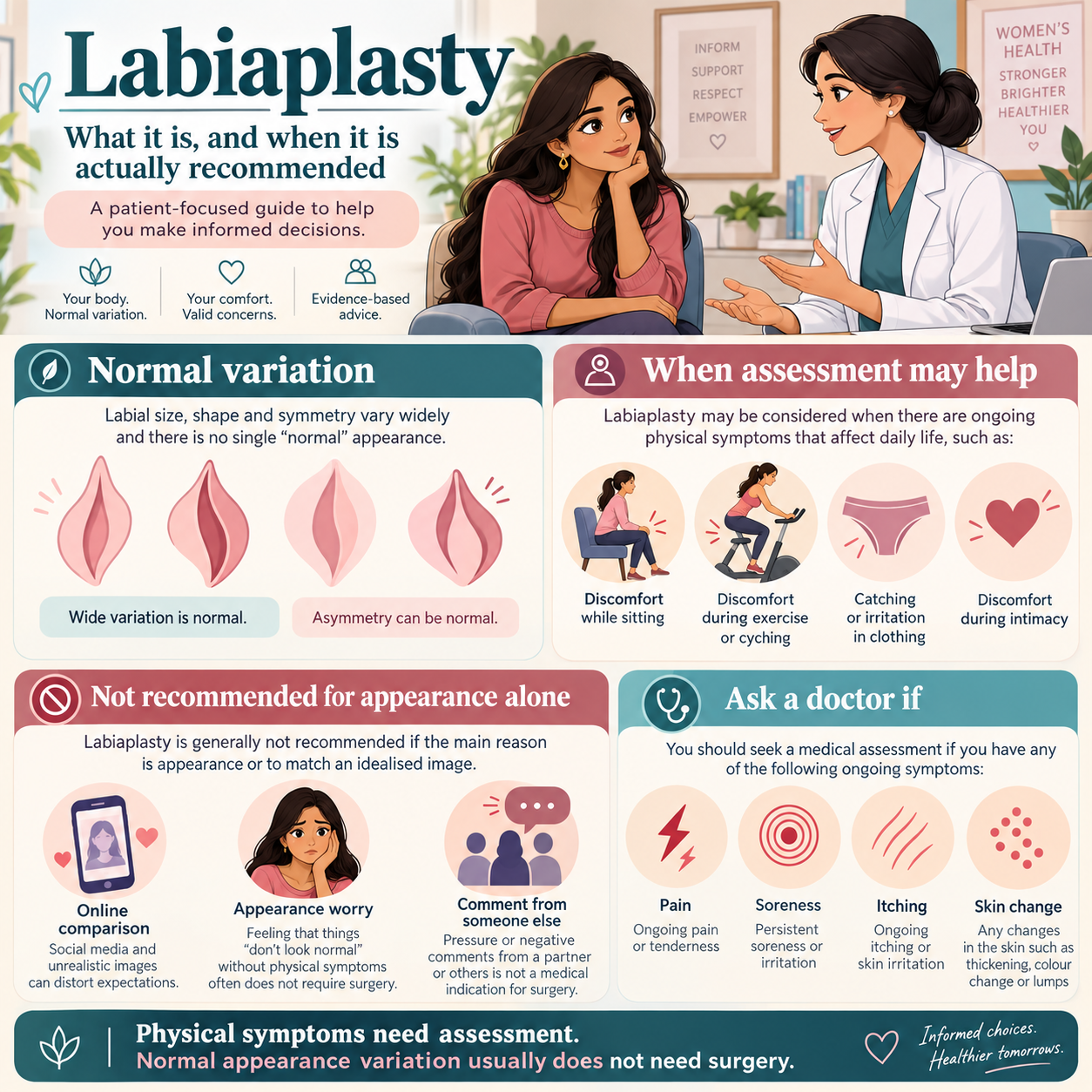
Labiaplasty is surgery to reduce the size of the labia minora. It is considered when the labia cause physical discomfort during exercise, sitting or intercourse, or catch in clothing. Wide variation in labial size and shape is normal and is not by itself a reason for surgery.
Written by Dr. Ashutosh A Shah, M.B.B.S., M.S., M.Ch., D.N.B., Board Certified Plastic Surgeon, Elegance Intimate Wellness, Surat. Reg. no. [REG NO]. 22+ years in plastic and reconstructive surgery.
Medically reviewed by Dr. Ashutosh A Shah · Published 30 September 2026 · Last reviewed 30 September 2026
Labiaplasty is surgery to reduce the size of the labia minora. It is considered when the labia cause physical discomfort during exercise, sitting or intercourse, or catch in clothing. Wide variation in labial size and shape is normal and is not by itself a reason for surgery.
Most people who search for this are not shopping for an operation. They are checking whether they are normal, usually after seeing something online or hearing a remark.
So this page answers that question first, before it describes the surgery at all. If you only read one section, read the next one.
What is labiaplasty?
It is an operation that reduces the size of the labia minora, the inner folds of the vulva. NHS Scotland describes it as the "partial removal and reduction in the size of the labia minora".
It is one of a group of procedures referred to collectively as female genital cosmetic surgery, and how it is classified matters, because it shapes what you should expect from it.
NHS Herts and West Essex states the position of the health service plainly: "Labiaplasty is generally a cosmetic procedure to improve appearance alone", and that "it should be considered as medically non-essential surgery and thus not routinely commissioned".
The same policy also acknowledges why people actually come: "Reasons for requesting labiaplasty are often to alleviate functional discomfort, improve appearance and increase self-esteem."
Both of those are true at once, and holding them together is the honest position. Some people have a genuine physical problem. Most people asking about this do not, and have been made anxious about something that is within the normal range.
How much variation in labia is normal?
A great deal, and considerably more than most people realise. Two separate NHS bodies say so in almost the same words, which is unusual and worth noticing.
NHS Scotland's guideline states: "The size range and symmetry of the adult labia shows a wide variation." NHS Herts and West Essex puts it as: "In reality, the size range of normal adult labia minora shows a wide variation."
Read those two sentences again. Note that both mention range, and one specifically mentions symmetry. Asymmetry between the two sides is part of the normal picture, not a defect.
Here is the finding that reframes this whole subject. The NHS Scotland guideline records that "up to 40% of patients are unable to correctly identify genital structures".
That is not a criticism of anybody. Nobody is taught this. But it means a substantial share of people who are worried about how they compare cannot reliably name the parts they are comparing, which makes the comparison unreliable in both directions. It is also why the guideline instructs clinicians to go through the anatomy of the vulva and discuss the range of normality before any conversation about surgery.
Where does the anxiety come from, if not from anatomy? Usually from a narrow and unrepresentative set of images, from the fact that almost nobody sees a range of real examples, and sometimes from a single comment made years ago by someone who should not have made it.
When is labiaplasty actually recommended?
For a physical problem rather than an appearance one. The clearest indications are structural: reconstruction after significant trauma, after cancer treatment, or for a significant congenital difference.
NHS Scotland lists the circumstances in which the procedure is offered as anatomical implications secondary to genital cancer, significant congenital malformations, and repair after significant trauma. NHS Herts and West Essex commissions it "Where repair of the labia is required after severe physical trauma; common consequence of childbirth will not be sufficient reason", along with cancer and significant congenital malformation.
An important distinction, because this page would otherwise mislead you in one direction or the other. Those are commissioning criteria. They describe what a health service will pay for, which is not the same as a complete list of situations in which a person has a real problem.
Functional discomfort is a genuine presentation. Labia that catch in clothing, that are painful during exercise or cycling, or that make intercourse uncomfortable are describing a physical symptom, not an aesthetic preference. Such symptoms are worth having assessed by a clinician who will examine you and look for other explanations first, because several conditions cause similar discomfort and only some of them are helped by surgery.
What being assessed properly looks like:
- An examination that looks for other causes, including skin conditions, which can produce discomfort that surgery would not fix.
- A conversation about what specifically is uncomfortable, when, and how often, rather than about how things look.
- Going through the anatomy, which the guideline recommends and which resolves a proportion of consultations on its own.
- Non-surgical options considered first where the symptom allows it.
When is it not the right answer?
When the reason is how it looks, how it compares, or what somebody said. Those are real feelings and they deserve to be taken seriously, but surgery is a poor treatment for them.
| Reason people ask | Is this an indication | What to consider first |
|---|---|---|
| It does not look like what I have seen online | No | Those images are a narrow and unrepresentative sample. Go through real anatomy with a clinician |
| One side is bigger than the other | No, on its own | Asymmetry is part of the documented normal range |
| A partner made a comment | No | This is worth talking about, but not with a surgeon first |
| It catches in clothing or hurts when cycling | Possibly | Assessment, and exclusion of other causes of the discomfort |
| Discomfort during intercourse | Possibly, and it needs assessing | Several conditions cause this. Surgery is not the first question |
| I think it will improve my confidence | No | The evidence for outcomes like this is weak. See the next section |
| I have been told it improves sexual or urinary function | No | NHS Scotland says directly that this is marketed without good evidence |
| Skin changes, itching, soreness or a lesion | No, and get it seen | These need a diagnosis, not a reduction |
On the marketing question, NHS Scotland is unusually direct: "Surgery can be marketed as helping urinary function and sexual functioning, however there is a lack of high quality evidence."
If a clinic tells you this operation will improve your sex life or your confidence, that claim is running ahead of the evidence, and you are entitled to ask what they are basing it on.
What does the procedure involve?
Removal of a portion of the labial tissue and closure of the resulting edge, done under local or general anaesthetic depending on the case. The technical description is short because the operation itself is not the complicated part. The decision to have it is.
What you should have established before the operation is discussed in detail:
- What specific symptom the surgery is intended to address, stated in your words and written down.
- That other causes of that symptom have been excluded.
- What will not change, which is usually more important than what will.
- Who is performing it and what their training is. This is genital surgery and it should be done by someone qualified in reconstructive surgery of this area.
- What happens if you are not satisfied, including whether revision is possible, because tissue that has been removed cannot be replaced.
That last point deserves its own sentence. This operation removes tissue permanently. It is not adjustable afterwards in the way some procedures are, and a result that is over-reduced is difficult to address.
What does recovery realistically look like?
Swelling, soreness and a period of restricted activity, with a wound in an area that is difficult to keep still and is exposed to friction. I am not going to give you a number of days, and the reason is worth explaining.
Both NHS sources used on this page set out indications, risks and age limits in detail. Neither gives any recovery timeline at all. Rather than repeat a figure from a clinic marketing page, which is where most of the timings circulating online come from, this page says plainly that your operating surgeon is the only reliable source for how long your recovery should take.
What recovery involves, which is answerable without inventing a schedule:
- Swelling and bruising, which in this area can be more pronounced than people expect and which settles gradually.
- Discomfort when sitting, which is often the most limiting part of the early period.
- Restrictions on exercise, cycling and intercourse until the wound has healed, with the duration set by your surgeon.
- Careful attention to the wound, in an area where wound breakdown is a recognised risk. The next section gives the figure.
- A follow-up appointment, which you should attend even if everything feels fine.
Ask for the recovery plan in writing before you agree to surgery, not on the day. If a clinic cannot tell you in advance how long you will be off work and off exercise, that is information about the clinic.
What are the risks, including the ones rarely mentioned?
Wound breakdown is common enough to be planned for, and changes in sensation are possible and permanent. These are not remote theoretical risks and they should be part of the conversation before you consent, not after.
NHS Scotland's guideline names the short term complications as "wound dehiscence (up to 30%)" and infection. Wound dehiscence means the wound edges separating rather than healing together, and up to thirty percent is a figure worth sitting with. Applied to this procedure, it means a meaningful minority of people do not heal straightforwardly first time.
The longer term risks are the ones most often left out of a consultation. The same guideline states: "there can be issues with residual pain, change in sensation and altered sexual functioning."
Each of those deserves naming plainly:
- Residual pain, meaning pain that persists after healing, including in people who had the surgery to relieve discomfort.
- Change in sensation, which may be reduced sensation, increased sensitivity, or an area that feels different. This can be permanent.
- Altered sexual functioning, which is listed by the guideline as a risk of the surgery, and which sits awkwardly alongside marketing that promises the opposite.
- Dissatisfaction with the result. NHS Scotland notes that the problems with this surgery "can stem from unrealistic expectations, with many women being disappointed with the outcome."
That final quotation is the one to weigh most carefully, because disappointment after this particular operation is difficult to remedy. The tissue is gone.
What questions should you ask before agreeing to it?
Ask what physical problem the operation is treating, and keep asking until you get an answer about symptoms rather than appearance. A clinic that cannot name the symptom is proposing surgery for how something looks.
- What specific symptom will this address, and what will it not change?
- What else could be causing my discomfort, and have those been excluded?
- Have you examined me and gone through the anatomy with me?
- What is your wound breakdown rate, and how do you manage it when it happens?
- What are the chances of a change in sensation, and is it reversible?
- What evidence is there that this improves the thing you are telling me it improves?
- How long will I be off work, off exercise, and how long before intercourse?
- What is your training in genital reconstructive surgery specifically?
- What happens if I am unhappy with the result, and what can and cannot be revised?
- Is there anything other than surgery that would help my symptom?
- Would you advise someone in my position to wait, and why or why not?
The last question is a good test. A clinician comfortable saying "yes, wait" or "no, I do not think you need this" is one whose "yes, I think surgery would help" is worth something.
NHS Scotland also notes that psychology referral should be considered before referral to gynaecology, and that whether counselling may be more appropriate than surgery is a question to ask. That is not an insult. It reflects that distress about appearance is a real problem with a real treatment, and that the treatment is not always an operation.
Why does age matter, and why is this not a procedure for under 18s on appearance grounds?
Because the body is still developing, and because a young person comparing herself to anything is comparing something unfinished. Both NHS sources set the same limit and they set it clearly.
NHS Scotland states that this surgery "should not normally be offered to individuals below 18 years of age", giving the reason as "due to continued anatomical development during puberty". NHS Herts and West Essex is more absolute: "Surgery will only be considered for adults (over 18), excluding cancer cases."
If you are reading this and you are under 18, this section is about you, so here it is directly.
Worrying about this at your age is extremely common. It is one of the most frequent things young people search about their own bodies, and almost everyone who worries about it has anatomy within the normal range. Your body is still changing, and the labia continue to develop through puberty, which means what you see now is not a finished state to be judged.
The right things to do are to talk to a doctor if something hurts, and to talk to someone you trust if the worry itself is the problem. Both are reasonable. Surgery is not on that list, and no reputable surgeon will offer it to you for how things look.
If something is physically painful, sore, itchy or changed, that is a different matter entirely and it should be seen by a doctor. Pain is always worth reporting. It is appearance that is not a reason for an operation at your age.
How is this assessed at the clinic in Surat?
By examining, going through the anatomy, and establishing whether there is a physical symptom before any discussion of surgery. In our practice in Surat, the single most common outcome of a first consultation about this is reassurance rather than a surgical plan.
People arrive having already decided that something is wrong, often after months of private worry and without having said it aloud to anyone. A meaningful proportion of those consultations end with someone learning that what they have is within the normal range, which is information they could not get anywhere else and had no way to check.
Where there is a genuine physical symptom, the sequence is assessment first: what hurts, when, and what else could be causing it. Skin conditions and other diagnoses are looked for before reduction is discussed, because operating on a symptom whose cause has not been established does not help.
Nobody here will suggest an operation for how something looks. If you come for that conversation, you will get an examination, an explanation of what is normal, and an honest answer, and it is entirely reasonable to leave with that and nothing else. Related concerns are covered separately in our pages on intimate pain and when to get help, intimate hygiene myths, and changes after childbirth.
Frequently Asked Questions
What is labiaplasty surgery?
It is an operation that reduces the size of the labia minora, described by NHS Scotland as partial removal and reduction in the size of the labia minora. NHS guidance classes it as generally cosmetic and medically non-essential, and it is not routinely commissioned by the health service.
Is my labia size normal?
Almost certainly. Two separate NHS sources state that the size range of normal adult labia minora shows a wide variation, and one specifically includes symmetry in that range. Asymmetry between the two sides is part of the normal picture rather than a defect.
When is labiaplasty recommended?
For a physical problem rather than appearance. NHS bodies commission it for repair after severe trauma, for cancer, and for significant congenital malformation. Functional discomfort is a genuine presentation worth assessing, but it needs examination and exclusion of other causes first.
Is labiaplasty painful, and how long is recovery?
Expect swelling, soreness and discomfort when sitting. Neither NHS source consulted gives a recovery timeline, so ask your operating surgeon rather than relying on figures found online. Get the plan in writing before agreeing, including time off work, exercise and intercourse.
What are the risks of labiaplasty?
NHS Scotland names wound dehiscence, meaning the wound edges separating, at up to thirty percent, along with infection. Longer term, the guideline lists residual pain, change in sensation and altered sexual functioning, and notes that many women are disappointed with the outcome.
Can labiaplasty affect sensation?
Yes. NHS Scotland lists change in sensation among the recognised problems, alongside residual pain and altered sexual functioning. This may be reduced sensation, increased sensitivity or an area that simply feels different, and it can be permanent. Removed tissue cannot be replaced.
Should teenagers have labiaplasty?
Not for appearance. NHS Scotland states it should not normally be offered below eighteen because anatomy continues developing through puberty, and NHS Herts and West Essex restricts it to adults. Worry about this is very common at that age and almost always concerns normal anatomy.
Next step
If you are worried about how you look, the useful first step is an examination and a conversation about what is normal, not a surgical consultation. If something hurts, that is worth having assessed on its own terms. Book a consultation with Dr. Ashutosh Shah in Surat, and it is entirely reasonable to come only for reassurance.
This page is for education and is not a substitute for examination and assessment. Discomfort, pain, itching, soreness or any change in the skin should be seen by a doctor, because several conditions cause similar symptoms and most are not treated with surgery. Labiaplasty permanently removes tissue and cannot be reversed. Please consult Dr. Ashutosh A Shah or another qualified clinician about your own situation.
Have a Private Question?
Every concern deserves an honest answer. Book a confidential consultation with Dr. Ashutosh Shah at Elegance Clinic, Surat, for guidance made just for you.

About the Author
Dr. Ashutosh Shah is a cosmetic gynecologist and plastic surgeon with over 22 years of experience. At Elegance Clinic in Surat, he is known for safe, honest and completely confidential intimate and aesthetic care.
What is labiaplasty surgery?
It is an operation that reduces the size of the labia minora, described by NHS Scotland as partial removal and reduction in the size of the labia minora. NHS guidance classes it as generally cosmetic and medically non-essential, and it is not routinely commissioned by the health service.
Is my labia size normal?
Almost certainly. Two separate NHS sources state that the size range of normal adult labia minora shows a wide variation, and one specifically includes symmetry in that range. Asymmetry between the two sides is part of the normal picture rather than a defect.
When is labiaplasty recommended?
For a physical problem rather than appearance. NHS bodies commission it for repair after severe trauma, for cancer, and for significant congenital malformation. Functional discomfort is a genuine presentation worth assessing, but it needs examination and exclusion of other causes first.
Is labiaplasty painful, and how long is recovery?
Expect swelling, soreness and discomfort when sitting. Neither NHS source consulted gives a recovery timeline, so ask your operating surgeon rather than relying on figures found online. Get the plan in writing before agreeing, including time off work, exercise and intercourse.
What are the risks of labiaplasty?
NHS Scotland names wound dehiscence, meaning the wound edges separating, at up to thirty percent, along with infection. Longer term, the guideline lists residual pain, change in sensation and altered sexual functioning, and notes that many women are disappointed with the outcome.
Can labiaplasty affect sensation?
Yes. NHS Scotland lists change in sensation among the recognised problems, alongside residual pain and altered sexual functioning. This may be reduced sensation, increased sensitivity or an area that simply feels different, and it can be permanent. Removed tissue cannot be replaced.
Should teenagers have labiaplasty?
Not for appearance. NHS Scotland states it should not normally be offered below eighteen because anatomy continues developing through puberty, and NHS Herts and West Essex restricts it to adults. Worry about this is very common at that age and almost always concerns normal anatomy.