
Why Chest Glands Can Stay Even After Losing Excess Fat
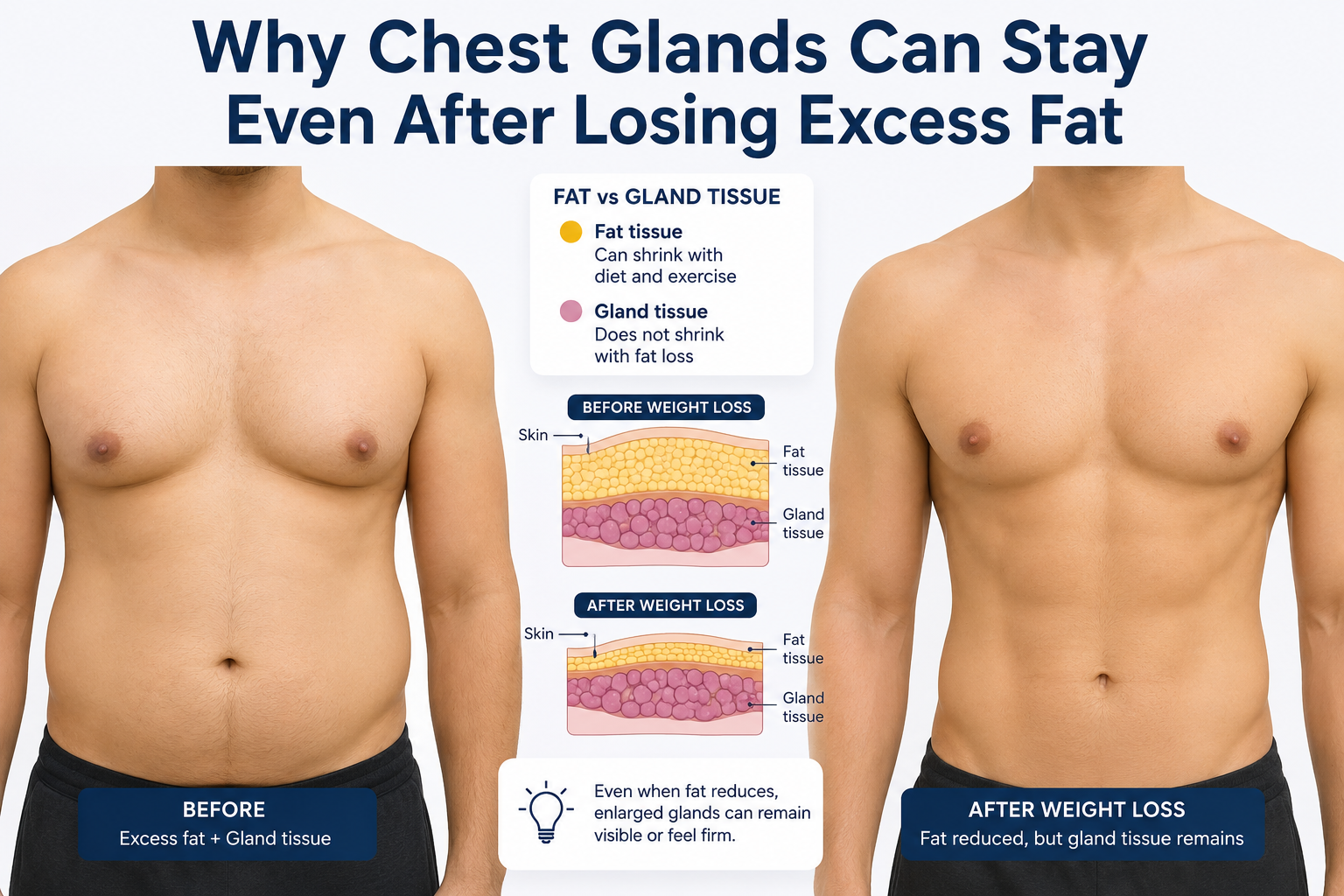
Chest fullness does not always disappear with weight loss. One reason is that what looks like “chest fat” may actually include glandular breast tissue. Unlike fat, glandular tissue does not respond to dieting or exercise in the same way.
Chest fullness does not always disappear with weight loss. One reason is that what looks like “chest fat” may actually include glandular breast tissue. Unlike fat, glandular tissue does not respond to dieting or exercise in the same way.
For people dealing with persistent chest fullness, understanding the difference between fat and glandular tissue can help determine whether Gland Excision Surgery in Surat may be appropriate.
Why Does Chest Gland Tissue Stay After Weight Loss?
Weight loss primarily reduces fat tissue. However, glandular tissue is structurally different.
This explains why someone may lose considerable weight and notice that their abdomen, face, or waist becomes slimmer while the chest still appears enlarged or puffy.
The remaining fullness may be related to:
- Glandular breast tissue
- Residual fat
- A combination of glandular tissue and fat
- Skin laxity after weight loss
- The underlying chest muscle and natural chest shape
So, losing more weight is not necessarily the answer when the main concern is glandular tissue.
Fat vs. Glandular Tissue: What Is the Difference?
Understanding the difference is important because the treatment approach can vary.
| Fat Tissue | Glandular Tissue |
|---|---|
| Soft and fatty in texture | Usually firmer or denser |
| Can decrease with overall weight loss | Does not necessarily disappear with weight loss |
| Influenced by body-fat percentage | May persist despite becoming leaner |
| Can sometimes be treated through fat-reduction techniques | May require direct gland excision |
| Often contributes to diffuse chest fullness | Can create a firmer or more prominent area beneath the nipple |
In many cases, both types of tissue are present. This is why a proper examination is more useful than trying to diagnose the tissue type based only on appearance.
Why Exercise May Not Remove Chest Glands
Exercise is valuable for improving overall fitness and developing the pectoral muscles. However, exercise does not selectively remove glandular breast tissue.
Chest exercises such as:
- Bench presses
- Push-ups
- Dumbbell presses
- Chest fly exercises
can improve muscle development beneath the chest.
But if persistent fullness is primarily caused by glandular tissue, building the muscle underneath it may not completely eliminate the appearance.
This is one reason some people feel frustrated after months of exercise despite becoming fitter and leaner.
What Is Gland Excision Surgery?
Gland excision surgery is a surgical technique used to remove unwanted glandular breast tissue from the chest.
The procedure may be considered when glandular tissue contributes significantly to chest enlargement or when persistent tissue remains despite lifestyle changes.
Depending on the individual anatomy, gland excision may be performed alone or combined with another technique when excess fatty tissue is also present.
The objective is not simply to remove tissue. A well-planned procedure aims to create a chest contour that looks balanced, proportional, and natural.
Who May Consider Gland Excision Surgery in Surat?
A consultation may be appropriate for someone who:
- Has persistent chest fullness despite weight loss
- Feels firm tissue beneath the nipple or areola
- Has concerns about a puffy or prominent chest appearance
- Has tried exercise and lifestyle changes without achieving the desired contour
- Has a combination of glandular and fatty chest tissue
- Wants to understand whether surgical correction could improve chest definition
However, not everyone with chest fullness requires surgery.
A surgeon should first determine the underlying cause and discuss whether observation, lifestyle measures, fat reduction, gland excision, or a combination approach is appropriate.
Why Accurate Assessment Matters
Chest appearance can be influenced by several factors, so treatment should be individualized.
During a consultation, the surgeon may assess:
- The amount of glandular tissue
- The amount of fatty tissue
- Skin elasticity
- Nipple and areola position
- Chest muscle development
- Overall body proportions
- The patient's desired chest contour
This assessment helps determine whether gland excision alone is suitable or whether another approach may provide a better result.
Does Gland Excision Remove All Chest Fullness?
Not necessarily.
If chest fullness is caused by both fat and glandular tissue, removing only the gland may leave some fullness.
Similarly, if loose skin contributes to the appearance, gland removal alone may not completely change the contour.
The goal is therefore to identify what is actually creating the fullness before selecting the procedure.
What Can Patients Expect From the Procedure?
The exact surgical plan varies from person to person.
Generally, gland excision involves accessing and removing the targeted glandular tissue while taking care to preserve an appropriate chest contour.
Depending on the patient's anatomy and treatment plan, the surgeon may discuss:
- Surgical technique
- Incision placement
- Whether additional fat reduction is required
- Expected contour changes
- Recovery period
- Possible risks and complications
- Post-operative care
- When normal activities can be resumed
A detailed consultation is important because surgical planning should be based on individual anatomy rather than a one-size-fits-all approach.
Recovery After Gland Excision
Recovery varies depending on the extent of surgery and whether additional procedures are performed.
Patients may experience temporary:
- Swelling
- Bruising
- Tenderness
- Tightness
- Changes in sensation
Following the surgeon's post-operative instructions can help support recovery.
Patients should also understand that the final chest contour may take time to become apparent as swelling gradually settles.
Choosing Gland Excision Surgery in Surat
If persistent chest fullness is affecting confidence, choosing an experienced surgical team is an important part of the process.
At Elegance Clinic, patients can undergo an individualized assessment to understand whether glandular tissue is contributing to their chest appearance. Dr. Ashutosh Shah can evaluate the chest contour and discuss appropriate treatment options based on the individual's anatomy and goals.
The emphasis should be on achieving a proportionate and natural-looking result rather than simply removing as much tissue as possible.
Conclusion
Losing weight but still having noticeable chest fullness does not necessarily mean that more dieting or exercise is required. Glandular tissue can remain even after excess fat has been reduced, which may explain why the chest continues to look enlarged or puffy.
For people considering Gland Excision Surgery in Surat, the first step is a professional assessment to determine whether the fullness is caused by glandular tissue, fat, skin laxity, or a combination of factors.
Considering Gland Excision Surgery in Surat?
If persistent chest fullness is affecting your confidence, schedule a consultation at Elegance Clinic to discuss your concerns and understand which treatment approach may be appropriate for your anatomy and goals.
Have a Private Question?
Every concern deserves an honest answer. Book a confidential consultation with Dr. Ashutosh Shah at Elegance Clinic, Surat, for guidance made just for you.

About the Author
Dr. Ashutosh Shah is a cosmetic gynecologist and plastic surgeon with over 22 years of experience. At Elegance Clinic in Surat, he is known for safe, honest and completely confidential intimate and aesthetic care.
What is Gland Excision Surgery in Surat?
Gland Excision Surgery in Surat is a surgical procedure that removes unwanted glandular breast tissue from the chest to help create a flatter and more proportionate chest contour.
Why does chest gland tissue remain after weight loss?
Glandular tissue is different from fat tissue, so losing body fat through diet and exercise may reduce surrounding fat while leaving the glandular tissue relatively unchanged.
Can chest exercises remove glandular tissue?
No. Chest exercises can strengthen the pectoral muscles and improve overall chest appearance, but they cannot directly remove glandular breast tissue.
Is chest fullness always caused by glandular tissue?
No. Chest fullness can result from fat, glandular tissue, loose skin, muscle structure, or a combination of these factors. A clinical examination can help identify the likely cause.
Is Gland Excision Surgery in Surat suitable for everyone with chest fullness?
No. Surgery is not automatically necessary for every case of chest fullness. An individualized assessment is needed to determine the underlying cause and whether gland excision is appropriate.