
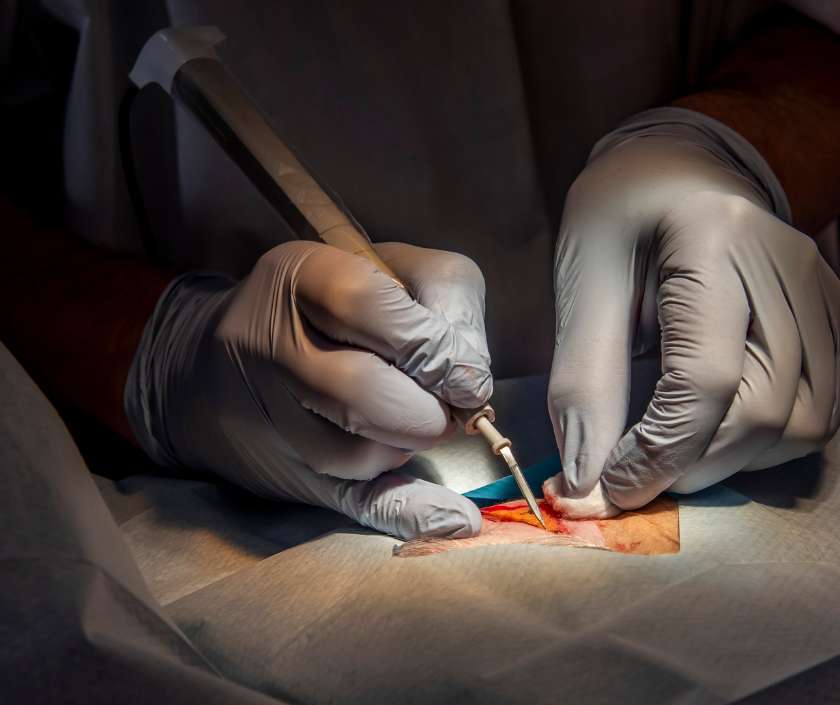
What is gland excision for a male chest?
Gland excision means cutting out the firm disc of breast tissue that sits behind the nipple, rather than suctioning fat around it. Gynecomastia Gland Excision is done through a short incision placed along the lower border of the areola, where the colour change helps hide the scar. Since glandular tissue is dense and fibrous, no amount of suction will clear it.
Importantly, this is the part of the operation that actually changes a peaked chest into a flat one. Fatty fullness responds to a cannula, whereas the disc has to be dissected free and lifted out. Both problems often sit together, so both are usually treated in the same sitting.
Why is the cause investigated before the gland is removed?
True gynecomastia is a diagnosis before it is an operation, and skipping the diagnosis invites trouble. Puberty itself accounts for a great many cases, producing a tender disc that often resolves without treatment in a year or two. Because several other causes are treatable, history, examination and selected tests come first.
- Anabolic steroids, some blood pressure medicines, certain antipsychotics and cannabis are all recognised triggers.
- Liver disease, thyroid disease and kidney disease alter hormone balance and must be identified.
- Testicular or adrenal tumours are rare, though they are looked for during assessment.
- A firm one sided lump in an older man requires assessment, since male breast cancer does occur.
Operating on a chest whose driver is still active tends to disappoint everyone. Instead, causes are excluded or treated and the condition is allowed to become stable, after which surgery is planned. Meanwhile, distinguishing true glandular gynecomastia from fatty pseudo gynecomastia decides the technique itself.
How do I know whether my chest is gland or fat?
Feel decides it, and examination by a doctor decides it reliably. Generally, glandular tissue forms a firm, sometimes tender, rubbery disc behind the areola and moves with the nipple. Fat, by contrast, feels soft and continues smoothly into the chest wall without a defined edge.
Additionally, ultrasound helps where the picture is unclear, particularly in heavier men. Very often both tissues coexist, with a disc of gland sitting in a fatty chest. Consequently the plan combines two techniques rather than choosing between them.
Which symptoms mean I should see a doctor before surgery?
Some findings call for medical assessment ahead of any cosmetic discussion, and none of them should be ignored. Seek an appointment promptly for any of these.
- A hard or fixed lump, or one that is clearly growing.
- Bloody discharge from a nipple, or discharge from one side alone.
- Recent retraction of a nipple, or a nipple newly turning inwards.
- Skin dimpling, puckering or an orange peel appearance over the chest.
- Ongoing pain confined to one side, or a rapid change in only one side.
Such signs can indicate breast cancer in men and are assessed with examination and imaging, often ultrasound with mammography. Cosmetic surgery never comes first in that situation. Only once a serious cause has been excluded does contouring enter the conversation.
Where is the incision placed and how visible is the scar?
The incision sits at the lower edge of the areola, curving along the natural boundary between darker and lighter skin. Length depends on the size of the disc, though it is kept as short as the work allows. Because the border already carries a colour transition, a well healed scar there tends to blend.
Scars nevertheless remain permanently in some form, and their quality varies between men. Thickened or raised scars occur more often in darker skin. Massage, silicone gel and sun protection all help, though nobody can promise an invisible line.
Why is liposuction usually combined with excision?
Suction is combined with excision because removing the disc alone leaves a step at its edge. Liposuction thins the fat around the area and feathers the transition outward into the chest wall, so the surface reads as one smooth plane. Excision then deals with the firm centre that suction could never take.
Working in this order also helps the surgeon judge how much gland is present. Fat is reduced first, after which the remaining firmness is easy to define through the small incision. Together the two steps generally give a better shape than either alone.
What is a crater or saucer deformity?
A crater or saucer deformity is a visible hollow beneath the nipple caused by taking too much tissue directly under the areola. Frequently it looks worse than the original problem, and it is difficult to repair. Correction may need fat grafting or local tissue rearrangement, with no certainty of a full recovery of shape.
Therefore prevention is the whole answer here. Leaving a deliberate cushion of tissue under the nipple, perhaps half a centimetre thick, keeps the areola supported. Judging that thickness with the patient sitting up, and comparing both sides during surgery, matters more than speed.
Why is the removed tissue sent for histology?
Excised tissue is sent to the laboratory because male breast cancer, though uncommon, is occasionally found in what looked like ordinary gynecomastia. Histology examination is an important safety step and should never be skipped to save cost. Ask your surgeon directly whether specimens are routinely sent.
Reports usually take several days and are discussed at follow up. Nearly always the result confirms benign glandular tissue. Occasionally it changes the plan entirely, and that is exactly why the test is done.
How is the operation performed?
Surgery is generally performed under general anaesthesia and takes between one and two hours for both sides. Markings are made with the man standing, since gravity changes everything about chest shape. Liposuction is carried out first through openings at the side, after which the areolar incision gives access to the glandular disc.
Dissection separates the disc from the skin above and the muscle below, and the specimen is removed whole and labelled for histology. Bleeding points are controlled carefully, because haematoma is the commonest early complication. A drain is sometimes placed, and a compression garment is applied before waking.
What is recovery like after gland removal?
Recovery is a little slower than after suction alone, though most men leave the same day or the next morning. Light work restarts within about a week and gym training at six weeks. Compression is worn continuously for the first month, then during the day for a further period on advice.
- Sutures at the areolar border are checked in the first week.
- Nipple numbness is frequent early on and generally improves over some months.
- Firmness under the areola is normal healing rather than returning gland.
- Final shape is judged at around six months, not at six weeks.
What are the risks?
Risks include haematoma, seroma, infection, poor scarring, nipple numbness, partial loss of nipple blood supply, asymmetry and the hollow deformity described above. No operation is risk free, and revision surgery is occasionally needed. Smoking raises several of these risks considerably.
Careful technique reduces but does not abolish them. Where skin is very loose, incidentally, a flat chest may still look draped afterwards, and our page on skin tightening explains why. Discussing this before surgery prevents an unwelcome surprise.
What does it cost in India?
Cost in India reflects the extent of the surgery, the anaesthesia, the hospital stay and whether histology and drains are needed. Fees are given in rupees and normally include theatre, the garment and routine follow up visits. Laboratory charges appear as a separate line.
Quoting a number before seeing the chest would be guesswork. Rather, you are given a clear written estimate after examination, and the reasoning behind each item is explained. Further context sits on the parent gynecomastia page.
Why choose Elegance Clinic in Surat?
Dr. Ashutosh Shah plans Gynecomastia Gland Excision around what examination shows rather than around a fixed package, and specimens go for histology as a matter of routine. Consultations are private, unhurried and free of sales pressure. Risks are described before benefits, which many men say they find reassuring.
Should this chest problem have bothered you for years, a quiet conversation in Surat is a reasonable place to begin. Appointment details are on our contact page. Bring your prescriptions and any scan reports with you.
Note: This page is for general information and is not a substitute for a medical consultation. Any new breast lump, nipple change or skin change should be assessed by a doctor before considering cosmetic treatment. Results vary between individuals and no outcome can be promised.
Ready to Talk, Privately?
Book a confidential consultation with Dr. Ashutosh Shah. There is no pressure, only clear and honest guidance.