What is skin tightening after gynecomastia surgery?
Skin tightening after gynecomastia surgery deals with the envelope left behind once gland and fat have gone. Gynecomastia Skin Tightening therefore describes a group of approaches ranging from doing nothing while the skin retracts naturally, through energy based devices, to actual removal of surplus skin. Which one applies depends on how much skin there is and how elastic it remains.
Younger skin with good recoil usually shrinks onto the new contour without help. Older skin, or skin stretched for many years, frequently will not. Recognising the difference before surgery allows the plan to include skin from the outset instead of treating it as an afterthought.
Why does the cause of gynecomastia still need investigating?
Even when skin is the visible worry, true gynecomastia remains a diagnosis before it is an operation. Puberty explains many cases in younger men and often settles by itself over a year or two. Consequently the underlying driver is looked for before any surgical plan is finalised.
- Medicines and substances such as anabolic steroids, some blood pressure medicines, some antipsychotics and cannabis.
- Liver disease, thyroid disease and kidney disease, all of which affect hormone handling.
- Testicular or adrenal tumours, which are rare yet must be considered.
- A firm one sided lump in an older man, which needs assessment because male breast cancer exists.
Surgery follows once these causes are excluded or treated and the chest has been stable for some months. Separating true glandular gynecomastia from fatty pseudo gynecomastia also matters here, since the two produce different amounts of skin excess. Above all, an operation planned around an untreated cause rarely satisfies anyone.
Why does chest skin sometimes fail to shrink back?
Skin fails to shrink when its elastic fibres have been stretched beyond recovery, which happens with large volume removal, long standing heavy chests, ageing and major weight loss. Think of it as a garment that has lost its shape. Once elastin is damaged, no cream, device or exercise restores it.
Massive weight loss produces the most extreme version, where skin hangs in folds and the nipple sits low on the chest. Smaller degrees follow removal of a large volume in a single sitting. Meanwhile smoking, sun damage and rapid fluctuations in weight all reduce recoil further.
Which chest or nipple changes need checking first?
Loose skin is a cosmetic matter, yet certain findings are not, and those need medical assessment before anything else. Arrange to be seen quickly where you notice any of the following.
- A lump that is new, growing, hard or fixed to the tissues around it.
- Nipple discharge, especially when bloody or from a single side.
- Recent inward turning or retraction of a nipple.
- Puckering, dimpling or orange peel texture in the chest skin.
- One sided pain that persists, or one side changing much faster than the other.
Findings of this kind can point to breast cancer in men and are investigated with examination and imaging. Cosmetic surgery is never the first move. After a serious cause has been ruled out, skin and contour can be planned properly.
How do I know whether my skin will retract on its own?
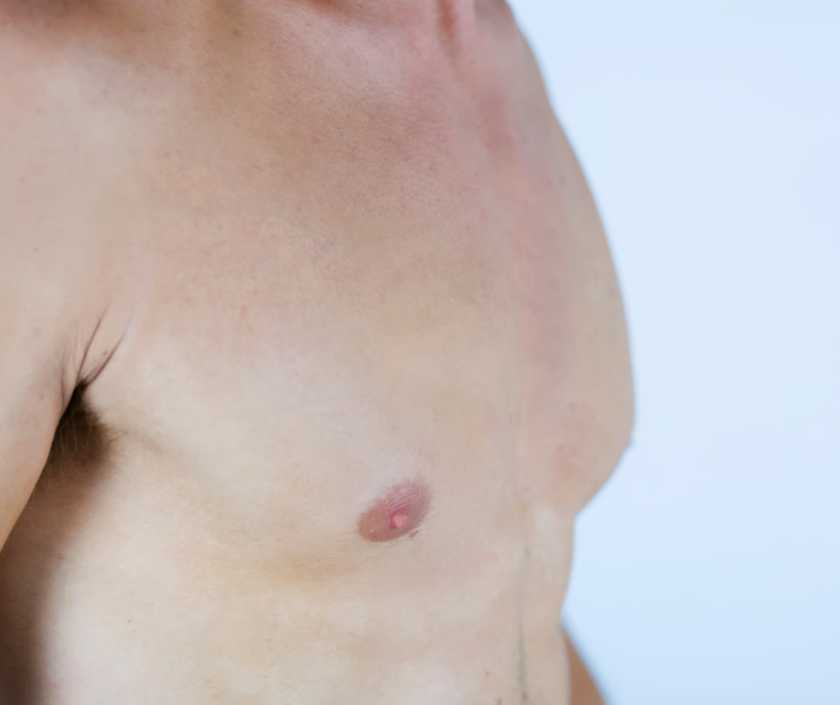
A simple pinch test at consultation gives most of the answer, alongside your age, the duration of the problem and your skin quality. Skin that snaps back briskly usually retracts well after suction. By contrast, skin that stays tented or shows fine crepe like wrinkling generally will not.
Stretch marks are another clue, since they indicate elastic fibres that have already torn. Nipple position matters too, because a nipple sitting below the fold suggests true descent rather than simple bulk. Therefore these features are recorded before surgery, not discovered afterwards.
Do energy based devices tighten loose chest skin?
Energy based devices have a limited effect on genuinely loose skin, and they cannot substitute for excision. Radiofrequency, ultrasound and laser platforms heat the deeper layers to encourage some collagen remodelling, which may modestly improve mild laxity. Where skin hangs, however, the improvement is small and easily overstated in marketing.
- These devices are not specifically approved for tightening chest skin after gynecomastia surgery, and evidence in men is limited.
- Several sessions are usually required, results vary considerably and some men notice little change.
- Costs accumulate across a course, which is money not spent on the treatment that would actually work.
- Risks include burns, blistering and pigment change, particularly in darker skin.
Being honest about this saves disappointment. Devices sit best as a small adjunct for borderline laxity in a man who accepts modest gains. By contrast, for real skin excess they are the wrong tool.
When is skin excision the only real answer?
Skin excision becomes the only real answer once the surplus is too great for retraction and too great for any device, which is common after massive weight loss and after very large gynecomastia. Gynecomastia Skin Tightening at this stage means removing skin rather than heating it. The trade is straightforward, since you exchange loose skin for scars, and that exchange has to feel worthwhile to you.
| Situation | Sensible approach | Scar expected |
|---|---|---|
| Mild laxity, young elastic skin | Suction alone, allow retraction | Tiny access openings |
| Moderate laxity, some crepe | Suction, consider a small periareolar tightening | Circle around the areola |
| Marked excess after weight loss | Formal skin excision, sometimes staged | Longer chest scars |
What scars come with skin excision?
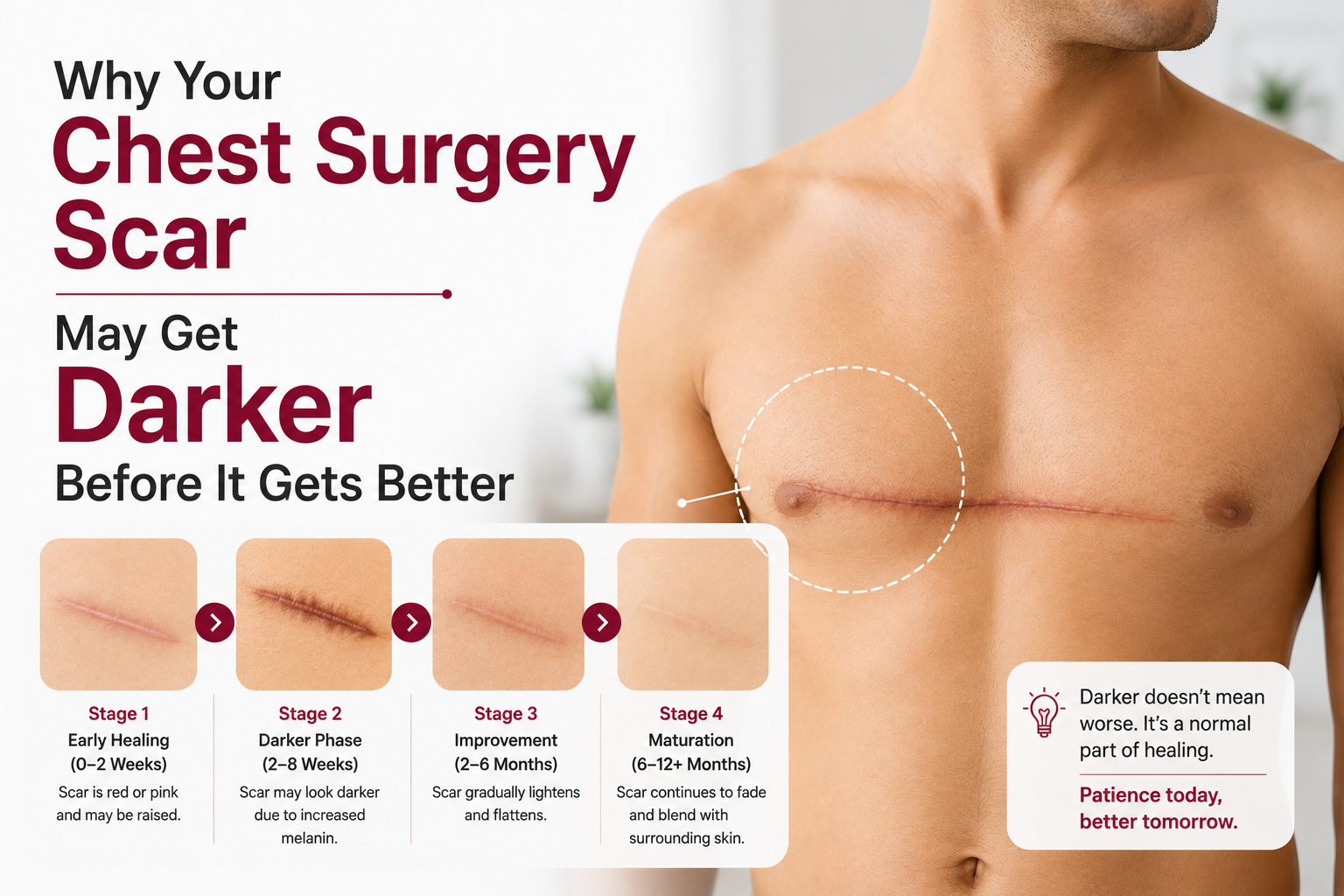
Scars vary with how much skin is removed and where it is taken from. A circular scar around the areola suits moderate excess and can pucker slightly at first before settling. Larger excisions leave horizontal scars along the chest, occasionally with the nipple repositioned as a graft in extreme cases.
Nobody enjoys these scars, though many men find them easier to live with than a draped chest. Quality improves over twelve to eighteen months with silicone, massage and sun protection. Even so, thickened scars occur, especially in darker skin, and no result can be promised.
How is the operation planned and staged?
Planning starts with markings taken while you stand, because gravity governs where skin actually sits. Gland and fat are usually addressed first, and in some men the chest is then left to settle for several months before any skin is removed. Staging in this way avoids taking more skin than necessary.
Weight should be stable for at least six months, particularly after bariatric surgery. Nutrition, protein intake and vitamin levels are checked, since healing depends on them.
What is recovery like?
Recovery after skin excision is longer than after suction, with roughly two weeks off work and about eight weeks before heavy training. Drains are sometimes used for the first days. Compression garments are worn continuously at first, then during the day, on the schedule you are given.
- Wound checks in the first and second weeks, with early attention to any separation.
- Scar care starting once the wounds are fully closed.
- Shoulder and arm movement limited briefly, then increased steadily.
- Final shape assessed at six to twelve months.
What are the risks?
Risks include wound separation, delayed healing, seroma, haematoma, infection, widened or thickened scars, altered nipple sensation, dog ears at the scar ends and asymmetry. No procedure here is risk free, and revision for scar or contour is not unusual. Smokers face substantially higher rates of wound problems.
Weight regain undoes much of the benefit. Similarly, poor nutrition after bariatric surgery impairs healing and should be corrected first. Where the gland was never properly removed, tightening the skin over it simply makes the disc more obvious, which is discussed on our gland excision page.
What does it cost in India?
Cost in India depends on whether skin is removed at all, how extensive the excision is, anaesthesia, hospital stay and any device sessions chosen. Fees are quoted in rupees and generally include theatre, garments and routine review. Device courses are priced per session and listed separately.
Estimating over a phone call helps nobody. Instead a clear written estimate after examination sets out the options side by side, including the ones we would advise against. Broader context on the condition sits on our gynecomastia page.
Why choose Elegance Clinic in Surat?
Dr. Ashutosh Shah will tell you plainly whether your skin is likely to retract, and will decline to sell you device sessions that cannot deliver what you want. Discussion covers scars honestly, with photographs of realistic outcomes rather than flattering ones. Privacy is respected throughout, and your details are handled discreetly.
Should loose chest skin be affecting how you dress or swim, a private consultation in Surat is worth arranging. Bring details of any weight loss surgery and your current weight history. There is no obligation to book anything on the day.
Note: This page is for general information and is not a substitute for a medical consultation. Any new breast lump, nipple change or skin change should be assessed by a doctor before considering cosmetic treatment. Results vary between individuals and no outcome can be promised.
Ready to Talk, Privately?
Book a confidential consultation with Dr. Ashutosh Shah. There is no pressure, only clear and honest guidance.