
Why Your Chest Surgery Scar May Get Darker Before It Gets Better
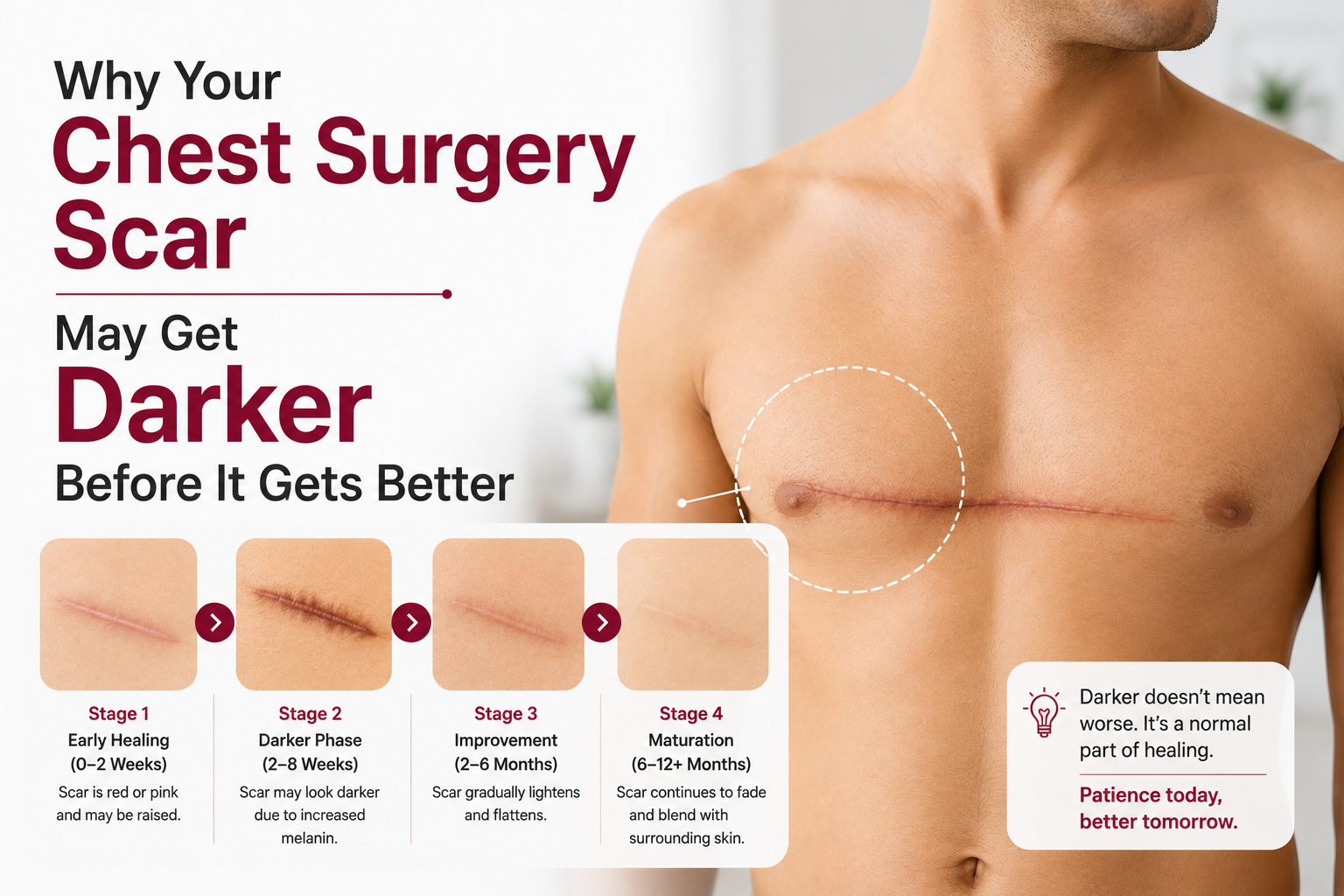
A chest surgery scar can sometimes look darker, redder, firmer, or more noticeable before it gradually improves. This can be concerning, especially when you expected the scar to become lighter immediately after the incision healed.
A chest surgery scar can sometimes look darker, redder, firmer, or more noticeable before it gradually improves. This can be concerning, especially when you expected the scar to become lighter immediately after the incision healed.
However, scar healing is a gradual biological process, and changes in colour and texture can continue for months. In some people, the scar may temporarily become more prominent before it begins to flatten and fade.
For people considering Chest Surgery Scar Treatment in Surat, understanding why these changes happen is an important first step in deciding whether a scar simply needs more healing time or would benefit from professional treatment.
Why Does a Chest Surgery Scar Get Darker After Surgery?
One of the least-known parts of scar healing is that a scar can become more noticeable before it becomes less noticeable.
After surgery, the body sends inflammatory cells and other healing components to the area. New collagen is produced to strengthen the tissue, while small blood vessels can make the scar appear pink or red.
As healing progresses, the scar may become:
- Red or pink
- Brown or darker than surrounding skin
- Firm or slightly raised
- Itchy or sensitive
- More noticeable than the original incision
This does not automatically mean that something has gone wrong.
The final appearance of a scar depends on factors such as skin type, genetics, wound healing, surgical technique, tension on the incision and how the scar is cared for during recovery.
A Scar Can Look “Worse” Before It Looks Better
Many people expect a surgical scar to follow a simple pattern:
Incision → healing → fading
In reality, scar maturation is more complicated.
A scar can pass through several stages. It may initially appear relatively subtle, then become more red, darker or firmer as collagen is reorganised. With time, the scar can gradually soften and become less noticeable.
This is why judging the final result too early can sometimes lead to unnecessary worry.
However, persistent or progressive changes should not simply be ignored. A clinician can determine whether the scar is undergoing normal maturation or whether a specific scar problem is developing.
Why Can Chest Surgery Scars Become Darker?
1. Post-inflammatory pigmentation
Inflammation can stimulate increased melanin production, particularly in people who are prone to pigmentation.
This can make a scar appear brown or darker than the surrounding skin.
2. Sun exposure
UV exposure can make healing scars more pigmented and noticeable.
Protecting a healing scar from direct sunlight is therefore important. Your clinician can advise when sunscreen can safely be introduced based on the stage of wound healing.
3. Individual skin characteristics
People do not all form scars in the same way.
Some individuals naturally develop darker pigmentation after skin injury, while others may be more prone to red or raised scars.
4. Tension across the incision
Stretching or tension across a healing incision can influence scar widening and appearance.
Chest surgery scars may be particularly noticeable because the area moves with the shoulders, arms and chest.
5. Scar maturation
A scar that is still actively remodeling can appear darker, redder or firmer than its eventual appearance.
When Is a Dark Chest Surgery Scar Normal?
A changing scar is often part of normal healing when it is:
- Gradually becoming softer
- Slowly changing colour
- Not increasingly painful
- Not producing pus or unusual discharge
- Not associated with significant swelling
- Not rapidly expanding beyond the original incision
Scar maturation can take considerable time, and the final appearance may not be apparent immediately.
That said, every person's healing timeline is different. A persistent concern is best assessed individually rather than judged solely by photographs or general timelines.
When Should You Consider Chest Surgery Scar Treatment?
Professional assessment may be useful when a scar remains:
- Significantly darker than surrounding skin
- Raised or thick
- Hard or firm
- Itchy or uncomfortable
- Wider than expected
- Uneven in texture
- Depressed or tethered
- Increasingly noticeable rather than gradually improving
The goal of Chest Surgery Scar Treatment in Surat is not necessarily to make a scar completely disappear. Instead, treatment may aim to make the scar less noticeable, softer, flatter, smoother, or closer in colour to the surrounding skin, depending on the individual's concern.
What Treatment Options May Help Chest Surgery Scars?
There is no single scar treatment that works for every person.
The appropriate approach depends on the type and maturity of the scar.
Silicone-Based Scar Management
Silicone sheets or silicone-based products may be recommended for certain healed surgical scars.
They can help support scar management, particularly when the scar is becoming raised or thick.
Use should follow professional advice, especially when the incision is not completely healed.
Scar Massage
Once the wound has appropriately healed, some patients may be advised to perform scar massage.
The objective may include improving scar flexibility and reducing stiffness or tightness.
Massage should not be started over an open, infected or incompletely healed wound unless specifically instructed by a healthcare professional.
Laser-Based Treatments
Certain laser technologies may be considered for scars with concerns such as redness, pigmentation or texture.
The appropriate laser depends on the scar characteristics and the individual's skin type.
Injections for Raised Scars
Some raised or hypertrophic scars may respond to injectable treatments prescribed by a qualified clinician.
These treatments are not appropriate for every scar and require careful assessment.
Scar Revision
When a scar is significantly widened, irregular or otherwise problematic, surgical scar revision may sometimes be considered.
Scar revision does not erase the scar. Instead, it aims to create a more favourable scar under appropriate circumstances.
Does a Dark Scar Mean the Surgery Was Done Incorrectly?
Not necessarily.
Scar colour and texture are influenced by many factors beyond surgical technique, including genetics, pigmentation tendency, wound tension, healing response and aftercare.
Therefore, a dark or prominent scar does not automatically indicate poor surgery.
A professional examination is more useful than judging the surgical result solely by scar colour.
Can You Prevent Chest Surgery Scars Completely?
No surgical scar can be guaranteed to disappear completely.
Whenever the skin is surgically cut, the body creates scar tissue as part of the healing process.
However, appropriate surgical planning, careful wound care, protection from excessive sun exposure and suitable scar-management strategies may help optimise the eventual appearance.
The earlier a concerning scar is identified, the easier it may be to discuss appropriate management options.
What Makes Chest Surgery Scar Treatment Different for Every Person?
Scar treatment should be personalised because two people can undergo similar procedures and develop very different scars.
A clinician may consider:
- Skin type
- Scar colour
- Scar thickness
- Scar age
- Scar location
- Previous history of prominent scars
- Wound-healing history
- Pigmentation tendency
- Symptoms such as itching or pain
- Whether the scar is flat, raised, widened or depressed
This assessment helps determine whether observation, topical scar care, procedures or scar revision may be appropriate.
At Elegance Clinic, Dr. Ashutosh Shah can assess the characteristics of an individual's scar and discuss suitable options based on the patient's concerns, healing stage and treatment goals.
How Long Does It Take for a Chest Surgery Scar to Mature?
Scar maturation is a long-term process rather than a quick change.
A scar may gradually become softer, flatter and less noticeable over time. The exact timeline varies considerably between individuals.
Therefore, a scar that appears prominent during the early healing period should not necessarily be considered the final result.
If the scar is becoming progressively thicker, darker, painful or increasingly symptomatic, however, professional evaluation is advisable.
What Should You Avoid While a Chest Surgery Scar Is Healing?
To support healthy scar management, avoid making assumptions that aggressive treatment will produce faster results.
Depending on your stage of healing, your clinician may advise you to avoid:
- Picking or scratching the scar
- Applying unapproved irritating products
- Excessive sun exposure
- Starting scar massage too early
- Using strong exfoliating products over healing skin
- Applying products to an open or infected wound
- Performing procedures without professional assessment
Your post-operative instructions should always take priority over general online advice.
Chest Surgery Scar Treatment in Surat: Why Professional Assessment Matters
Searching for Chest Surgery Scar Treatment in Surat is only the first step. The important question is what type of scar you have and what is causing it to remain noticeable.
A treatment that may be useful for a raised scar may not be the right choice for pigmentation. Similarly, a procedure designed for redness may not address a widened or tethered scar.
A personalised evaluation helps match the treatment to the actual scar characteristics rather than treating every scar in the same way.
Conclusion
A chest surgery scar becoming darker, redder or firmer before gradually improving can be part of the normal scar-maturation process. However, scars that remain significantly raised, thick, symptomatic, widened or unusually pigmented may benefit from professional evaluation.
If you are looking for Chest Surgery Scar Treatment in Surat, the right approach depends on the scar's age, colour, texture, thickness and your individual healing response. Treatment may range from conservative scar care to procedures such as laser treatment, injections or scar revision when clinically appropriate.
Looking for Chest Surgery Scar Treatment in Surat?
If you are concerned about the appearance of a scar after chest or gender-affirming surgery, consider a professional assessment rather than relying on home remedies or comparing your healing with someone else's.
Contact Elegance Clinic in Surat to discuss your chest surgery scar concerns and learn which scar-management options may be suitable for you.
Have a Private Question?
Every concern deserves an honest answer. Book a confidential consultation with Dr. Ashutosh Shah at Elegance Clinic, Surat, for guidance made just for you.

About the Author
Dr. Ashutosh Shah is a cosmetic gynecologist and plastic surgeon with over 22 years of experience. At Elegance Clinic in Surat, he is known for safe, honest and completely confidential intimate and aesthetic care.
Why does my chest surgery scar look darker after surgery?
A chest surgery scar may look darker because of inflammation, pigmentation, sun exposure or normal scar maturation. It does not necessarily mean there is a complication.
Can chest surgery scars be treated?
Yes. Depending on the scar, treatment may include silicone-based scar care, massage after appropriate healing, laser-based procedures, injections or scar revision.
Can chest surgery scars completely disappear?
No. Surgical scars generally cannot be completely erased, but appropriate treatment may make them significantly less noticeable.
Can silicone help chest surgery scars?
Silicone-based scar products may help manage certain healed surgical scars, particularly scars that are raised or thick. They should be used according to professional guidance.
Can a chest surgery scar be revised?
Yes. Surgical scar revision may be considered for selected scars that are significantly widened, irregular or otherwise problematic. Revision creates a new scar rather than completely removing scarring.
How long does a chest surgery scar take to mature?
Scar maturation varies from person to person and can continue for many months. Early scar appearance should not always be considered the final result.