
Mons Bulge After a C-Section: Why the Scar Creates an Overhang and How It Is Corrected
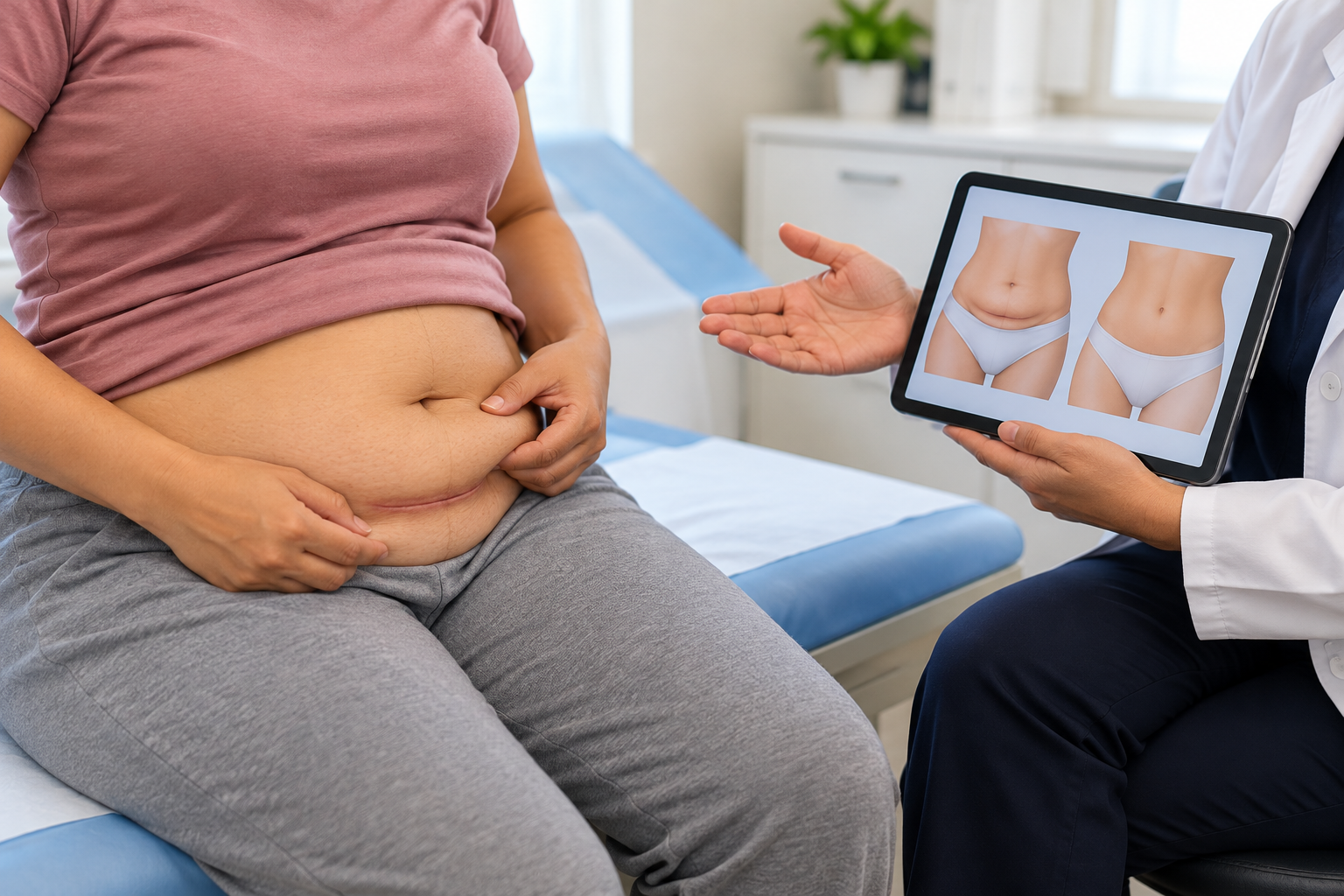
A bulge after a C-section forms when the scar tethers skin to deeper tissue, so fat and loose skin fold over it, while the mons below can look fuller. Correction waits until about six to twelve months after delivery and after breastfeeding. Options range from liposuction with scar release to monsplasty or a mini tummy tuck.
<style type="text/css"> </style> A bulge after a C-section forms when the scar tethers skin to deeper tissue, so fat and loose skin fold over it, while the mons below can look fuller. Correction waits until about six to twelve months after delivery and after breastfeeding. Options range from liposuction with scar release to monsplasty or a mini tummy tuck.
Many women notice changes in their lower abdomen after a caesarean delivery. Even after pregnancy weight decreases, a small bulge may remain around the surgical scar.
Some describe it as a shelf, pouch or overhang. Others notice that the mons pubis after c section looks swollen or more prominent than before pregnancy.
These changes can occur because of scar tissue, fat distribution, skin laxity or abdominal muscle separation.
Understanding the cause is important because exercise, liposuction and surgery address different problems.
Why Does a Bulge Form Around a C-Section Scar?
A C-section incision passes through several layers of tissue.
As the area heals, scar tissue forms between the skin and deeper structures.
Sometimes the scar becomes attached to the underlying tissue, creating a visible indentation.
When skin or fat above that indentation remains prominent, an overhang develops.
1. Scar Tethering
Scar tethering occurs when healing tissue pulls the skin inward.
This can create a shelf-like appearance above the incision.
The overhang may become more noticeable when standing or sitting.
Scar release or revision may improve the contour in selected patients.
2. Fat Accumulation
Pregnancy can change fat distribution around the lower abdomen and pubic mound.
Some women notice fat mons pubis after c section even when their overall weight has returned close to its previous level.
Localised fat may respond to liposuction if skin elasticity is adequate.
However, liposuction does not reliably correct significant loose skin or deep scar tethering by itself.
3. Loose Abdominal Skin
Pregnancy stretches abdominal skin.
After delivery, some skin gradually contracts, but significant excess may remain.
If the overhang consists mainly of loose skin, fat removal alone may not produce a satisfactory result.
4. Postoperative Swelling
A swollen mons pubis after c section can occur during early healing.
Fluid retention and postoperative inflammation may contribute to temporary fullness.
Swelling generally improves over time, although the pattern varies.
Sudden, painful, red or progressively increasing swelling requires medical assessment.
5. Abdominal Muscle Separation
Diastasis recti occurs when the abdominal muscles separate along the midline during pregnancy.
It can contribute to abdominal protrusion but is not the same as a mons bulge.
A clinical examination helps determine whether muscle separation, scar tethering or skin excess is responsible for the contour.
How Long Should You Wait After Delivery Before Correction?
The body continues changing for months after childbirth.
Skin contraction, swelling reduction, weight changes and scar maturation can alter the appearance of the lower abdomen.
For elective contour surgery, many surgeons prefer to assess the result after approximately six to twelve months, once recovery and weight have stabilised.
This is a general planning range, not a universal rule.
Why Is Early Surgery Usually Avoided?
During the early postpartum period:
-
Swelling may still be resolving.
-
The C-section scar is maturing.
-
Body weight and fat distribution may change.
-
Breastfeeding and childcare can affect recovery planning.
-
Additional surgery may introduce unnecessary risks.
The timing of post pregnancy monsplasty should therefore be individualised.
Does Breastfeeding Affect Surgical Timing?
Breastfeeding does not automatically prohibit every operation.
However, elective body-contouring procedures are often deferred until the patient's health, weight and recovery circumstances are stable.
Anaesthesia, medication safety, hydration, infant care and lifting restrictions should be discussed individually.
Should You Wait Until After Your Final Pregnancy?
If another pregnancy is planned soon, postponing elective contour correction may help preserve the result.
Future pregnancy can stretch skin and change fat distribution again.
When Does Liposuction With Scar Release Work?
Liposuction is most useful when the bulge contains localised fat and the skin has reasonable elasticity.
Scar release may be considered when a tethered incision creates a deep crease.
These treatments address different components of the contour.
Liposuction for Mons Fullness
Liposuction removes selected deposits of subcutaneous fat through small incisions.
It may improve a prominent mons when the main problem is excess fat.
However, it does not tighten severely stretched skin or repair abdominal muscle separation.
Scar Release
Scar release involves freeing restrictive scar attachments when clinically appropriate.
The surgeon may combine it with scar revision or another contouring procedure.
The exact technique depends on the scar's position, depth and surrounding tissues.
Patients can read more about C-section scar correction and how different scar problems are evaluated.
Can Liposuction and Scar Release Be Combined?
In selected patients, combining techniques may address both fat fullness and a tethered scar.
However, the surgeon must consider blood supply, wound healing and the risk of contour irregularities.
Combining procedures is not automatically necessary or appropriate.
When Is Monsplasty or a Mini Tummy Tuck Needed?
Post pregnancy monsplasty may be considered when the mons has persistent excess skin, fat or sagging that cannot be adequately addressed by observation or liposuction alone.
The operation aims to improve the contour of the pubic mound.
Monsplasty
Monsplasty may involve removing excess skin, adjusting underlying tissue and, when appropriate, reducing fat.
The procedure can help lift a sagging mons.
Depending on the anatomy, it may be performed alone or alongside abdominal contour surgery.
For details about surgical options, visit Monsplasty.
Mini Tummy Tuck
A mini abdominoplasty addresses selected lower abdominal skin excess.
It may help when the overhang is primarily above the pubic area.
However, a mini tummy tuck does not automatically correct every mons contour problem.
Full Abdominoplasty
A full tummy tuck may be considered when significant abdominal skin laxity or muscle separation accompanies the lower abdominal overhang.
It involves a more extensive operation and a longer scar than smaller procedures.
Which Procedure Is Best?
The decision depends on whether the main finding is:
-
Localised fat
-
Scar tethering
-
Excess mons skin
-
Lower abdominal skin laxity
-
Muscle separation
-
A combination of these changes
A physical examination is necessary to identify the appropriate approach.
Timing and Correction Options After a C-Section
| Time Since Delivery | Breastfeeding Status | Main Finding | Possible Treatment | Scar Outcome |
|---|---|---|---|---|
| First weeks to months | Any | Healing-related swelling | Observation and assessment if symptoms are concerning | Existing C-section scar |
| After postpartum recovery | Individual assessment | Localised fat with firm skin | Liposuction if suitable | Small access scars |
| After scar maturation | Individual assessment | Tethered C-section scar | Scar release or revision | Existing scar may be revised |
| After weight stabilisation | Individual assessment | Loose or sagging mons skin | Monsplasty | Low scar depending on technique |
| After weight stabilisation | Individual assessment | Lower abdominal skin excess | Mini tummy tuck in selected patients | Longer lower abdominal scar |
| After weight stabilisation | Individual assessment | Significant skin excess and muscle separation | Full abdominoplasty if appropriate | More extensive abdominal scar |
Important: This table provides general guidance. The treating surgeon determines whether surgery is appropriate and when it can be performed safely.
Can Exercise Flatten a C-Section Overhang?
Exercise can improve overall fitness, muscle strength and body composition.
However, it cannot remove excess skin or release a deeply tethered surgical scar.
When Exercise May Help
Gradual postpartum rehabilitation may improve:
-
Core strength
-
Posture
-
General muscle conditioning
-
Overall body composition
-
Functional recovery
Pelvic floor and abdominal rehabilitation may also be helpful after pregnancy.
When Exercise May Not Be Enough
If the visible shelf is caused mainly by scar attachment or loose skin, exercise alone may not correct it.
Similarly, targeted abdominal exercises cannot selectively remove fat from the mons.
The goal should be functional recovery and overall health rather than attempting to force a particular body shape.
Mons Lift After C Section Vadodara: When Should You Consider Treatment?
Women researching post pregnancy monsplasty may benefit from a consultation when the lower abdominal or mons bulge remains persistent after postpartum recovery.
At Elegance Intimate Wellness, Dr. Ashutosh Shah, MBBS, MS, MCh, DNB, Plastic and Reconstructive Surgeon, can assess whether scar tethering, fat deposits or excess skin contribute to the concern and discuss appropriate surgical or non-surgical options.
A consultation should include medical history, previous C-section details, examination of the scar, future pregnancy plans and realistic expectations.
Treatment is elective when the concern is purely cosmetic.
Patients considering broader recovery and body-contour options can also explore the Postpartum restoration programme.
Does Another Pregnancy Undo the Correction?
Another pregnancy does not necessarily reverse every surgical improvement.
However, pregnancy can stretch abdominal skin and change fat distribution.
This may alter the result of monsplasty or tummy tuck surgery.
What Happens to the Scar?
Existing scars may stretch or change with pregnancy.
The degree of change varies between individuals.
Can You Have Another C-Section?
A previous cosmetic contour procedure does not automatically prevent a future C-section.
However, the obstetrician should know about all previous abdominal operations.
Should Surgery Be Delayed?
Patients planning another pregnancy in the near future may prefer to delay elective correction.
Read more about Pregnancy after intimate surgery.
What Are the Risks of Monsplasty and Scar Correction?
Every surgical procedure has potential complications.
Possible risks include:
-
Bleeding
-
Infection
-
Fluid collection
-
Delayed wound healing
-
Changes in sensation
-
Scarring
-
Asymmetry
-
Contour irregularities
-
Persistent swelling
-
Need for further correction
The likelihood of complications depends on the procedure, medical history and individual healing.
Smoking, poorly controlled diabetes and certain medications may increase surgical risk.
Patients should discuss these factors before deciding on treatment.
Have a Private Question?
Every concern deserves an honest answer. Book a confidential consultation with Dr. Ashutosh Shah at Elegance Clinic, Surat, for guidance made just for you.

About the Author
Dr. Ashutosh Shah is a cosmetic gynecologist and plastic surgeon with over 22 years of experience. At Elegance Clinic in Surat, he is known for safe, honest and completely confidential intimate and aesthetic care.
Is Swelling of the Mons Normal Soon After a C-Section?
Some swelling is common during early recovery. However, rapidly increasing swelling, severe pain, redness, fever or unusual discharge requires medical assessment. Persistent fullness may have a different cause from temporary postoperative swelling.
Can Exercise Flatten the Overhang?
Exercise can improve strength and overall body composition, but it cannot reliably remove loose skin or release a tethered C-section scar. Treatment depends on the cause of the overhang.
Will the New Scar Be in the Same Place as the C-Section Scar?
Sometimes the existing incision can be revised or incorporated into the surgical plan. However, a monsplasty or tummy tuck may require a longer or differently positioned scar.
Can I Plan Correction During a Second C-Section?
Cosmetic contour correction is not routinely recommended during a C-section. Pregnancy-related swelling, altered tissues and additional surgical risks may affect the result. Any combined procedure would require careful assessment by the obstetric and surgical teams.
Is Numbness Above the Scar Normal?
Temporary numbness around a C-section incision is common because small sensory nerves may be affected during surgery. Sensation may improve gradually, although some changes can persist. New or worsening symptoms should be evaluated.
Is Correction Covered by Insurance?
Purely cosmetic procedures are generally excluded from many insurance policies. Coverage may differ when there is a documented medical indication. Patients considering mons lift after c section vadodara should request a clinical assessment and confirm coverage directly with their insurer.