
What is Revision Top Surgery and Scar Revision?
Revision Top Surgery and Scar Revision covers the second stage work that refines a chest once the first operation has healed. Some of it deals with shape, such as leftover tissue or an uneven contour, whereas the rest deals with scars that healed thicker or wider than anyone wanted. Both kinds are ordinary parts of the pathway rather than emergencies. Practical questions belong on this page, while identity, counselling and the rest of the transition journey sit on our dedicated transgender health site.
Is needing revision a failure?
No, revision is common, and it is not a failure by you or by your surgeon. Chests heal unpredictably, therefore even careful surgery sometimes leaves something worth adjusting later. Many surgeons plan the first operation knowing a small touch up may follow, because chasing perfection in a single sitting risks taking too much away. Judging your own result at three months is unfair to yourself, since swelling and firmness are still settling then.
What problems does revision address?
Revision addresses four broad areas, namely residual tissue, contour, the nipple and areola, and scar quality. In short, below is the honest list of what men come back about.
- breast tissue left behind, often near the armpit or beneath the nipple
- a dished or hollow area where slightly too much was removed
- lumpiness or unevenness from healing and internal scarring
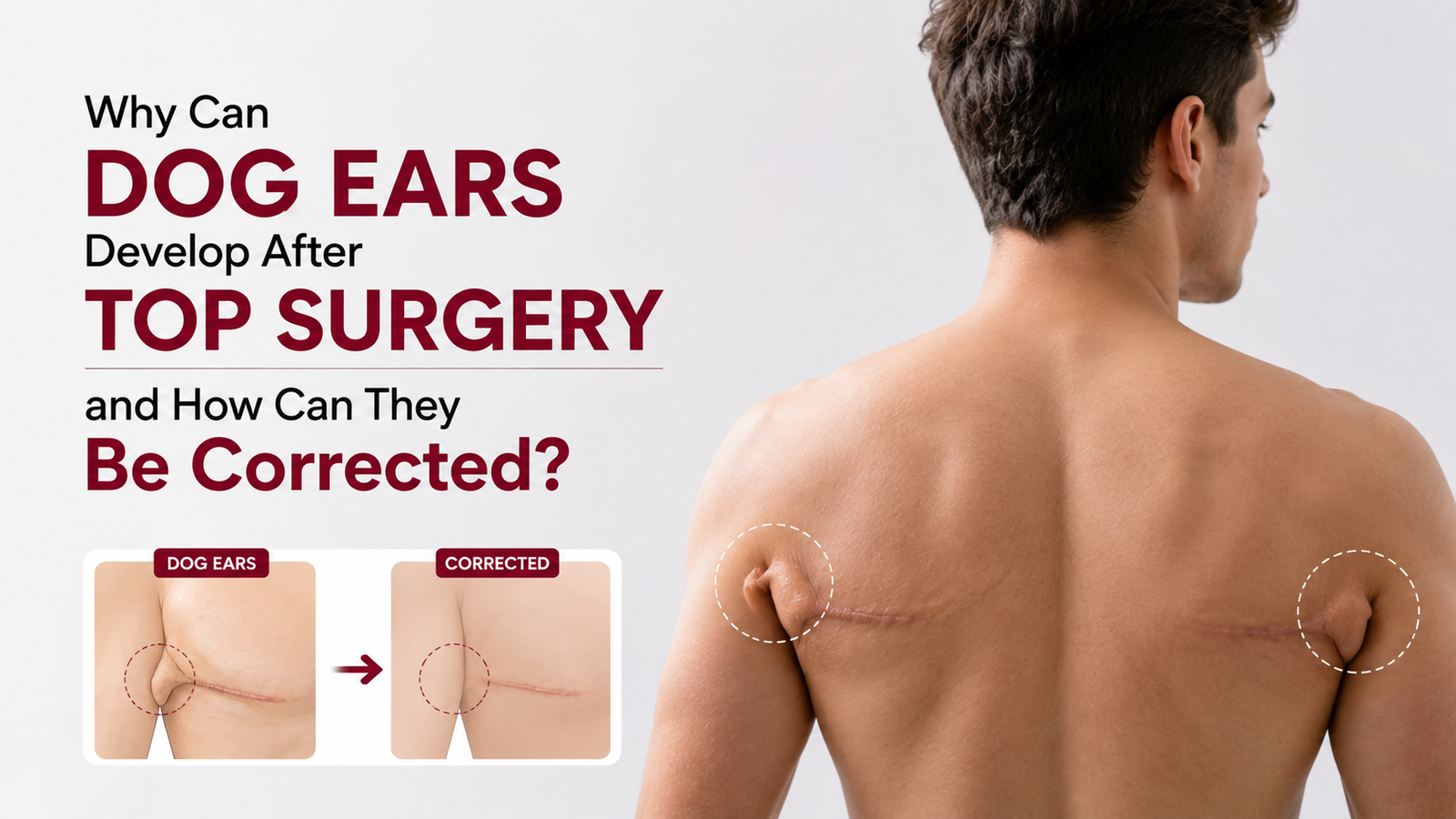
- fullness or a pucker at the end of a chest scar
- a nipple sitting too high, too low or too close to the midline
- an areola that healed wider than planned, or graft pigment that faded
- scars that are thick, raised, wide, dark or persistently itchy
- asymmetry between the two sides in any of the above
Puckers at the scar ends have their own page on dog ear correction.
How are residual tissue and contour corrected?
Leftover tissue is taken out through the existing scar wherever possible, so no new line appears on the chest. Liposuction handles fatty fullness neatly, while firm gland usually has to be cut out directly. Hollows are the harder problem, therefore fat grafting is sometimes used to fill a dished area with your own fat. Some transferred fat is reabsorbed over the following months, so more than one session is occasionally needed.
Can nipple position or size be changed later?
Position and size can both be adjusted, once the chest has settled properly. Areolae that healed wide are reduced with a circular excision, and the resulting scar hides at the colour border. Moving a nipple upward or outward means either a fresh graft or a local flap, which brings healing and pigment considerations of its own. Waiting a year is normal, since a chest carries on tightening and a nipple moved too soon can end up wrong again. Planning principles are set out on the nipple and areola page.
Why do scars thicken, and what is keloid?
Scars thicken when the body lays down more collagen during healing than the wound actually needs. Hypertrophic scars stay within the boundary of the original cut, and they often improve slowly across a year or two. Keloid scars grow beyond that boundary onto normal skin, and they rarely settle without active treatment. Indian and other deeply pigmented skin carries a greater tendency to both, therefore this deserves proper attention rather than a passing line. Tension across the chest, infection and slow healing all make thickening more likely.
What non surgical scar treatments help?
Several treatments genuinely help, although most work best when started early and continued patiently.
| Treatment | How it is used | What to expect |
|---|---|---|
| Silicone gel or sheeting | Daily from about three weeks, for three to six months | Softer, flatter and paler scars in many people |
| Massage | Firm circular pressure for a few minutes, twice a day | Less firmness and less itching over time |
| Steroid injection | Into a thick or keloid scar, repeated every four to six weeks | Flattening and softening, although skin can thin |
| Taping or pressure | Paper tape or a garment along the scar line | Less tension, so less widening while healing |
| Sun protection | Clothing or sunscreen over the chest for a year | Limits darkening of a fresh scar |
Response differs between people, therefore none of these suits everyone equally.
When is surgical scar revision the right answer?
Surgical revision suits a scar that is wide, badly placed or tethered, rather than one that is merely still red. Cutting out a stretched scar and closing it under less tension can produce a far finer line. Keloids are approached cautiously, because cutting alone often brings them back, therefore surgery is combined with injections or other measures. Timing counts for more than technique here, since an immature scar operated on too early tends to repeat its own history.
Why does waiting for scar maturation matter?
Maturation is the long, quiet process by which a scar turns from red and firm into pale and soft. Most of that change happens between six and eighteen months, so a scar judged at three months is being judged at its very worst. Blood vessels reduce, collagen reorganises and itching settles across that period. Operating sooner means working on inflamed tissue, which usually gives a worse scar than the one you began with. Patience is genuinely part of the treatment here.
What is recovery like after revision?
Recovery is generally shorter than after the original surgery, because far less tissue is disturbed. Local anaesthesia covers many of these procedures, therefore a day visit is the norm. Desk work often restarts within two or three days, while lifting waits two to three weeks. Compression may be advised again where liposuction or fat grafting has been part of the plan.
What are the risks?
Second operations carry their own risks, so they are set out honestly here.
- bleeding or a collection of blood under the skin
- infection or delayed wound healing
- a scar that thickens again, occasionally worse than before
- new asymmetry created while correcting the old one
- loss of grafted fat, so repeat sessions may be wanted
- changed or reduced sensation over the treated area
- skin thinning or colour change following steroid injection
- the need for more than one revision over time
What does it cost in India?
Fees in rupees vary widely, because a scar injection and a full contour revision sit at opposite ends of the scale. Whether local or general anaesthesia is used makes a considerable difference as well. Asking your original surgeon about their revision policy is worthwhile, since some include it within a set period. A clear written estimate after examination is provided here, with each part listed separately.
Why choose Elegance Clinic?
Dr. Ashutosh Shah reviews revision requests at Elegance Clinic in Surat with the same care as a first consultation, including chests operated on elsewhere. Photographs, earlier operation notes and an honest look at timing then feed into the plan. Sometimes the advice is simply to wait, and that is said straight rather than dressed up as a procedure. Meanwhile, the primary techniques themselves are compared across the FTM top surgery section.
If your chest has healed in a way that still bothers you, Revision Top Surgery and Scar Revision may quietly solve it once the timing is right. Bring any old records along, because context makes planning much easier. Nothing is dismissed as vanity here, and nobody is judged for wanting a better result.
Note: This page is for general information and is not a substitute for a medical consultation. Every procedure carries risk, results vary between individuals, and no outcome can be promised. Dr. Ashutosh Shah will advise honestly whether a procedure is appropriate for you.
Ready to Talk, Privately?
Book a confidential consultation with Dr. Ashutosh Shah. There is no pressure, only clear and honest guidance.