
Natural Breast Augmentation in Surat: What Fat Transfer Can and Can't Do
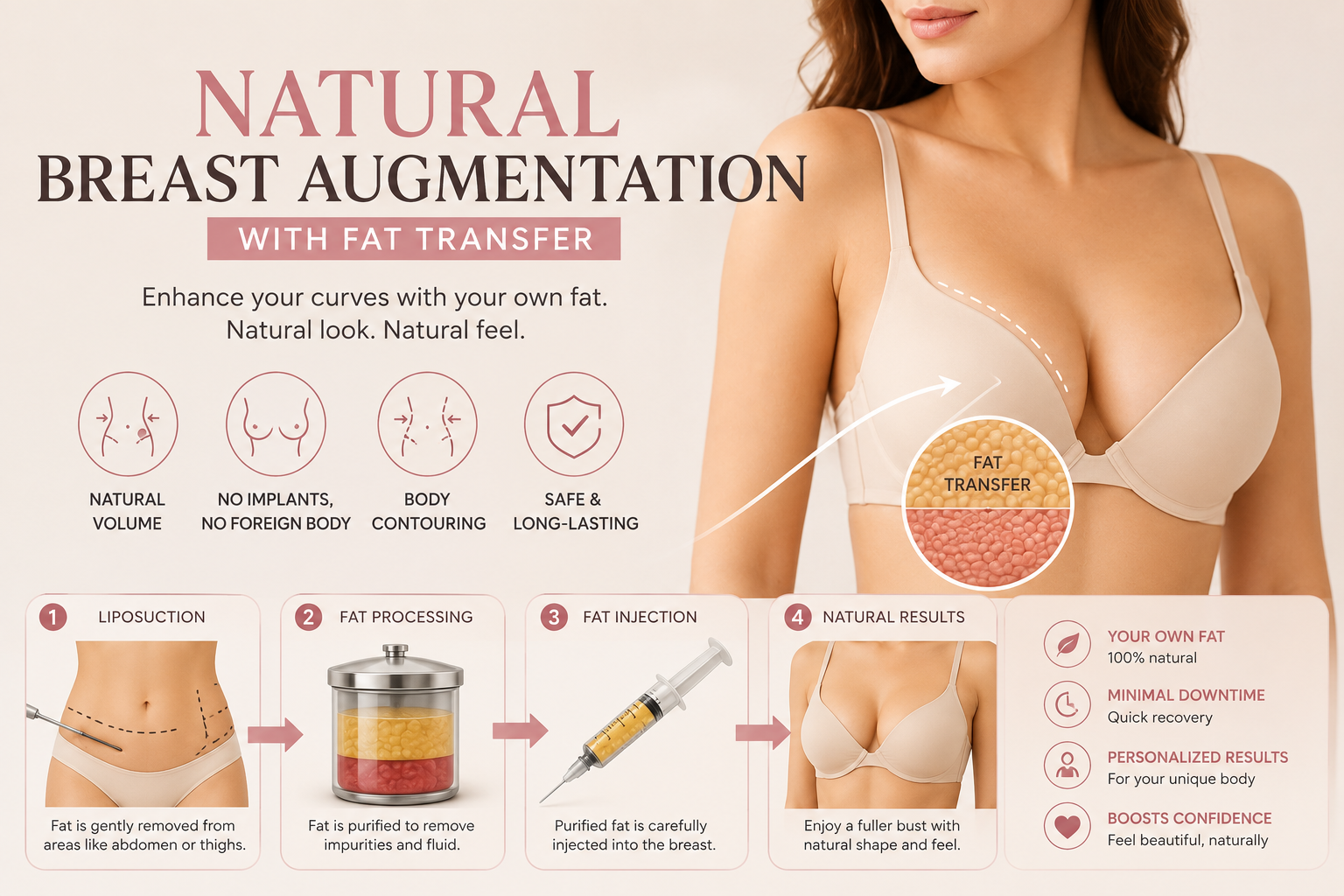
Natural breast augmentation in Surat uses liposuction to harvest a woman's own fat and inject it into the breast, adding volume without placing any implant.
Natural breast augmentation in Surat uses liposuction to harvest a woman's own fat and inject it into the breast, adding volume without placing any implant. It's a genuinely different option from implant surgery, but it comes with real limits — modest size gains, partial fat reabsorption, and a need for adequate donor fat — that any honest consultation should explain upfront.
The appeal of "natural" breast augmentation is easy to understand: no foreign device, no future implant exchange, and body contouring at the donor site as a side benefit. But natural doesn't mean unlimited, and understanding exactly what fat transfer can realistically deliver is the difference between a satisfying result and a disappointing one.
What Is Natural Breast Augmentation?
Natural breast augmentation, medically known as autologous fat grafting or fat transfer breast augmentation, moves fat from one part of your body — commonly the abdomen, flanks, or thighs — into the breast to add volume and improve contour. Because the added tissue is entirely your own, there's no implant to monitor, replace, or worry about rupturing years down the line.
How Much Bigger Can You Realistically Get?
This is the single most important expectation to set correctly before considering the procedure. Most women achieve roughly half a cup to one cup size increase from a single session, since only a limited volume of fat can be placed in the breast at one time without crowding the tissue and cutting off its blood supply. Clinics promising a dramatic size jump from fat transfer alone are setting expectations that the biology of the technique simply cannot support.
Natural (Fat Transfer) vs Implant-Based Augmentation
| Fat Transfer (Natural) | Implant-Based Augmentation | |
|---|---|---|
| Material used | Your own fat, no device | Silicone or saline implant |
| Size increase per session | Roughly half to one cup size | Predictable, larger increase in one operation |
| Long-term device issues | None — no implant to exchange or monitor | Possible capsular contracture, rupture, or need for future replacement |
| Added benefit | Body contouring at the donor liposuction site | None beyond the breast itself |
| Best suited for | Modest, natural-looking volume increase | Larger or more predictable size change |
A detailed side-by-side comparison, including how each option affects future mammograms, is covered on our fat grafting breast augmentation page, alongside our standard breast augmentation service for those considering implants instead.
Do You Have Enough Donor Fat?
Donor fat supply is often the deciding factor in candidacy, more than personal preference. Women with little spare fat at the abdomen, flanks, or thighs may not have enough to harvest for a meaningful graft, while a very lean frame simply can't provide the raw material this technique needs. A stable weight also matters, since grafted fat behaves like the rest of your body fat and will shrink if you lose weight afterward.
Why Might You Need More Than One Session?
A portion of every fat graft is naturally reabsorbed by the body in the months after transfer — this is normal biology, not a sign the procedure failed. The fat that survives generally establishes its own blood supply and stays long-term, but reaching a fuller result often means planning for a second session several months after the first, each with its own recovery.
What Does Research Say About Fat Transfer Breast Augmentation?
A 2024 systematic review pooling 35 studies and nearly 3,800 women found an average fat volume retention of 58%, with a wide range between 44% and 83% depending on technique and patient factors, alongside a complication rate of roughly 28% — most commonly fat necrosis, which typically presents as small firm areas rather than a serious problem (Seth et al., Plastic and Reconstructive Surgery, 2024). Encouragingly, the same review found patient satisfaction averaged 92% at one year of follow-up, suggesting that when expectations are set realistically from the start, most women are genuinely happy with a modest, natural-looking outcome.
Why Breast Screening Awareness Matters More With This Technique
Fat grafted into the breast can occasionally create small calcifications or fatty cysts that show up on a future mammogram. Radiologists are generally able to distinguish these benign changes from anything concerning, but only if they know a fat transfer procedure was performed. Telling your radiographer and radiologist about your history at every future screening appointment is essential — it may mean an extra imaging view is taken, but it does not change how often you should be screened.
What Does Recovery Involve?
Because two areas are treated in the same surgery — the donor site and the breast — recovery involves healing in both places at once. The breast itself tends to feel mildly sore, while the liposuction sites are typically more bruised and tender for two to three weeks. Most women return to desk work within about a week, while exercise and firm pressure on the breasts are avoided for four to six weeks to protect the newly transferred fat while it establishes blood supply.
What Does Natural Breast Augmentation Cost in Surat?
Cost depends on how many donor areas are treated, anaesthesia and theatre time, and whether a second session is planned later for additional volume. Because donor fat availability and goals vary so much between individuals, a genuine, written cost estimate is only possible after an in-person assessment — not a number quoted sight-unseen.
Natural Breast Augmentation at Elegance Clinic, Surat
At Elegance Clinic, natural breast augmentation is performed personally by Dr. Ashutosh Shah, a board-certified plastic and cosmetic surgeon with over two decades of surgical experience in Surat, Gujarat. As an expert doctor who is upfront about what fat transfer can and cannot achieve, Dr. Shah's consultations focus on matching the right technique — fat grafting, implants, or a combination — to your donor fat, goals, and health, rather than defaulting to whichever procedure sounds most appealing on paper.
Book a Confidential Consultation
The right approach to breast augmentation depends entirely on your donor fat, goals, and anatomy — and deserves an honest, private conversation rather than a generic promise. Book a confidential consultation with Elegance Clinic in Surat, or reach out directly on WhatsApp to discuss whether natural breast augmentation is right for you.
Disclaimer: This article is for general educational purposes only and is not a substitute for professional medical advice. Any new breast lump, nipple change, or skin change should be assessed by a doctor before considering any cosmetic treatment. Please consult Dr. Ashutosh Shah or a qualified plastic surgeon for an individual assessment.
Have a Private Question?
Every concern deserves an honest answer. Book a confidential consultation with Dr. Ashutosh Shah at Elegance Clinic, Surat, for guidance made just for you.
About the Author
Dr. Ashutosh Shah is a cosmetic gynecologist and plastic surgeon with over 22 years of experience. At Elegance Clinic in Surat, he is known for safe, honest and completely confidential intimate and aesthetic care.
Is natural breast augmentation safer than implants?
Fat transfer avoids device-related issues such as capsular contracture or implant rupture, which is a genuine advantage. However, it carries its own surgical risks, including fat necrosis, oil cysts, and donor site irregularities, so "safer" depends on which specific risks matter more to you.
How long before I know my final breast size after fat transfer?
Swelling makes the breast look fuller than it will end up in the first few weeks, so six months is generally considered the fair point to judge the true final volume. Absorption of some transferred fat continues gradually over that period.
Can natural breast augmentation affect breastfeeding?
Many women breastfeed normally after fat transfer, but no guarantee can be made, since the injections pass through breast tissue near the milk ducts. If you're planning a future pregnancy, mention this at consultation so it can factor into your treatment timing.
Will fat transfer show up on a mammogram?
It can cause calcifications or fatty cysts that need to be distinguished from more concerning findings. Always inform your radiographer and radiologist about your history so they can interpret your imaging correctly and add extra views if needed.
Who is not a good candidate for natural breast augmentation?
Women with very little donor fat, an unstable weight, untreated breast symptoms, or expectations of a large size increase are generally not well suited to this technique. A private consultation clarifies whether your goals genuinely match what fat grafting can deliver.
Can I combine fat grafting with a breast implant?
Yes, some women use a small amount of fat grafting alongside an implant to refine contour or add fullness in specific areas. Your surgeon can discuss whether a combined approach suits your anatomy and goals.