
What is Exosome and Growth Factor Intimate Rejuvenation?
Exosome and Growth Factor Intimate Rejuvenation refers to preparations said to contain cell derived particles or signalling proteins, applied or injected into intimate tissue in the hope of encouraging repair. Importantly, this is an emerging area rather than established care. Regulatory status for such products remains unsettled in many countries, meanwhile the evidence for intimate use is still developing. Therefore Elegance Clinic does not present this as a routine service, and no woman should assume it is simply available on request. Instead, it is discussed only with those who clearly understand how early the science is. Our exosome and regenerative treatments page holds the wider overview.
Why is this described as an emerging area?
It is described as emerging because the basic laboratory science is genuinely interesting while the clinical proof is not yet there. Studies in intimate tissue are few, small and short, meanwhile products differ so much between suppliers that results cannot be compared reliably. Consequently no standard protocol exists, no agreed dose exists, and long term safety data are lacking. Meanwhile enthusiasm in marketing has run considerably ahead of published evidence. In short, promise is not the same thing as proof, and we keep those two words apart.
What is the regulatory position?
Regulatory status for exosome and growth factor products is unsettled in many countries, and several regulators have warned about unapproved products being marketed for regenerative claims. Separately, the US Food and Drug Administration has issued a safety communication about vaginal rejuvenation procedures, cautioning against exactly these kinds of marketing claims and noting reported harms with energy based devices, including burns, scarring and lasting pain. Professional bodies including the American College of Obstetricians and Gynecologists have said available evidence does not yet support efficacy claims in intimate rejuvenation generally. Consequently anything discussed here is framed as experimental in nature rather than as accepted treatment.
What are exosomes and growth factors, in plain words?
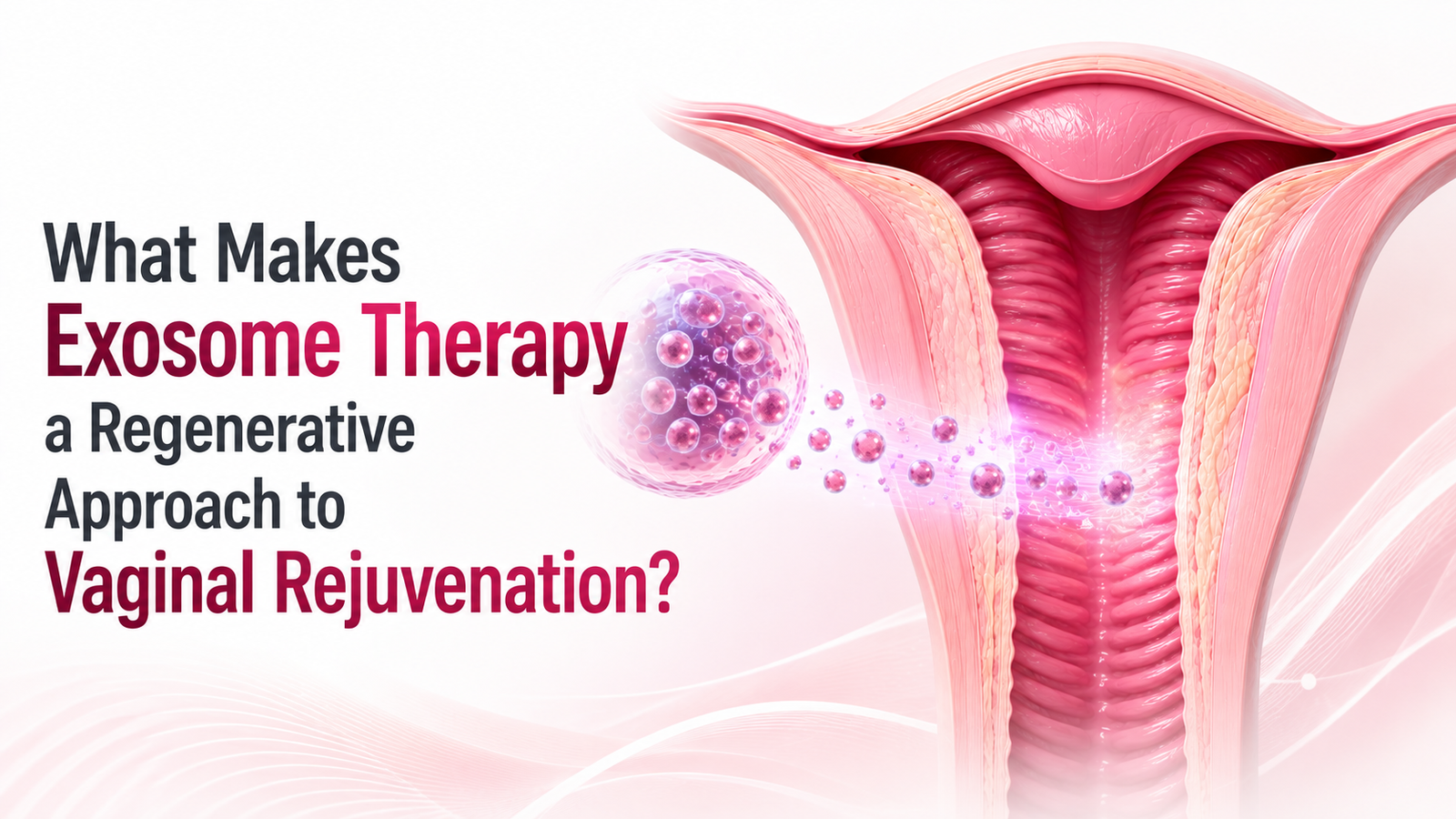
Exosomes are tiny packages released by cells, and they carry signals that then influence how neighbouring cells behave. Similarly, growth factors are proteins that instruct tissue to repair, form new blood vessels or lay down collagen. Laboratories can also concentrate these substances, and that is what commercial products claim to supply. However, a signal that works in a dish does not automatically work in a woman, since living tissue is far more complicated. Moreover, the contents of commercial preparations vary considerably, so what is actually being given is often unclear.
How does this differ from PRP?
PRP uses your own blood, spun to concentrate platelets, whereas exosome products generally come from an external source and arrive as a manufactured preparation. Importantly, that difference matters for both regulation and traceability. Neither approach has strong evidence in intimate rejuvenation, however, so the comparison is between two uncertain options rather than between good and better.
| Point of comparison | PRP | Exosome or growth factor product |
|---|---|---|
| Source | Your own blood | An externally manufactured preparation |
| Contents | Variable between individuals | Variable between suppliers |
| Regulatory position | Handled as an autologous procedure | Unsettled in many countries |
| Evidence in intimate use | Limited and inconsistent | Early and still developing |
| Long term safety data | Sparse | Largely absent |
Our page on PRP and the O Shot covers that route separately.
What does the evidence currently show?
Current evidence does not allow anyone to promise you a benefit, and that is the honest summary. Moreover, published work in this field is early, often funded by product suppliers, and rarely compared against a placebo. Follow up periods are short, meanwhile outcome measures rely on questionnaires that are difficult to interpret. Consequently a doctor quoting impressive figures should be asked where those figures came from. Because the evidence is still developing, we treat every claim, including hopeful ones, with caution.
Who might this even be discussed with?
Discussion is limited to well informed adult women who have already had a full gynaecological assessment and who understand the uncertainty involved. Even then, established options are revisited first, because they carry far better evidence. Anyone considering this route should be comfortable with the following.
- Accepting that benefit is unproven and may not occur at all
- Understanding that regulatory status for such products is unsettled
- Knowing that long term safety information is largely unavailable
- Having tried, or properly considered, treatments with better evidence
- Taking time to decide rather than agreeing during a single appointment
Who should not consider it?
Several women should not consider this at all, and saying so early avoids wasted money. First, pregnancy and breastfeeding rule it out. Active infection, unexplained bleeding, an undiagnosed skin condition or a suspicious lesion must be investigated properly instead. Similarly, women with a current or recent cancer, or those on immune suppressing treatment, need specialist advice before any regenerative product is contemplated. Meanwhile anyone hoping for a change in sexual response should know that no such effect can be relied upon. Above all, financial pressure is a reason to decline, not a reason to hurry.
What would treatment involve if it were agreed?
Treatment, where it is agreed at all, involves applying or injecting a prepared solution into vulval or vaginal tissue after numbing. Sessions are typically short, and protocols differ widely because no standard exists. Soreness, swelling and discharge for a few days are the usual immediate experience. Because nothing is guaranteed by the process, careful record keeping matters, therefore symptoms are documented before and after in the woman's own words. If nothing changes, treatment is not repeated simply out of hope.
What are the risks?
Risks include infection, an inflammatory or allergic reaction, pain, swelling, and the strong possibility of no benefit whatsoever. Product quality is a genuine concern where regulation is unsettled, since contents and sterility cannot always be verified independently. Injecting into delicate tissue carries bruising and, rarely, damage to a blood vessel. Longer term effects are simply unknown, which is itself a risk worth weighing. Consequently the safest choice for most women remains an established treatment, and we say that plainly.
What should be tried first?
Established care should come first, every time. Dryness, soreness and pain around menopause often respond to local oestrogen and emollients when they are prescribed properly. Pelvic floor physiotherapy helps muscle related symptoms, meanwhile infection, lichen sclerosus, thrush and diabetes all need specific medical treatment. Where laxity is genuinely structural, surgery under cosmetic gynaecology surgery may serve far better than any injectable. Therefore an assessment frequently ends with a simple prescription rather than a procedure, and that is a good outcome.
What does it cost in India?
Cost varies widely with the product and the protocol, and prices in this field are often high relative to the evidence behind them. Fees are quoted in rupees, and Elegance Clinic issues a clear written estimate after examination when anything is agreed. Because benefit is unproven, spending should be considered carefully rather than treated as an investment. Consultation is charged separately, therefore you may take advice and go home. By contrast, package deals urging several sessions upfront deserve real scepticism.
Why choose Elegance Clinic in Surat?
Elegance Clinic would rather explain why something is uncertain than sell it enthusiastically. Dr. Ashutosh Shah discusses Exosome and Growth Factor Intimate Rejuvenation as an emerging area, sets out the unsettled regulatory position, and recommends established treatment wherever it fits your symptoms. Equally, consultations are private, unhurried and free of pressure. Related material appears throughout our non surgical rejuvenation section, written in the same cautious tone.
If you have read about regenerative intimate treatments and want a balanced opinion, a private consultation with Dr. Ashutosh Shah in Surat is the right place for it. Bring the marketing material you have seen, along with your questions. Leaving with a prescription and no procedure is a perfectly good result.
Note: This page is for general information and is not a substitute for a medical consultation. Non surgical intimate treatments are not specifically approved by regulators for these uses, evidence of benefit is limited, and results vary between individuals. Dr. Ashutosh Shah will advise honestly whether a treatment is appropriate for you.
Ready to Talk, Privately?
Book a confidential consultation with Dr. Ashutosh Shah. There is no pressure, only clear and honest guidance.