
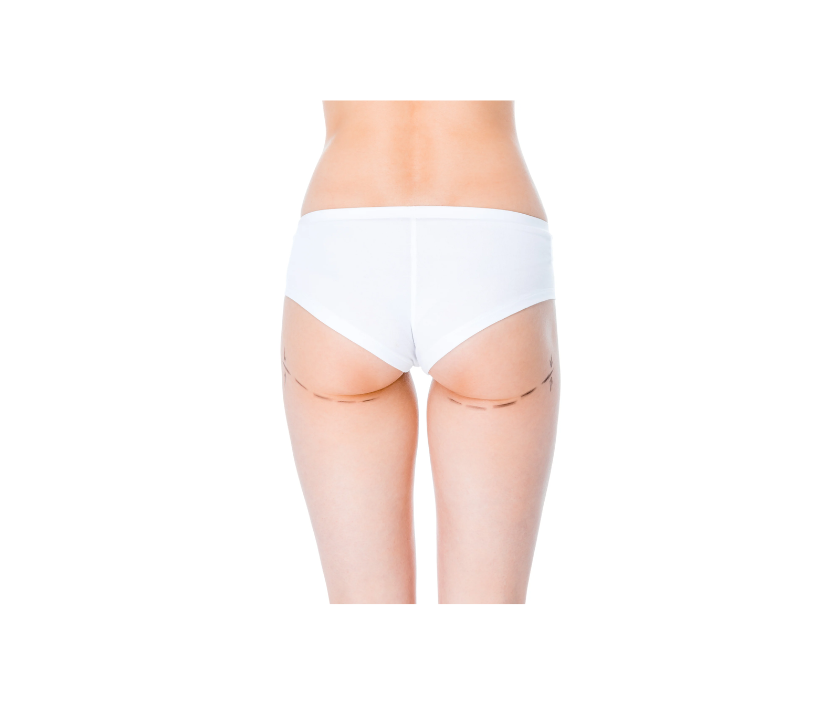
What are hip dips?
Hip dips are the gentle inward curves seen on each side of the body between the hip bone and the top of the thigh, and they are a normal feature of human anatomy. Most people have them, whether slim, athletic or heavier, and they become visible in some outfits and invisible in others. They are not a medical condition, not a sign of poor health, and not something anybody needs to correct. Reading that clearly matters, because the internet has turned an ordinary body shape into an imagined defect.
What causes hip dips?
Bone position causes them. The rim of the pelvis sits high and wide, while the top of the thigh bone sits lower and further out, and the soft tissue stretched between those two points naturally falls inward. Muscle attachments across the outer hip add to that shallow hollow. Fat distribution then decides how noticeable the shadow becomes. Because the underlying reason is skeletal, the dip belongs to the shape you inherited rather than to anything you did or failed to do.
Do hip dips mean I am overweight or unfit?
Not at all, and the opposite is often true. Very lean women frequently show the curve more plainly, since there is less soft tissue to soften the outline over the bone. Athletes with strong hips show it too. Weight loss therefore rarely removes a dip, and in some cases it makes the outline sharper. Nobody should read this feature as feedback about diet, discipline or fitness, because it simply reflects the position of two bones.
Can exercise or creams remove them?
Exercise can soften the appearance a little, whereas creams do nothing whatsoever. Building the muscles of the outer hip with abduction work, side lying leg raises and resistance band training adds a small amount of bulk above the hollow, which reduces the contrast. However muscle cannot fill a gap created by bone position, so the change stays modest. Anything sold as a cream, wrap or device for reshaping this area has no plausible mechanism. Honest strength training is still worth doing for other reasons.
What is Hip Dips Correction and what can it change?
Hip Dips Correction is fat transfer into the hollow at the outer hip, usually combined with careful contouring of the areas above and below it. Fat is taken from a donor site by liposuction, processed, then placed in small droplets within the fatty layer beneath the skin so it can pick up a blood supply. Softening is the realistic goal. Because the skeleton underneath does not move, the curve is blurred rather than abolished, and any surgeon promising a perfectly straight line from waist to thigh is overselling. Volume also settles as part of the graft is reabsorbed, so planning allows for that.
Is liposuction on its own useful here?
Sometimes, though only as part of the plan rather than as the answer by itself. Reducing a full flank above the hollow, or fullness on the outer thigh below it, lessens the contrast that makes a dip stand out. Even so, liposuction is contour work for a stable weight and it is not a treatment for obesity, and the amount removed changes shape rather than the number on the scale. Skin quality sets the ceiling on every result here, since loose skin will not shrink over a smaller contour and can look worse afterwards. Where skin has genuinely lost elasticity, excision is the more honest option and that is said plainly at the consultation.
Who is a suitable candidate?
Suitable women have enough donor fat, stable weight, good general health and expectations that match anatomy. Someone extremely lean may not have sufficient fat to harvest, which by itself rules the operation out. Emotional context deserves attention too, because a woman who has been told online that her body is wrong may be better served by an honest conversation than by an operation.
- Weight steady for at least six months before surgery.
- Adequate fat at the abdomen, flank or thigh for harvesting.
- Reasonable skin tone across the hip and outer thigh.
- No uncontrolled diabetes, clotting disorder or active infection.
- Understanding that a dip is softened rather than removed.
- Not planning pregnancy in the immediate future.
How is fat transfer to the hip done?
Markings for the hollow and the donor sites are made before anaesthesia, with you standing. Fat is then harvested gently through small cannulas, since rough handling damages the cells that need to survive. Processing removes fluid, blood and oil, after which the graft is injected through blunt cannulas in fine passes and multiple layers within the subcutaneous plane. Placement stays superficial to the muscle deliberately, because deeper injection near large vessels is where serious complications arise in body fat grafting. Surgery usually lasts two to three hours and is often day care, therefore most women go home the same evening.
What is recovery like after hip fat transfer?
Recovery involves protecting the graft as much as resting yourself. Direct pressure on the treated hip is limited for a few weeks, so lying flat on that side is discouraged early on. Compression is applied to the donor areas rather than tightly over the grafted hip. Swelling and bruising dominate the first fortnight, while the true volume becomes clear across three to six months. Office work restarts within a week for most women, however exercise waits four to six weeks.
What results are realistic?
Realistically, the hollow becomes shallower and the outline of the hip smoother in clothes. Grafted fat that establishes a blood supply behaves like the rest of your body fat afterwards, so it grows with weight gain and shrinks with weight loss. Part of the transferred volume is reabsorbed during the first months, which is expected rather than a complication. Some women choose a second smaller session once healing is complete, and that possibility is discussed from the start. Results vary between individuals and no specific shape can be promised.
What are the risks of this procedure?
No surgery is risk free, and fat grafting carries its own set of problems alongside the usual ones. Uneven take, palpable lumps, fat necrosis, oil cysts, asymmetry and under correction are the common issues. Infection, bleeding, seroma and prolonged numbness also occur. Serious events including fat entering the bloodstream are described in body fat grafting, which is precisely why the graft is kept in the subcutaneous layer and away from deep planes. Buttock fat transfer is a separate and considerably higher risk operation, and it is never treated casually here.
How much does correction cost in India?
Fees in rupees depend on donor sites, graft volume, theatre and anaesthetic time, garments and reviews. Combining hip grafting with flank contouring raises the total, although doing both together usually costs less than two separate sittings. Every patient receives a clear written estimate after examination, including the possibility of a top up session later. Insurance does not fund aesthetic body contouring in India.
Why choose Elegance Clinic?
Because nobody here will tell you that a normal hip is a deformity. Dr. Ashutosh Shah explains what your pelvis allows, offers Hip Dips Correction only where it genuinely helps, and is comfortable advising against surgery when the honest answer is that nothing needs fixing. Wider options are set out under hip augmentation, and the detail of grafting technique, donor fat and injectable alternatives sits on our Hip Fat Transfer and Fillers page.
Should you wish to talk this through calmly, a private consultation in Surat will give you a clear picture of what is anatomy and what is genuinely treatable. Bringing photographs of yourself rather than of anyone else helps the discussion. Appointments are arranged through our contact page.
Note: This page is for general information and is not a substitute for a medical consultation. Every procedure carries risk, results vary between individuals, and no outcome can be promised. Dr. Ashutosh Shah will advise honestly whether a procedure is appropriate for you.
Ready to Talk, Privately?
Book a confidential consultation with Dr. Ashutosh Shah. There is no pressure, only clear and honest guidance.