What is tightening of the vulvar tissue?
Tissue Tightening and Contouring means improving the quality and the outline of the skin over the outer genital area rather than adding or removing bulk. Volume work fills a deflated area, whereas this approach deals with skin that has become slack, crinkled or uneven. Because the two problems look similar in a mirror, they are often confused. However, they need different solutions. Sometimes a device is enough, while other times only excision will do. You can see how this sits within the wider surgical picture on our vulvar lift page.
Why does the skin here lose its firmness?
Skin loses firmness because collagen and elastin, the fibres that give it spring, reduce steadily with age. Oestrogen falls around menopause, therefore the tissue becomes thinner and drier at the same time. Pregnancy stretches the area, then leaves it slightly longer than before. Meanwhile, repeated weight change acts like an elastic band pulled too many times. Genetics play a part too, since some women simply have thinner skin from youth. Consequently, laxity is rarely anybody's fault, and it is far more common than most conversations suggest.
How do I know skin quality is my problem?
You can usually tell by pinching the tissue gently between two fingers. Skin that stretches easily and then returns slowly is lax, whereas firm skin springs back at once. Typical clues include:
- Fine crinkling of the outer lips that shows even at rest
- An outline that looks untidy rather than large
- Skin that folds over itself when you sit or bend
- A dragging feeling by the end of a long day
- Creams and oils that make no difference at all
However, only an examination can confirm this. Therefore, treat the pinch test as a hint rather than a diagnosis.
What are the treatment options available?
Two broad routes exist, and they suit very different degrees of slackness.
| Point of comparison | Surgical tightening | Energy based non surgical tightening |
|---|---|---|
| What it does | Removes surplus skin and reshapes the outline | Heats the deeper layers to stimulate new collagen |
| Anaesthesia | Local anaesthesia, often with sedation | Usually numbing cream alone |
| Sessions | One planned operation | Commonly three sessions, spaced weeks apart |
| Downtime | About five to seven days of quiet activity | Little or none |
| Scars | Fine lines hidden in natural creases | None |
| Best suited to | Clear excess skin and hanging folds | Early laxity with no surplus tissue |
| Durability | Long lasting, since tissue is actually removed | Gradual fading, so maintenance is expected |
Further detail on the device based route sits on our non surgical rejuvenation page.
Which degree of laxity suits which treatment?
Mild laxity suits energy based treatment, moderate laxity sits on the fence, and marked laxity needs surgery. To be plain about it, skin that only crinkles when you stretch it, with nothing hanging, responds reasonably well to heat based devices. Moderate cases, where a small fold appears on sitting but disappears on standing, may improve partly with devices, although expectations must stay modest. By contrast, skin that hangs visibly at rest will not be lifted by any device, whatever the advertisement promises. Therefore, honest grading at the first visit saves both money and disappointment.
Who is a good candidate for the surgical route?
Good candidates have genuine surplus skin, steady weight and no active infection in the area. Being fit for a short procedure under local anaesthesia matters more than age. Women who have finished their family are easier to plan for, since pregnancy stretches the tissue again. Moreover, anyone using blood thinning medicines needs a physician opinion first. Smoking should stop several weeks before, because nicotine narrows the small vessels that feed a healing edge. However, mild cases are usually advised to try the gentler route first.
How is the surgical tightening performed?
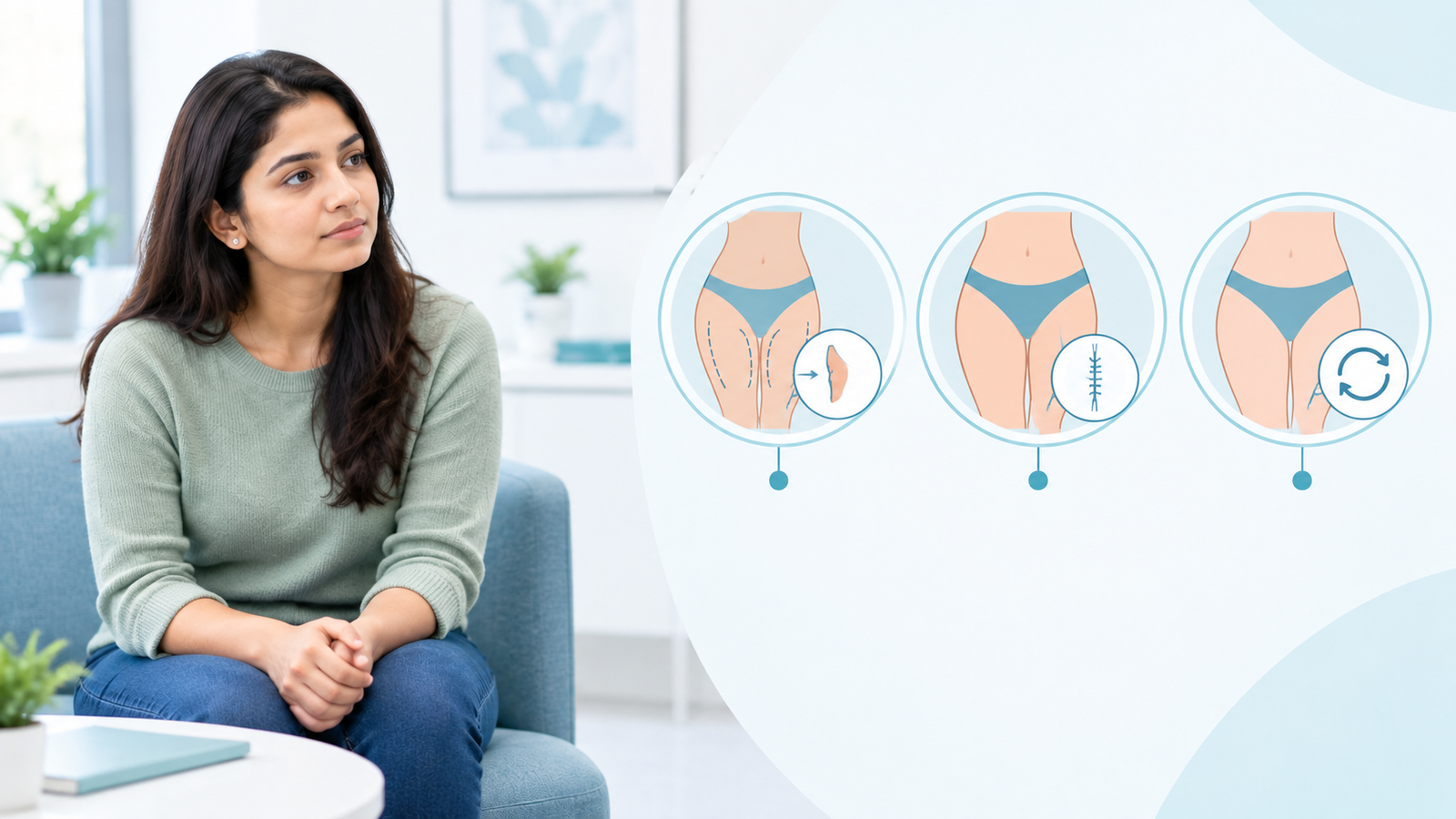
Surplus skin is marked with you standing, then removed through a fine crescent shaped excision within a natural fold. Marking upright matters, because tissue falls differently once you lie down. The deeper layer is closed with stitches that support the repair while it heals. Afterwards the skin edges are brought together with sutures that dissolve by themselves. Most cases take under ninety minutes, therefore an overnight stay is seldom needed. Meanwhile, if fat is also excessive, a small amount may be reduced at the same sitting, as described on our labia majora reduction page.
How long does recovery take?
Expect three to four days of definite tenderness, followed by a week of steady improvement. Ice used through a cloth for short spells eases the first two days. Loose clothing and cotton underwear reduce friction, therefore they help more than any ointment. Sitting on a soft cushion is sensible for a while. Meanwhile, keep the area clean and dry, exactly as instructed, since moisture delays healing. Strenuous exercise waits about six weeks. However, light household activity can resume within a couple of days if you feel able.
What kind of result is realistic?
The outline usually looks neater and the skin feels less slack, although perfection is not the aim. Early swelling will exaggerate the tightness, so the honest verdict comes at three months. Contour improves more predictably than texture, because removing surplus skin is a mechanical change while texture depends on healing. Fine crinkling therefore softens rather than vanishes. Importantly, Tissue Tightening and Contouring improves what you have instead of creating a shape you never had. Consequently, women who want comfort and tidiness are usually the happiest afterwards.
What can go wrong?
Risks include bleeding, infection, slow healing and a scar that stays firm longer than expected. Over correction is possible, and it can leave a feeling of tightness on movement. Under correction is more common, because surgeons here prefer caution to regret. Temporary altered sensation along the incision may last some months. Meanwhile, energy based treatment carries its own small risks of burns or blistering when it is delivered carelessly. Therefore, ask who operates the device and what training they hold.
How is this priced in India?
Pricing separates neatly into a one time surgical fee and a per session device fee. Surgery in rupees covers theatre, anaesthesia, the operation itself and follow up visits. Device sessions look cheaper individually, however three or more sessions plus maintenance change the arithmetic over a few years. Because of this, both routes are costed side by side for you. You will receive a clear written estimate after examination rather than a number over a phone call. Above all, judge value by what the treatment can genuinely achieve for your grade of laxity.
Which myths should I ignore?
The commonest myth is that a machine can replace surgery for every woman. Marketing blurs a line that examination makes obvious:
- Devices tighten early laxity only, and they cannot remove a single millimetre of skin
- Laser treatment is not painless for everyone, although discomfort is usually mild
- Surgery does not leave an obvious mark, since incisions hide inside creases
- Tightening does not change sexual sensation in the way rumours suggest
Consequently, a careful grading discussion beats any package deal. Meanwhile, women who have lost a great deal of weight often need the broader plan described on our post weight loss intimate reshaping page.
Why see Dr. Ashutosh Shah in Surat?
Dr. Ashutosh Shah offers both routes, therefore the advice you receive is not limited by what the clinic happens to own. Grading is done carefully at the first visit, then explained in plain words. Because Tissue Tightening and Contouring can be approached surgically or with a device, being told which one your tissue actually needs is worth more than a discount. Consultations at Elegance Clinic in Surat are unhurried and private, with a female attendant present. If you would like a straight opinion before deciding anything, you are welcome to come and ask.
Note: This page is for general information and is not a substitute for a medical consultation.
Ready to Talk, Privately?
Book a confidential consultation with Dr. Ashutosh Shah. There is no pressure, only clear and honest guidance.