What is Post Weight Loss Breast Reshaping?
Post Weight Loss Breast Reshaping is surgery to rebuild shape once a breast has emptied and dropped after major weight loss. Skin stretched to cover a much larger breast rarely shrinks back, so the tissue hangs low and looks flat towards the top. Surgery therefore removes the surplus skin, moves the nipple to a natural height and reshapes what remains into a rounder mound. Our breast reshaping page also covers the wider family of procedures this belongs to.
Why does the breast change so much after major weight loss?
Breast tissue is largely fat, therefore losing a great deal of weight empties the breast in a way little else does. Skin then behaves like a garment that no longer fits, since it has lost elastic recoil and simply drapes. Bariatric surgery makes this more marked, because the loss is usually greater and faster than with diet alone. Consequently many women describe a flattened, deflated breast sitting low on the chest, with the nipple pointing downwards and loose skin folding towards the armpit.
Which breast changes need medical assessment first?
Any new or unexplained breast symptom is assessed before cosmetic surgery is considered, because some of these signs can indicate breast cancer. Examination and imaging are used first, occasionally with a needle test. Report the following without delay:
- Lump that has appeared recently, is enlarging, feels hard or seems fixed.
- Bloodstained discharge from a nipple, or discharge from one side only.
- Nipple that has newly turned in or been drawn inward.
- Skin that dimples, puckers or takes on an orange peel texture.
- Pain on one side that will not settle, or two sides becoming quickly different.
Most such findings usually prove harmless. Nevertheless the order matters, and cosmetic surgery is never the first step.
Is a lift usually needed?
Yes, a lift is usually needed, because the main problem after weight loss is surplus skin rather than missing volume alone. Tightening the skin envelope and repositioning the nipple higher does most of the work, while reshaping the remaining tissue into a fuller cone does the rest. Occasionally tissue from the lower breast is also folded upward to build height at the top. Where a woman wants more volume as well, that discussion happens separately once the lift plan is settled. More detail about that operation sits on our breast lift surgery page too.
How much does skin quality limit the result?
Skin quality sets the ceiling here, so it is the single most important thing to understand beforehand. Tissue that has stretched and lost elasticity holds a new shape less reliably than firm tissue, therefore some settling and relaxation during the first year or two is common. Thin, crepey or heavily stretch marked skin also behaves least predictably. Surgeons can remove more skin, however what stays behind is still the same quality of skin. Results vary between individuals, so a realistic plan serves you better than an ambitious one the tissue cannot hold.
When is the right time to operate?
Weight should be stable for at least six months before surgery, and stable means genuinely settled rather than still slowly falling. Operating during active weight loss risks a shape that loosens again once more fat disappears. Bariatric patients are usually advised to reach a plateau and hold it, which often takes twelve to eighteen months after their original operation. Smoking must stop well in advance, since it affects blood supply to the skin flaps and raises the risk of wound breakdown. Patience at this stage therefore protects the very result you are paying for.
Why does nutrition matter after bariatric surgery?
Healing depends on nutrition, yet bariatric surgery commonly leaves women short of the things wounds need most. Protein, iron, vitamin B12, folate, vitamin D and zinc are all absorbed less well after some bariatric operations, while a shortage of any of them slows healing and weakens scars. Blood tests are therefore checked beforehand, and any deficiency is corrected with your physician or bariatric team first. Daily protein intake is discussed specifically, because long suture lines and skin flaps depend on it. Anaemia is treated before theatre rather than afterwards.
Which women are suitable candidates?
Good candidates usually have stable weight, corrected nutrition, no active smoking, controlled medical conditions and a clear understanding of the scars they are accepting. Emotional readiness counts too, since this operation follows a long and often difficult journey. Anyone with an unexplained breast symptom is assessed for that first. By contrast, a woman still losing weight, or one hoping for a shape her skin cannot support, is better advised to wait and be reviewed again later.
How is the operation done?
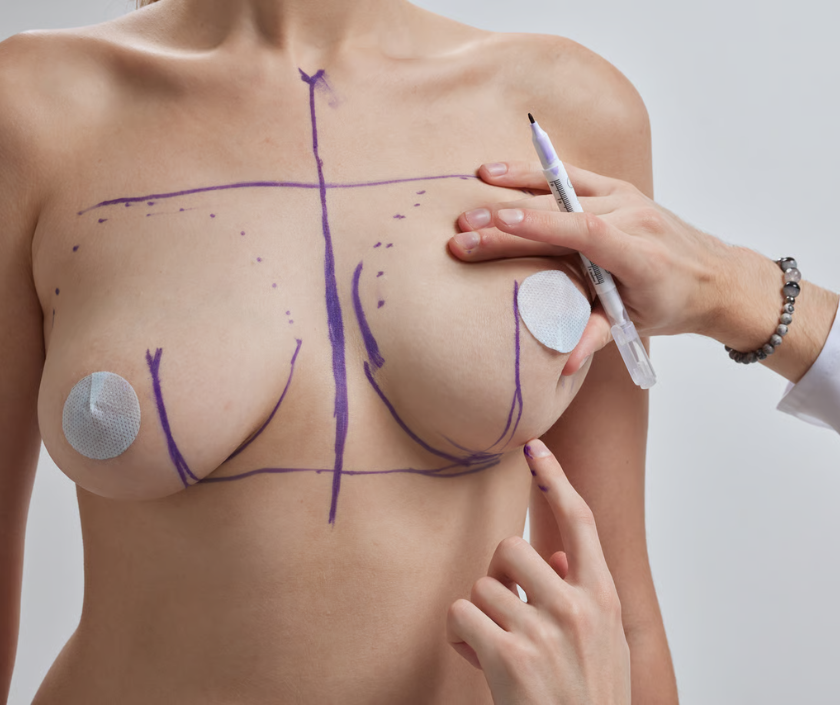
Surgery is carried out under general anaesthesia and usually takes two to three hours. Markings are drawn while you stand, because gravity decides where everything actually sits. The surgeon removes excess skin, moves the nipple and areola higher on their own blood supply, reshapes the remaining tissue into a narrower and taller cone, then closes in layers. Internal support stitches are often added to hold the new shape. Most women then stay one night in hospital.
What will the scars look like?
Scars here are longer than in a standard lift, so this is the honest trade at the centre of the operation. Removing a large amount of loose skin means the incisions must be long enough to take it out, therefore an anchor pattern around the areola, down the front of the breast and along the fold beneath it is usual. Some plans also add a short scar towards the armpit where skin folds that way. Marks fade over twelve to eighteen months, yet they never disappear, and skin prone to thickened scarring can leave more visible lines. Decide about this before agreeing to surgery, because you are exchanging loose skin for permanent scars.
What does recovery involve?
Expect two to three weeks away from work, although a job involving lifting needs longer. Support garments are then worn day and night for around six weeks. Arm movement is limited early, then increased gradually on advice. Wound healing is watched closely where the scars meet, since that junction is the slowest point to heal. Driving resumes once braking is comfortable and pain free.
What are the risks of this operation?
No operation is risk free, and this one carries a slightly higher wound risk than a routine lift because tissue quality is poorer. Delayed healing where the scars meet, wound separation, infection, bleeding, altered or reduced nipple sensation, asymmetry, thickened scars and, rarely, partial loss of nipple tissue are all recognised too. Breast surgery can affect the ability to breastfeed, and the risk is greater where the areola and ducts are involved, so raise any plan for a future pregnancy before the operation is designed. Some settling of shape over the following years is expected rather than preventable.
What does this operation cost in India?
Cost in rupees usually reflects theatre time, general anaesthesia, the complexity of the reshaping, hospital stay and your review visits. Post Weight Loss Breast Reshaping costs more than a routine lift, because it takes longer and involves more tissue work. A clear written estimate is provided after examination, with every element listed so nothing surprises you afterwards. Cosmetic body contouring is rarely covered by insurance in India, although asking your insurer is still worthwhile where documented physical symptoms exist.
Reaching a stable weight after years of effort is an achievement, so wanting your shape to match that effort is entirely reasonable. Once you are ready, a private consultation with Dr. Ashutosh Shah at Elegance Clinic in Surat will usually cover what your skin allows, what the scars involve and when the timing is right. Confidentiality is respected at every visit. You can also reach us through our contact page or read more across breast and chest aesthetics.
Note: This page is for general information and is not a substitute for a medical consultation. Any new breast lump, nipple change or skin change should be assessed by a doctor before considering cosmetic treatment. Results vary between individuals and no outcome can be promised.
Ready to Talk, Privately?
Book a confidential consultation with Dr. Ashutosh Shah. There is no pressure, only clear and honest guidance.