
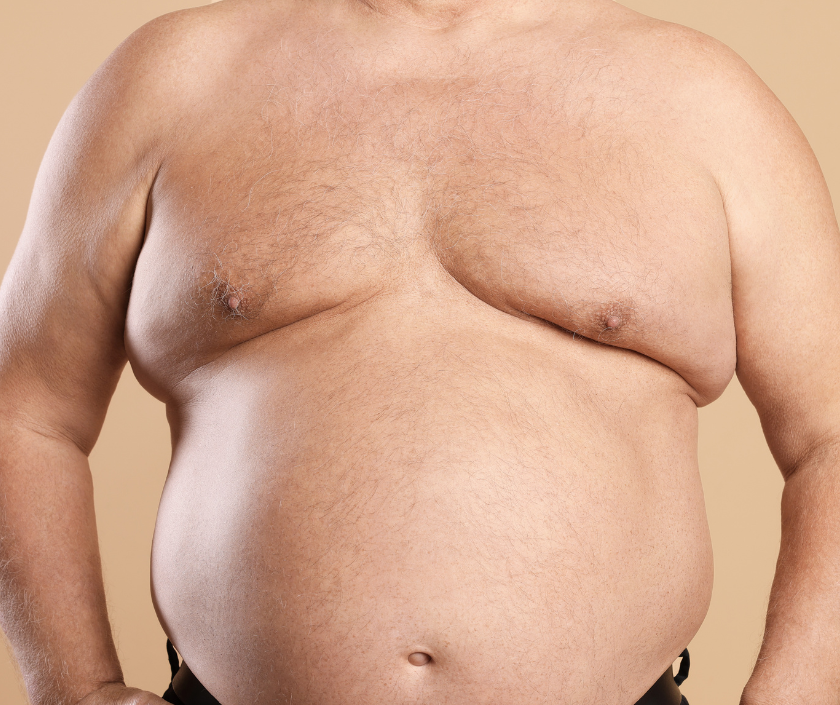
What is Post Massive Weight Loss Male Chest Correction?
Post Massive Weight Loss Male Chest Correction is surgery to remove hanging chest skin left behind after a very large weight loss. Excess skin is cut away and the remaining skin is redraped, so reduction and repositioning of the areola are usually included. Because skin is removed rather than suctioned, scars are longer than in ordinary contouring, so their placement becomes a central part of the plan. Men usually come after losing thirty kilograms or more, whether through diet or bariatric surgery.
Why does the skin hang, and can anything tighten it without surgery?
Skin hangs because it was stretched for years and its elastic fibres are damaged. Collagen and elastin do not simply return to their earlier state once volume disappears, therefore a fold remains. Creams, massage, radiofrequency and other energy devices are widely advertised for this, however they cannot lift genuinely loose skin and evidence for meaningful tightening at this scale is limited. Consequently skin excision is nearly always unavoidable when a real fold exists. Where the excess is mild, contouring alone may still be worth discussing, so Male Chest Liposuction is considered before longer scars are proposed.
When am I ready for this operation?
Readiness means a stable weight and a healthy nutritional state, rather than simply a target reached. Weight should have held within a few kilograms for at least six months, because further loss will create new laxity while further gain will stretch what has been tightened. Nutrition matters just as much after bariatric surgery, since protein, iron, vitamin B12, vitamin D and zinc are commonly low and every one of them affects wound healing. Blood tests are therefore checked and deficiencies corrected before a date is offered.
- Weight steady for six months or longer, so the shape has settled.
- Protein intake adequate, so supplements are taken reliably.
- Anaemia and vitamin deficiencies corrected once blood tests return.
- Diabetes controlled, since high blood sugar delays healing.
- Smoking stopped for at least four to six weeks beforehand.
Where will the scars be, and what is the trade off?
Scar position depends on how much skin has to go, so the trade off is honest and unavoidable. Less skin means shorter scars, whereas more skin means longer ones. Moderate excess can sometimes be handled when a scar around the areola alone will do. Greater excess needs a horizontal scar in the fold, and the largest cases need one running outward towards the armpit. In effect a man swaps a fold that shows in a shirt for a line that shows once the shirt is off. Discussing this beforehand, with drawings on your own chest, prevents the resentment that follows a surprise.
| Skin excess | Likely scar | What it means for you |
|---|---|---|
| Mild | Around the areola only | Well hidden, though tightening is limited |
| Moderate | Around the areola and in the fold | Better shape, since a line becomes visible without a shirt |
| Severe | Fold extended towards the side or armpit | Greatest change in contour, yet the longest scar |
Which findings must be assessed before this surgery?
Examination and imaging come before cosmetic planning whenever a lump or nipple change is present. Weight loss can make previously hidden tissue easier to feel, so new lumps do get noticed at this stage, and male breast cancer, though uncommon, must be ruled out rather than assumed away. Please report the following.
- Swelling that has appeared recently, or a lump that is enlarging.
- Tissue feeling hard, irregular or anchored to skin or muscle when pressed.
- Any discharge from a nipple, above all blood or fluid from one side.
- Retraction of a nipple that previously sat normally, even if intermittent.
- Dimpled or puckered skin, so the surface takes on an orange peel look.
- One sided pain that persists, or a quickly growing difference between the sides.
Such findings are assessed with clinical examination, ultrasound or mammography and sometimes a biopsy. Surgery for appearance waits until that is settled.
Is any of this gynecomastia?
Sometimes, and it is worth separating from loose skin because the operation differs. Glandular tissue, which is true gynecomastia, feels firm and sits under the areola, whereas pseudo gynecomastia is fat and loose skin is neither. Causes of glandular growth are looked for in every man, so the list below is worked through.
- Puberty, when gland appears commonly and often regresses without treatment.
- Medicines and substances such as anabolic steroids, though drugs for blood pressure, some antipsychotics and cannabis also count.
- Liver disease, thyroid disorder and kidney disease, any of which can follow years of poor health.
- Tumours of the testis or adrenal gland, rare yet checked for when suspicion arises.
Men over fifty with a firm lump on a single side are investigated first, without exception. Once causes are treated or excluded and the situation is stable, gland can be removed at the same sitting as the skin.
Who is a suitable candidate?
Suitable men have completed their weight loss, kept it stable, and accept the scars in exchange for the shape. Fitness for anaesthesia is assessed formally, since many have a history of diabetes, high blood pressure or sleep apnoea. Psychological readiness counts too, because body image after huge weight loss is complicated and expectations need proper discussion. Anyone still losing weight is asked to wait rather than operate twice.
How is the operation done?
Markings are drawn with you standing, since skin falls differently once you lie down. Under general anaesthesia the planned skin is removed, any gland beneath the areola is excised, and suction is often used at the edges so the result blends into the side of the chest. The areola is usually reduced and repositioned, either on its own blood supply or, in extreme cases, as a graft. Drains are also commonly placed for a few days. Surgery of this scale takes two to four hours and involves an overnight stay in most cases.
What is recovery like?
Discharge from hospital is generally the next day, once drain output falls. Compression garments are worn for six weeks, while lifting anything heavy waits at least as long. Desk work restarts around week two, though physical jobs need six weeks or more. Wound care is closer than after smaller procedures, because longer incisions under tension carry a higher rate of delayed healing. Reviews are frequent early, then spaced out to three, six and twelve months.
What results should I expect?
Expect a flatter chest with a defined fold, and expect visible scars in exchange. Scars stay red and firm for months, soften across a year and fade further into the second year, yet they never disappear altogether. Silicone gel or sheeting, sun protection and time all help, so scar care continues for months. Results vary between individuals, so revision for a dog ear or a widened scar is not unusual. No specific appearance can be promised, and photographs of other men are examples rather than predictions.
What are the risks?
This is the largest operation on the male chest, therefore risk is correspondingly higher. Wound edge separation, delayed healing, infection, seroma, haematoma, widened or thickened scars, altered nipple sensation, partial loss of the areola, asymmetry and contour irregularity are all recognised. Clots in the leg or lung are a genuine concern after longer surgery, so early movement and preventive measures are used. Poor nutrition, uncontrolled diabetes and smoking multiply these problems, which is exactly why they are checked in advance. No operation is risk free.
What will it cost in India?
Fees in rupees reflect the extent of skin removal, the anaesthetic, the hospital stay, drains, garments and also the number of reviews. This procedure costs considerably more than simple contouring, since it takes longer and needs inpatient care. A clear written estimate after examination is provided, so you can see what is and is not included. Some insurers consider skin removal where there is documented recurrent infection or rash in the fold, although purely aesthetic work is not covered.
Why choose Elegance Clinic?
Men after major weight loss deserve a frank discussion about scars, not a brochure. Dr. Ashutosh Shah plans the incision pattern with you, explains what each option gains and costs, and will postpone surgery if weight or nutrition are not yet right. Records and photographs are handled under our privacy and confidentiality policy. Because this work belongs with related male procedures, it is listed under male chest contouring.
If loose chest skin is holding you back after everything else you have achieved, a private consultation in Surat will set out what surgery can and cannot change. Bring your weight history and also recent blood reports. You can arrange an appointment through our contact page.
Note: This page is for general information and is not a substitute for a medical consultation. Any new breast lump, nipple change or skin change should be assessed by a doctor before considering cosmetic treatment. Results vary between individuals and no outcome can be promised.
Ready to Talk, Privately?
Book a confidential consultation with Dr. Ashutosh Shah. There is no pressure, only clear and honest guidance.