What is Cleavage Enhancement?
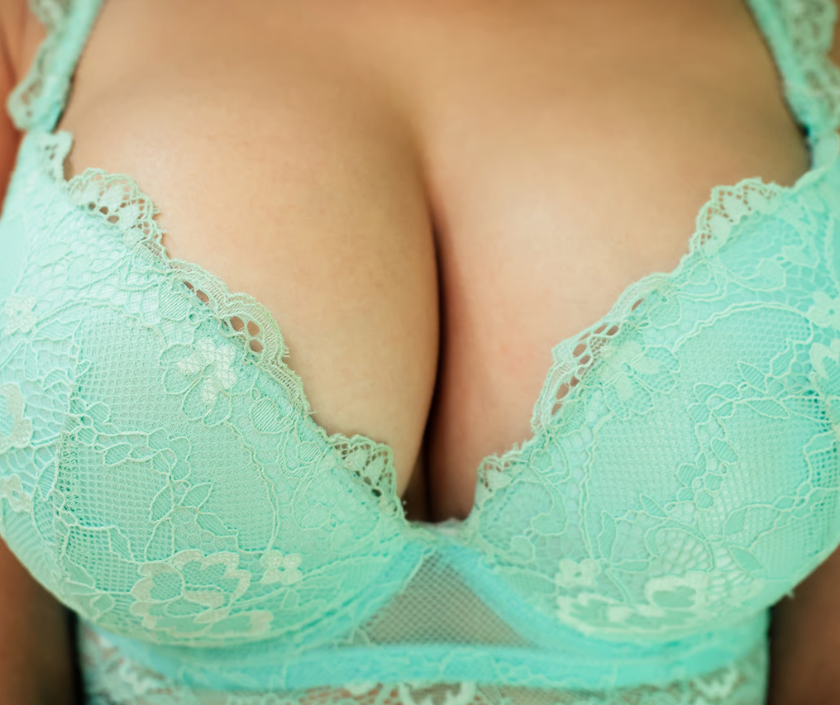
Cleavage Enhancement means improving fullness and shadow between the breasts, usually by adding a modest amount of your own fat to the upper inner part of each breast. It does not move the breasts closer together, because the gap between them is set by your anatomy. Understanding that difference early therefore saves a great deal of disappointment later. Our breast fat grafting page also describes the technique itself in more detail.
What actually decides how much cleavage a woman has?
Cleavage is decided mostly by where each breast sits on the chest wall, and that position comes from anatomy rather than choice. Each breast rests on a footprint, meaning the patch of chest it attaches to, while the distance between those two footprints varies naturally between women. Ligaments and the fascia over the breastbone then hold that gap where it is. Meanwhile the shape of the ribcage matters too, since a rounded or prominent breastbone pushes the breasts apart while a flatter chest brings them nearer. Volume, skin tension and breast position then add or subtract a little on top of that fixed base.
Can surgery move the breasts closer together?
No, surgery cannot simply shift the breasts across the chest, so any clinic suggesting otherwise is overstating what is possible. Releasing the supporting ligaments in the middle often causes more trouble than it solves, including an odd shape and the two sides drifting together unnaturally. Instead, what surgery can do is add fullness to the inner upper part of each breast so the visible line looks deeper in clothing. Honest wording therefore matters here: this is enhancement of what exists, not relocation of the breasts.
Which breast changes need a doctor before any cosmetic plan?
Certain symptoms need prompt assessment, since they can be signs of breast cancer, and cosmetic surgery is never the first step. Watch for these:
- Lump that is new, enlarging, hard, or fixed to the tissue around it.
- Discharge from a nipple, especially when bloodstained or from one side alone.
- Nipple that has recently turned inward or become retracted.
- Puckering, dimpling or skin that looks like orange peel.
- One sided pain that persists, or a quickly changing difference between the two sides.
Examination and imaging usually sort these out, occasionally with a needle test, and most prove harmless. However the checking comes first, always. Raising such things at your consultation is sensible rather than awkward.
What can fat grafting to the upper inner pole do?
Fat placed in the upper inner pole softens a hollow and often adds gentle fullness where a neckline sits. Small volumes are used, laid down in fine layers so the surface stays smooth. Because the tissue here is thin, restraint matters far more than quantity, and overfilling looks obvious instead of natural. Modest is therefore the word we use with patients, and it is meant literally.
What is realistic, and what is not?
Realistic goals are usually a fuller upper inner curve and a slightly deeper shadow in a fitted top. Closing a wide natural gap is not realistic, because anatomy sets that width and no operation safely changes it.
| Feature | Can it be changed? | Comment |
|---|---|---|
| Distance between the two breast footprints | Very little | Held by the chest wall and supporting ligaments |
| Fullness of the upper inner pole | Yes, modestly | Small volume fat grafting, often more than once |
| Shape of the ribcage and breastbone | No | Bone is not reshaped for an appearance concern |
| Breast that has dropped over time | Yes, with a lift | See breast lift surgery |
| Appearance in clothing | Yes | A properly fitted bra changes this more than most women expect |
Who is suitable for this procedure?
Suitable women usually have some upper pole hollowing, spare fat to harvest, stable weight and a clear picture of what a modest change looks like. Smoking harms graft survival, therefore stopping well ahead is asked for. Anyone with an unexplained breast symptom is also investigated before anything cosmetic is booked. By contrast, a woman whose main wish is a much larger breast, or one hoping her natural gap will close, needs a longer discussion about what her anatomy allows.
How is the procedure carried out?
Fat is harvested by gentle liposuction, usually from the abdomen or thighs, then processed and injected through two or three tiny entry points. Placement is layered and unhurried, since grafted fat needs contact with living tissue to gain a blood supply. Sedation with local anaesthetic suits most small cases, while larger work uses a general anaesthetic. Theatre time is often one to two hours, and many patients go home the same day.
How long does recovery take?
Desk work usually resumes within two to four days. Swelling and bruising are more noticeable at the donor site than on the chest, so a compression garment supports that area for a few weeks. Firm bras, underwires and pressure over the treated pole are avoided early, because compression reduces how much fat survives. Exercise then returns gradually, on advice given at your review.
Will grafted fat affect my mammogram?
It can, so screening deserves a plain explanation rather than a footnote. Fat that does not survive may form calcifications and oil cysts, and these can resemble changes caused by cancer, so a radiologist has to tell them apart. Extra views, an ultrasound or a needle sample are therefore sometimes needed before anyone can be sure. Tell the radiographer and the radiologist that you have had fat grafting and when it was done, every single time, because that history changes how the images are read. Screening should also carry on exactly as your doctor recommends.
What can go wrong?
No procedure is risk free, and this one is no exception. Bruising, swelling, temporary numbness, small lumps of fat necrosis, infection, uneven fullness and an imperfect donor area are all possible too. Reabsorption is expected rather than a complication, therefore a further session is often planned from the outset. Breast surgery can affect the ability to breastfeed, and how much depends on the technique and how close the work sits to the areola and the ducts, so tell us before surgery if you are planning a pregnancy.
What are the common myths?
Myths often cause more unhappiness here than the surgery itself does. Widely believed ones include the idea that a surgeon can simply push the breasts together, that creams or exercises narrow the gap, and that one fat grafting session gives a fixed result for life. Chest exercises build the muscle beneath the breast, yet the gap stays the same. Creams do not alter ligaments. Fat, meanwhile, partly reabsorbs, so a second sitting is normal rather than a sign of failure.
How much does this cost in India?
Cost in rupees usually varies with the volume harvested, the anaesthesia chosen, theatre time and the likelihood of a second session. Cleavage Enhancement is a smaller undertaking than a full augmentation, however two sittings change the total, so the estimate states that plainly. A clear written estimate is therefore given after examination, listing surgeon, theatre, anaesthesia and follow up visits. Cosmetic work is excluded by most insurance policies in India, therefore budget for it as a personal expense.
If the appearance of your neckline has been on your mind, then a private consultation with Dr. Ashutosh Shah at Elegance Clinic in Surat is a sensible next step. Examination comes first, then a frank explanation of what your own anatomy allows, and you are never pushed towards surgery. You can also reach us through our contact page or browse the wider section on breast and chest aesthetics.
Note: This page is for general information and is not a substitute for a medical consultation. Any new breast lump, nipple change or skin change should be assessed by a doctor before considering cosmetic treatment. Results vary between individuals and no outcome can be promised.
Ready to Talk, Privately?
Book a confidential consultation with Dr. Ashutosh Shah. There is no pressure, only clear and honest guidance.