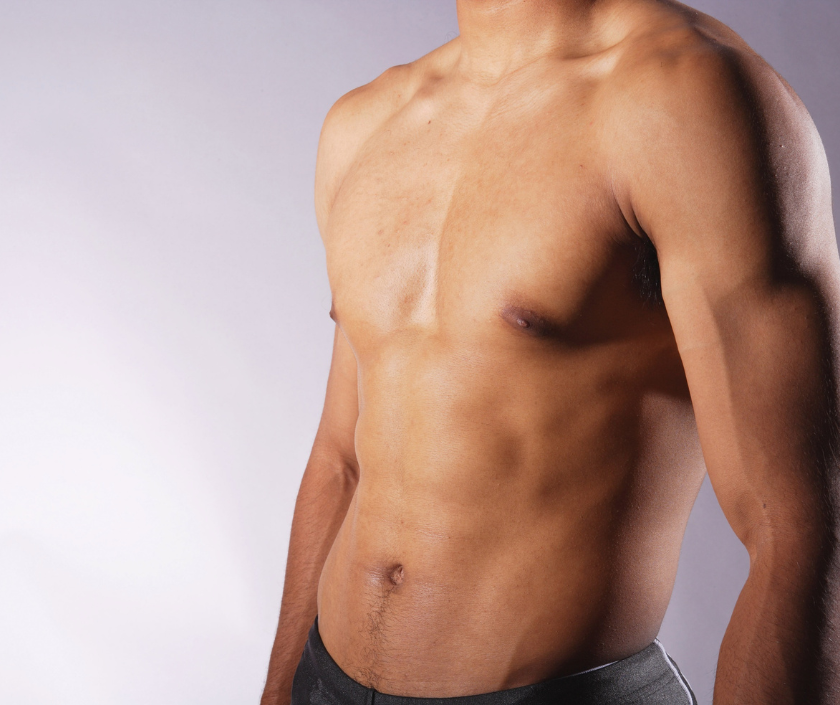
What is Body Contouring for the Male Chest?
Body Contouring for the Male Chest is not a single procedure, it is a decision about which tissue is causing the shape you dislike and which treatment addresses that tissue. Three culprits exist, namely fat, glandular breast tissue and excess skin, and each responds to something different. Choosing wrongly wastes both money and time, therefore this page is written to help you narrow it down before you book anything. Examination remains the only way to be certain, however, so treat what follows as a guide rather than as a diagnosis.
How do I work out which problem I have?
Feel the chest carefully, lying down and then standing, and notice what your fingers find. Fat feels soft, spreads widely and flattens somewhat when you lie flat. Glandular tissue feels quite different, presenting as a firm rubbery disc centred beneath the nipple with an edge you can trace. Loose skin declares itself when you pinch a fold and it stays creased, or when a fold hangs by itself while you stand. Many men find more than one of these, which is entirely normal and simply means the plan needs more than one element.
Which problem needs which treatment?
Matching the problem to the answer is the single most useful thing on this page. Below is that match set out plainly.
| What you have | How it feels | What actually addresses it | What will not work |
|---|---|---|---|
| Fat with good skin tone | Soft, diffuse, no firm disc | Weight loss and training first, then liposuction or non surgical fat reduction | Skin tightening devices alone |
| Glandular tissue present | Firm rubbery disc under the nipple | Investigation of the cause, then surgical excision once stable | Any non surgical fat or skin treatment |
| Loose or hanging skin | Pinches into a fold that stays creased | Surgical excision of skin, with the nipple repositioned if needed | Radiofrequency or ultrasound devices |
| A combination of two or three | Soft bulk plus a disc, often with a fold | A staged plan combining liposuction, gland excision and skin work | Any single treatment used on its own |
What must be ruled out before any cosmetic plan?
Some findings need medical assessment first, because they can reflect disease rather than contour. Breast cancer does occur in men, and although it is uncommon, a firm lump on one side always calls for examination and imaging before any cosmetic decision. Watch for the following and seek assessment promptly.
- A lump that is new, growing, or present on one side only.
- Hardness that seems tethered to the skin or to deeper structures.
- Any discharge from a nipple, most of all if bloodstained.
- Recent inward pulling or flattening of a nipple.
- Puckered, dimpled or orange peel skin over the chest.
- Persistent one sided discomfort, or sides that are rapidly diverging.
Ultrasound is usually the first test, with mammography and a needle sample where indicated. Reshaping is postponed until those answers are known.
Why does the difference between fat and gland matter so much?
It matters because the two need entirely different treatments and no device can tell them apart for you. Pseudo gynecomastia is fat, which responds to weight loss, to training and to fat reduction methods including liposuction. True gynecomastia is glandular, and dense glandular tissue is not dissolved by cooling, heating or injections, so it must be cut out to go. Men who feel a firm rubbery disc under the nipple should therefore read our page on gynecomastia rather than shopping for devices. Similarly, the fatty version is described in detail on our pseudo gynecomastia page.
Where does true gynecomastia come from?
Glandular enlargement has causes, and looking for them comes before any operation is planned. Puberty is much the commonest reason in adolescents, and it settles by itself in the majority within a year or two. Medicines and substances form the next group, including anabolic steroids, several blood pressure drugs, some antipsychotic medicines and cannabis. Liver disease is a well recognised cause, as are thyroid disorders and kidney disease. Rarely, a tumour of the testis or adrenal gland is found, which is one reason the examination includes more than the chest. Surgery is offered once the responsible cause has been excluded or treated and the chest has remained stable for a reasonable period.
What can non surgical treatment realistically offer?
Non surgical treatment offers modest, gradual change to a limited amount of fat, plus possible mild firming of skin. Cooling, focused ultrasound and injectable fat dissolving treatments work slowly across weeks and need repeating. Regulators have not specifically approved these devices for reshaping the chest, published evidence in men is limited, and results vary considerably between individuals. Consequently these options suit a man near his target weight with one stubborn soft area, and they suit nobody whose problem is gland or hanging skin. Being told that honestly at the outset saves a good deal of disappointment later.
What does surgery offer?
Surgery offers a definite change in one planned operation, at the cost of anaesthesia, recovery and scars. Liposuction removes fatty bulk, while a small incision at the lower edge of the areola allows the glandular disc to be excised. Skin excision is added where the envelope is too loose to redrape, and the nipple is repositioned when it sits too low. Recovery generally means a compression garment for several weeks and a pause in heavy training. Our surgical approach is set out on the male chest contouring page.
What if I have a combination?
Most men who dislike their chest have a combination, and expecting one neat cause is usually unrealistic. Typically there is soft fat across the lower chest, a glandular disc behind the nipple, and skin that has stretched over the years. Each element is then dealt with by the method that suits it, sometimes within a single operation and sometimes in stages. Assessment is what reveals the proportions, which is why an honest examination beats hours of reading. Above all, a plan built on the wrong diagnosis will disappoint however well it is carried out.
What results are realistic?
Realistic results depend entirely on which route your diagnosis leads to. Gland removal reliably takes away the disc and the pointed look it creates under a shirt, whereas non surgical fat treatment produces partial softening of contour over several months. Skin excision genuinely flattens a fold, though it exchanges that fold for a scar which fades but does not disappear. Body Contouring for the Male Chest works best when weight is stable, since regaining weight undoes fat related gains. Nobody can promise a specific shape, and any clinic that does is overreaching.
What are the risks?
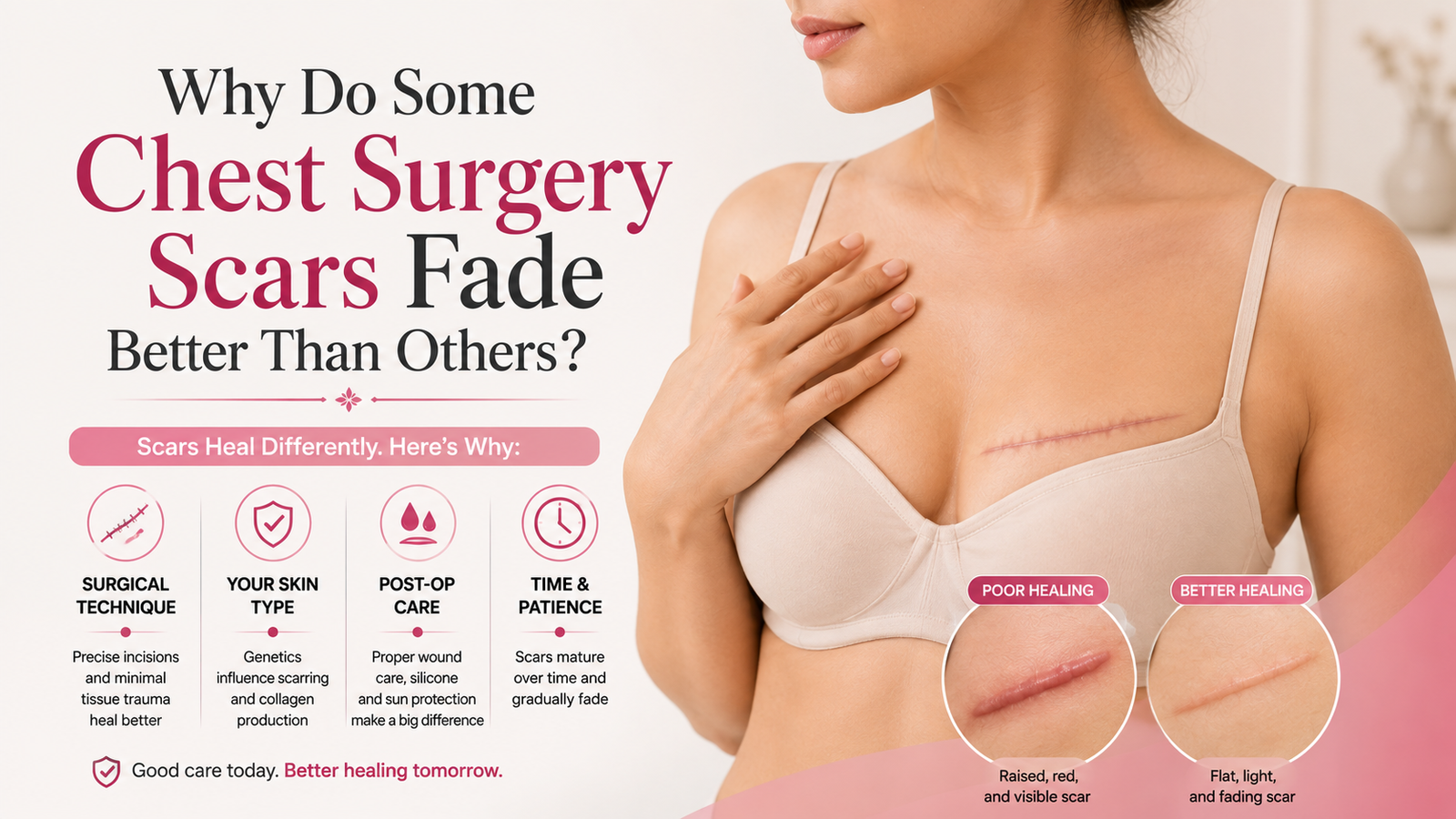
Every route carries risks, and they differ by route. Surgery brings bleeding, collection of fluid under the skin, infection, altered nipple sensation, asymmetry, contour irregularity and scars that occasionally thicken. Non surgical methods bring swelling, numbness, bruising, burns with heat based devices and, rarely, an enlargement of the treated fat that then needs surgery. Both routes share the risk of a result that falls short of what you hoped for. Discussing that possibility beforehand is part of proper consent, not pessimism.
How much does chest contouring cost in India?
Costs in India vary with the route chosen, the extent of the work and the setting in which it is done, and all fees are quoted in rupees. Surgery involves theatre, anaesthesia and garment costs, while device based courses accumulate over multiple visits. Naming a figure without examining you would be guesswork, so we avoid it. You receive a clear written estimate after examination, itemised so you can see what you are paying for. Comparing quotations is fair, provided you compare the same operation and the same surgeon experience.
Why choose Elegance Clinic?
Dr. Ashutosh Shah begins with diagnosis and only then discusses treatment, which is the order this problem demands. Men are shown, in their own examination, what is fat, what is gland and what is skin, so the recommendation makes sense rather than needing to be trusted blindly. Where an operation is the better answer, that is said plainly, and where nothing needs doing at all, that is said too. Related pages across breast and chest aesthetics cover each route in more depth.
Should you wish to understand your own chest properly, a private consultation with Dr. Ashutosh Shah in Surat can be arranged discreetly. Ask everything you want to ask, including what happens if you do nothing. No decision is expected from you at that visit.
Note: This page is for general information and is not a substitute for a medical consultation. Any new breast lump, nipple change or skin change should be assessed by a doctor before considering cosmetic treatment. Results vary between individuals and no outcome can be promised.
Ready to Talk, Privately?
Book a confidential consultation with Dr. Ashutosh Shah. There is no pressure, only clear and honest guidance.